| | Overview - working on paper prints
This exercise is divided into two parts and does not require the use of LEOWorks.
Part 2
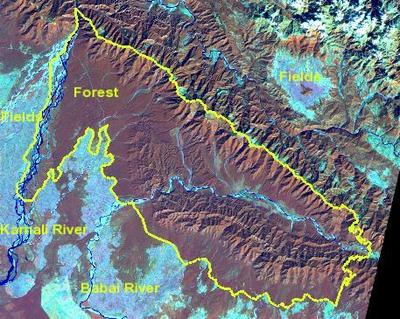
The Bardia National Park's boundaries (1990)
This Landsat ETM satellite image of the Bardia region was acquired on 8 November 1990. It is a false colour infrared image showing the Bardia area in the mid-western Terai plains and Churia ranges (part of the Siwalik mountain ranges of Nepal), north of the border with India. The image shows the Karnali River flowing from north to south, forming the western border of the Park, and the Babai River, flowing east to west and then south. More specific physical features visible in the image are the Churia Hills (forming the valley of the Babai River), the flood plains, and the extended river beds.
1. Take a map of Nepal in your atlas or a map of the Bardia region, and find the area shown in the satellite image of the Bardia National Park Boundaries in 1990 (shown above).
2. Name and locate the major rivers and the mountain chains.
The forest and vegetated crop fields can be easily demarcated in this false colour image (red and reddish).
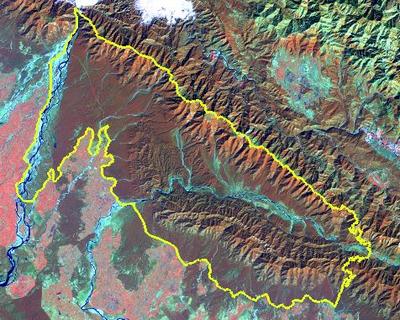
The Bardia National Park's boundaries (2002)
The image shown here is a Landsat near infrared false-colour composite of the Bardia region acquired on 2 February 2002.
Again, the vegetation pattern in the infrared false-colour image of the Bardia region is more distinct. The winter crops in the agricultural land are shown in a reddish colour, due to the strong reflective characteristics of chlorophyll in the near infrared band.
3. Look at the image and describe the distribution of vegetation seen in the 1990 image. Distinguish between forest and crop fields. Can you recognise the two classes?
Why do bright colour spots appear in some parts of the hill top?
4. Explain the differences in the red colour of this false colour near-infrared image.
5. Do the same type of analysis for the 2002 image.
6. Look for differences between the 1990 and the 2002 image.
Distinguish between long-term changes of land cover (deforestation, reforestation, eroded areas, roads, river courses) and seasonal changes (November is the end of the monsoon crop, February shows the winter crop).
7. In which land cover have changes occurred? Mark them with different colours on an overlaid transparency. Add a legend. Which type of changes occur within the park and in the area surrounding the park?
8. What are the consequences of changes within the park (e.g. more/less forest) with respect to habitats of wild animals?
9. Discuss the usefulness of recently acquired satellite images for the management of the park.
| |



 Previous