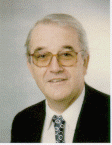

It is with great pleasure that I open this Biennial Report which carries a message of success and encouragement.
In the past two years, the exponential expansion of ECSL since its establishment has been confirmed and consolidated. The ECSL community has continued to grow and strengthen. The number of National Points of Contact has increased and they have carried out numerous activities which contributed to stimulating interest in space law issues.
The significant efforts made by ECSL in the academic field have been extremely rewarding. The success of the Summer Course is going far beyond the expectations of those who laid down its basis. Teams sponsored by ECSL for the Manfred Lachs Space Law Moot Court Competition have represented Europe in a brilliant manner. ECSL has succeeded in promoting the knowledge of space law and in motivating a number of students to undertake studies in this field and constitute a community of space lawyers able to work out the legal challenges of the future.
ECSL has also continued to devote attention to the Practitioners' community. The Practitioners' Forum has reached its level of maturity, with a growing regular attendance of European lawyers from private practice, industry, government agencies, and with an attractive agenda updating their knowledge on European issues. as well as on space law developments in the United States. Research conducted by ECSL has also very much contributed to strengthening the awareness of the practising lawyers of emerging legal issues.
Promoting the knowledge of space law also means offering the ECSL community proper ways of accessing information and data. Important efforts have been made in this respect by publishing proceedings of the workshops organised, articles in specialised journals, the ECSL Newsletter 'ECSL News', and, especially by updating and improving ESALEX. This year 1995 will be a turning point for ESALEX, which will experience tremendous changes both from the technical and contents points of view. ECSL is aware of the importance of electronic information in the future and will concentrate on ensuring that ESALEX is recognised as a leading database in the field of space law in Europe. Finally, ECSL has expanded its network of contacts and cooperation worldwide. A number of joint projects have been undertaken or scheduled with other entities, as can be read in this report. Such opportunities both confirm the recognition of ECSL as a serious partner, and open to the Centre a wider sphere of action. Also, in many of my discussions with scholars and practitioners of non-European countries, I have discovered that the idea of ECSL itself, the network of people developed, the dynamism and quality of its action, is taken as a model for setting up similar structures around the world. This shows how much has been achieved by the Centre in only six years of existence.
Although the period 1993-1995 was understood as a period of consolidation for ECSL, it has also been a period of tremendous expansion in response to the demand of European space lawyers and to the accelerating evolutions in the field of space activities. The spiral of acceleration is not over. The coming two years will witness major decisions of Europe as to its future in space. Such decisions will be mostly political, but they will open to the lawyers new areas of interest, more and more practice-oriented, and where, therefore, more and more adaptability and flexibility will be needed. Also, more knowledge and more research will be the solid grounds on which the future legal framework of future space activities will rest. I am convinced that ECSL and its Members will continue to join their efforts and motivation to provide Europe with the thinking it needs to successfully achieve its objective and promote its interests.
Let me express my personal and warm thanks to all of you and particularly to the ECSL Secretaries for their work, for their devotion, as well as to the European Space Agency.


 ECSL Biennial Report 1993-1994 (BR-104).