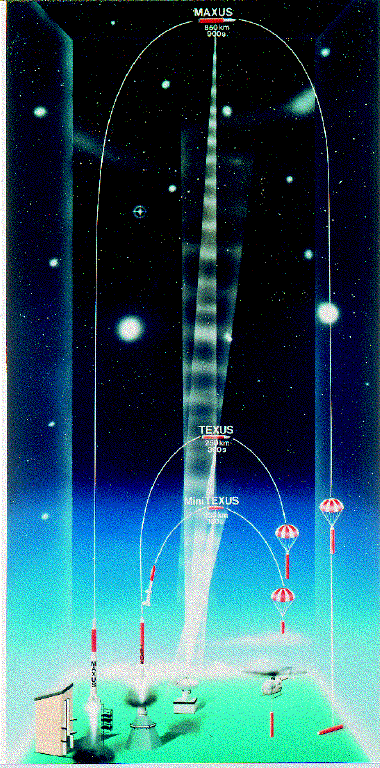
Fig. 1.1 Mission profiles of MiniTEXUS, TEXUS and MAXUS. (DASA)

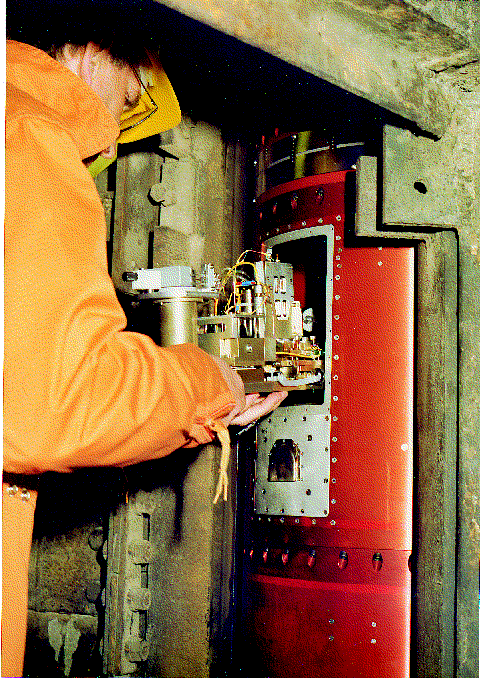
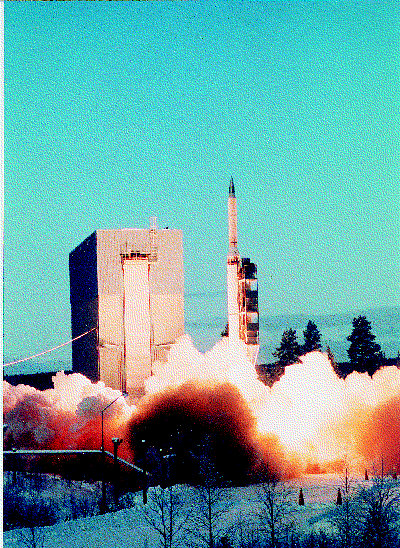
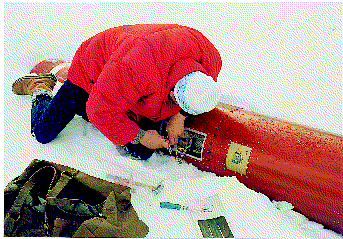
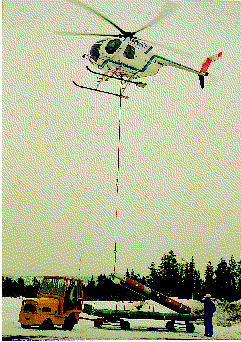
A total of 32 TEXUS rockets had been launched successfully by the end of 1994, together with six MASER and one MAXUS vehicles. Sweden's MASER (Material Science Experiment Rocket) programme was started by ESA in 1987 to meet the increasing demand for capacity. TEXUS and MASER can carry payloads of about 250 kg up to apogees typically around 250-300 km, yielding 5-7 min µg with a residual acceleration of less than 10-4 g. Each payload consists of 4-6 modules housing up to a few dozen samples.While TEXUS and MASER continue to provide up to 7 min of µg, the MAXUS sounding rocket was developed as a joint venture by DASA and the Swedish Space Corporation to satisfy the scientific requirement for longer periods (15 min).. MAXUS carries a scientific payload of up to 500 kg to an apogee around 750 km. All vehicles are launched from ESRANGE near Kiruna in northern Sweden (Lapland) to enable land recovery of the scientific payloads. The campaigns take place either in March to mid-May or from November to early December. A typical mission profile is shown in Fig. 1.1. The rocket consists of the rocket motor, the scientific payload and the service systems (telemetry, rate control, recovery; Fig. 1.2). After landing, the payload is recovered and returned to the launch site. Biological experiment modules are usually designed (Figs. 1.3a-e) to allow experimenter access up to 30 min before launch, an important requirement for living samples. Earliest sample retrieval is 30 min after landing. Adequate laboratory facilities for pre- and post-flight work are available at the launch site. Science teams are usually accommodated at ESRANGE. Annual flight rates of 1-5 have been achieved, varying with budget status and scientific requirements.
Fig. 1.1 Mission profiles of MiniTEXUS, TEXUS and MAXUS. (DASA)
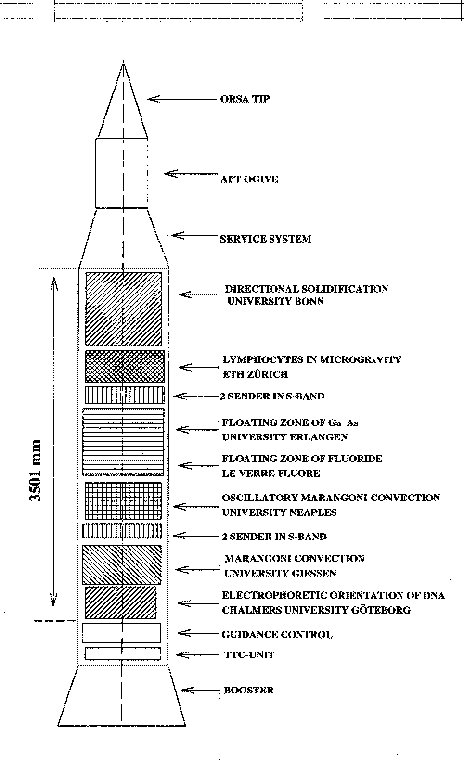
Fig. 1.2. Configuration of the MAXUS 1 payload.
Fig. 1.3. Critical steps of a sounding rocket flight at the ESRANGE facility near Kiruna in Sweden.
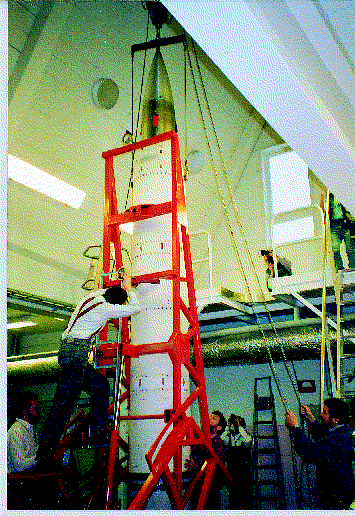 (a)
(a)
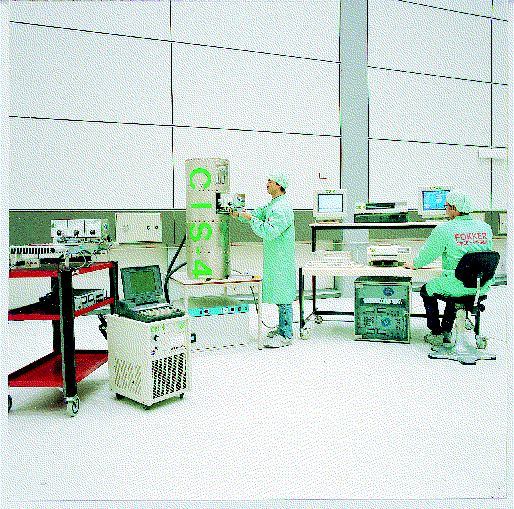 (b)
(b)
 (c)
(c)
 (d)
(d)
 (e)
(e)
 (f)
(f)
The advantages of sounding rockets for investigations in µg are:
relatively short interval between acceptance of a proposal and its flight (1- 2 years);
These advantages are helping to achieve the goals established by the life sciences programmes of ESA and DARA. The goals are expressed in the International Strategic Plan for Life Sciences, representing the interests and objectives of many scientists and space agencies worldwide. They improve the scientific foundation of our understanding of the processes related to life, health and disease; strengthen the scientific underpinning of programmes to ensure safe and productive human space flight; contribute meaningfully to the development of various applications of space technologies and biotechnologies to solving scientific and medical problems on Earth.
In gravitational biology, the role of gravity for growth, development, reproduction, movement, orientation and other physiological processes, as well as the mechanisms of adaptation and compensation, are investigated. The elucidation of graviperception and signal transduction are of special importance. In bioprocessing, the influence of space conditions, especially µg, on separation, cell fusion and cell cultivation techniques is investigated. Also, growth of high quality monocrystals of biological macromolecules for crystal structure analysis is performed.
In particular, sounding rocket experiments can contribute to the study of gravi-perception and gravi-orientation of single cells (gravitaxis), gravitropism of plants, gravi-response, biochemical and biophysical analysis of signal transduction chains, reproduction, electrophoresis and electro-cell- fusion. The biological experiments, including basic science and technology, performed within the sounding rocket programme on TEXUS (flights 11-32, 1985- 1994), MASER (flights 3-6, 1989-1993) and MAXUS (flight 1B, 1992) are listed in Table 1.1. As described in Section 3, the biology instrumentation ranges from simple incubation and pre-programmed plunger units to more sophisticated systems that can operate some experiments via telescience from the ground.
Table 1.1. Overview of sounding rocket experiments in life sciences 1985- 1994.
                                                                                                             Experiment     Principal
Flight         Launch       Experiment Title                               Organisms                         Module         Investigator
----------------------------------------------------------------------------------------------------------------------------------------------

1 TEXUS 11   27 Apr 85  Electrofusion of yeast cells                  Saccharomyces sp                       TEM 06-5        U. Zimmermann

2 TEXUS 13   30 Apr 86  Electrofusion of yeast cells                  Saccharomyces sp.                      TEM 06-5        U. Zimmerman

3 TEXUS 13   30 Apr 86  Electrofusion of plant protoplasts            Nicotiana tabacum, Avena sativa        TEM 06-5        R. Hampp

4 TEXUS 14B   3 May 87  Electrofusion of yeast cells                  Saccharomyces cerevisiae               TEM 06-11       U. Zimmermann

5 TEXUS 14B   3 May 87  Electric field-induced gene transfection      Human lymphocytes                      TEM 06-11       U. Zimmermann

6 TEXUS 17    2 May 88  Electrofusion of plant protoplasts            Nicotiana tabacum                      TEM 06-5        R. Hampp

7 TEXUS 17    2 May 88  Fertilisation and embryo polarity             Xenopus laevis                         TEM 06-15       G. Ubbels

8 TEXUS 18    6 May 88  Statolith sedimentation in cress roots        Lepidium sativum                       TEM KT          D. Volkmann

9 TEXUS 18    6 May 88  Free-flow electrophoresis of cells            Rabbit, rat & guinea pig erythrocytes  TEM 06-13       K. Hannig

10 TEXUS 18   6 May 88  Electrofusion of yeast cells                  Saccharomyces cerevisiae               TEM 06-11       U. Zimmermann

11 TEXUS 18   6 May 88  Electric field-induced gene transfection      Human lymphocytes                      TEM 06-11       U. Zimmermann

12 TEXUS 19  28 Nov 88  Statolith sedimentation in cress roots        Lepidium sativum                       TEM KT          D. Volkmann

13 TEXUS 19  28 Nov 88  Motility and viability of spermatozoa         Bull spermatozoa                       TEM 06-5        W. -B Schill

14 TEXUS 20   2 Dec 88  Free-flow electrophoresis of cells            Mammal & bird erythrocytes             TEM 06-13       K. Hannig

15 MASER 3   10 Apr 89  Fertilisation and embryo polarity             Xenopus laevis                         TEM 06-15       G. Ubbels

16 MASER 3   10 Apr 89  Sexual interaction of gametes                 Chlamydomonas eugametos                CIS-1           H. van den Ende

17 MASER 3   10 Apr 89  Growth factor-induced signal transduction     A431 epidermoid cells                  CIS-1           S. W. de Laat

18 MASER 3   10 Apr 89  Membrane binding of concanavalin A            Human lymphocytes                      CIS-1           A. Cogoli

19 TEXUS 21  30 Apr 89  Electrofusion of plant protoplasts            Nicotiana tabacum                      TEM 06-5        R. Hampp

20 TEXUS 21  30 Apr 89  Cytoskeleton and graviperception in rhizoids  Chara sp.                              TEM 06-16       A. Sievers

21 TEXUS 22   3 May 89  Electrofusion of yeast cells                  Saccharomyces cerevisiae               TEM 06-11       U. Zimmermann

22 TEXUS 22   3 May 89  Electric field-induced gene transfection      Human lymphocytes                      TEM 06-11       U. Zimmermann

23 TEXUS 23  25 Nov 89  Statolith sedimentation in cress roots        Lepidium sativum                       TEM BIO         D. Volkmann

24 TEXUS 23  25 Nov 89  Gravitaxis of protozoa                        Euglena sp.                            TEM 06-19       D.-P. Hader

25 TEXUS 24   6 Dec 89  Free-flow electrophoresis of cells            Human erythrocytes                     TEM 04-1(06-13) K. Hannig

26 MASER 4   29 Mar 90  Membrane binding of concanavalin A            Human lymphocytes                      CIS-2           A. Cogoli

27 MASER 4   29 Mar 90  Fertilisation of sea urchin eggs              Paracentrotus lividus                  CIS-2           H.-J. Marthy

28 MASER 4   29 Mar 90  Growth factor-induced signal transduction     A431 epidermoid  cells                 CIS-2           S. W. de Laat

29 MASER 4   29 Mar 90  Growth factor-induced signal transduction     A431 epidermoid  cells                 CIS-2           A. Verkleij

30 TEXUS 25  13 May 90  Cytoskeleton and graviperception in rhizoids  Chara sp.                              TEM 06-16       A. Sievers

31 TEXUS 25  13 May 90  Electrofusion of plant protoplasts            Nicotiana tabacum                      TEM 06-5        R. Hampp

32 TEXUS 26  15 May 90  Motility and viability of spermatozoa         Bull spermatozoa                       TEM 06-19       W.-B. Schill

33 TEXUS 26  15 May 90  Electrofusion of human lymphocytes            Human lymphocytes                      TEM 06-11       U. Zimmermann

34 TEXUS 27  15 Nov 90  Gravitaxis of protozoa                        Paramecium sp.                         TEM 06-19       R. Hemmersbach

35 TEXUS 28  23 Nov 91  Cytoskeleton and graviperception in rhizoids  Chara sp.                              TEM 06-16       A. Sievers

36 TEXUS 28  23 Nov 91  Gravitaxis and phototaxis of protozoa         Euglena sp.                            TEM 06-5        D.-P. Hader

37 TEXUS 28  23 Nov 91  Gravitaxis of protozoa                        Paramecium sp.                         TEM 06-5        R. Hemmersbach

38 MASER 5    9 Apr 92  Electrofusion of fibroblasts                  Human fibroblasts                      CIS-3           J. Jongkind

39 MASER 5    9 Apr 92  Protein kinase C signal transduction          A431 epidermoid cells                  CIS-3           S. W. de Laat

40 MASER 5    9 Apr 92  Fertilisation of sea urchin eggs              Paracentrotus lividus                  CIS-3           H.-J. Marthy

41 TEXUS 29   5 Sep 92  Gravitaxis of protozoa                        Euglena sp.                            TEM 06-5        D.-P. Hader

42 TEXUS 29   5 Sep 92  Cytoskeleton and graviperception in rhizoids  Chara sp.                              TEM 06-5        A. Sievers

43 MAXUS 1B   8 Nov 92  Cell movements and cytoskeleton               Human lymphocytes                      TEM 06-5M       A. Cogoli

44 TEXUS 30   1 May 93  Protein pattern in leaves protoplasts         Vicia faba                             TEM 06-21       H. Schnabl

45 TEXUS 30   1 May 93  Gravity and energy metabolism                 Nicotiana tabacum                      TEM 06-21       R. Hampp

46 TEXUS 30   1 May 93  Gravitaxis and phototaxis of protozoa         Euglena sp.                            TEM 06-5        D.-P. Hader

47 TEXUS 30   1 May 93  Cytoskeleton and graviperception in rhizoids  Chara sp.                              TEM 06-5        A. Sievers

48 MASER 6    5 Nov 93  Early development of sea urchin eggs          Sphaerechinus granularis               CIS-4           H.-J. Marthy

49 MASER 6    5 Nov 93  Development of frog eggs fertilised in space  Xenopus laevis                         CIS-4           G. Ubbels

50 MASER 6    5 Nov 93  Regulation of cell growth                     A431 epidermoid cells                  CIS-4           S. W. de Laat

51 TEXUS 32   4 May 94  Electrofusion of plant protoplasts            Nicotiana tabacum                      TEM 06-21       R. Hampp

52 TEXUS 32   4 May 94  Protein pattern in leaves protoplasts         Vicia faba                             TEM 06-21       H. Schnabl
The TEXUS, MASER and MAXUS programmes are financed by Germany and ESA, with the investigators supported by their national funding institutions. New experiment proposals should be submitted to ESA or to DARA. They will be reviewed by independent scientific peers. The experiment-specific hardware will be manufactured by industry in close co-operation with the investigator. The agencies are responsible for the flight schedule, overall programme management and procurement of the experiment hardware.


 SP1206