Can there be another Earth

A close-up photo showing Plato’s array of 26 cameras, which it will use to study exoplanets and their stars.
We know that there are eight planets in our Solar System, but did you know that astronomers have discovered thousands of planets beyond our Solar System? These are called extra-solar planets, or exoplanets for short.
Yet out of all these planets only one is known to host life: Earth. But what if Earth isn’t a one-of-a-kind world? What if there are other planets out there with oceans, atmospheres, and the right conditions for life?
This is the biggest questions driving the Plato mission: is there another planet like Earth in the Universe?
What does “Earth-like” really mean?
When scientists talk about an “Earth-like” planet, they don’t mean a perfect copy. Instead, they look for a combination of key features: a rocky surface rather than a gas giant, a similar size and mass to Earth, and the right distance from its star.
That last factor is crucial, because it determines temperature. Too close, and a planet may become a scorching world. Too far, and it could freeze over. But in-between lies a narrow region where conditions might be just right.
The habitable zone: not too hot, not too cold
Astronomers call this region the habitable zone, often nicknamed the Goldilocks zone. In this area, temperatures could allow liquid water to exist on a planet’s surface. And water is one of the key ingredients for life as we know it.
But being in the habitable zone doesn’t guarantee a planet is actually habitable. A planet might still lack an atmosphere, or perhaps have a toxic atmosphere, or maybe experience extreme radiation from its star. So, a planet being in the habitable zone is more like a first clue for another Earth, rather than a final answer.
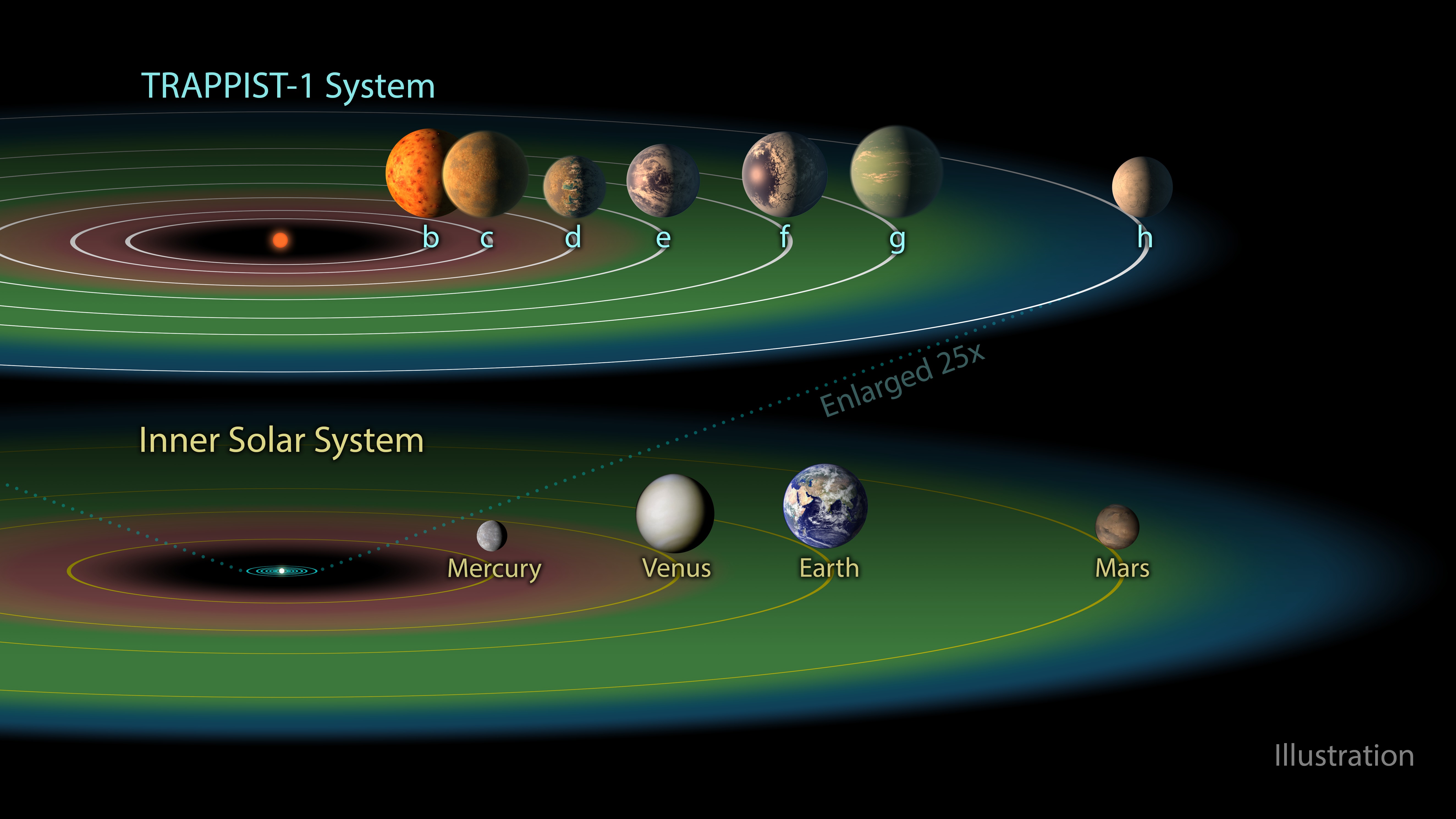
Extrasolar systems have habitable zones around their stars. Finding an Earth-like planet in one of these regions would be an exciting discovery!
Finding Earth-like worlds
This is where ESA’s Plato mission comes in. This high-tech space telescope is designed to find planets that are similar in size to Earth, orbiting stars like our Sun, and located within their stars’ habitable zones.
By observing tiny dips in starlight as planets pass in front of their stars, Plato can detect new worlds and measure their sizes and orbits. Moreover, Plato will study stars similar to our Sun that are bright enough to be also studied in detail by scientists in observatories on Earth. All this information together will help them to discover planets and measure how big they are and how much mass they have. By knowing a planet’s size and mass, scientists can work out what it is made of and whether it is rocky like Earth or mostly made of gas like Jupiter.
Then, by studying the stars themselves, Plato can determine their age and properties, which helps scientists understand the planets orbiting them with much greater precision. This means Plato will help identify the best candidates for planets that may be truly Earth-like.
A Universe full of possibilities
This is where things become more uncertain, and more exciting. Life, at least as we understand it, depends on a delicate balance of conditions. It needs liquid water, a stable environment, and the right chemical ingredients. When scientists search for life beyond Earth, they often start by looking for planets where similar conditions could exist. That’s why finding planets in the habitable zone is such an important step.
Over the past few decades, astronomers have discovered thousands of exoplanets, revealing that planets are common throughout the Galaxy. The big question now is not whether these planets exist, but how many of them might be like Earth. By building a detailed catalogue of nearby planetary systems, the Plato mission will help answer that question.
So, is there another Earth? The answer, for now, is: we don’t know. But for the first time in human history, we have the tools to find out.
Somewhere among the stars, there may be a small, rocky planet orbiting at just the right distance, with the right conditions, quietly circling its star. A world with oceans, skies, and maybe even life. Thanks to Plato, we’re getting closer to finding it!

The Universe is full of exoplanets, many strange and wonderful – but is Earth’s twin among them? Plato may find out!
Last modified 30 June 2026