ESA satellite tracks down methane on Mars

29 April 2019
Back on 15 June 2013, NASA’s Curiosity rover was busy exploring the surface of Mars. Its sensors detected something that made its operators back on Earth very excited: a gas called methane. We have a lot of methane on Earth. It can be created by geological processes, and by living creatures.
In science, the more data you collect about something, the better your studies can be. So, a group of scientists have been studying data collected by ESA’s Mars Express satellite, which was orbiting Mars at the same time. They have now found that Mars Express detected the methane too!
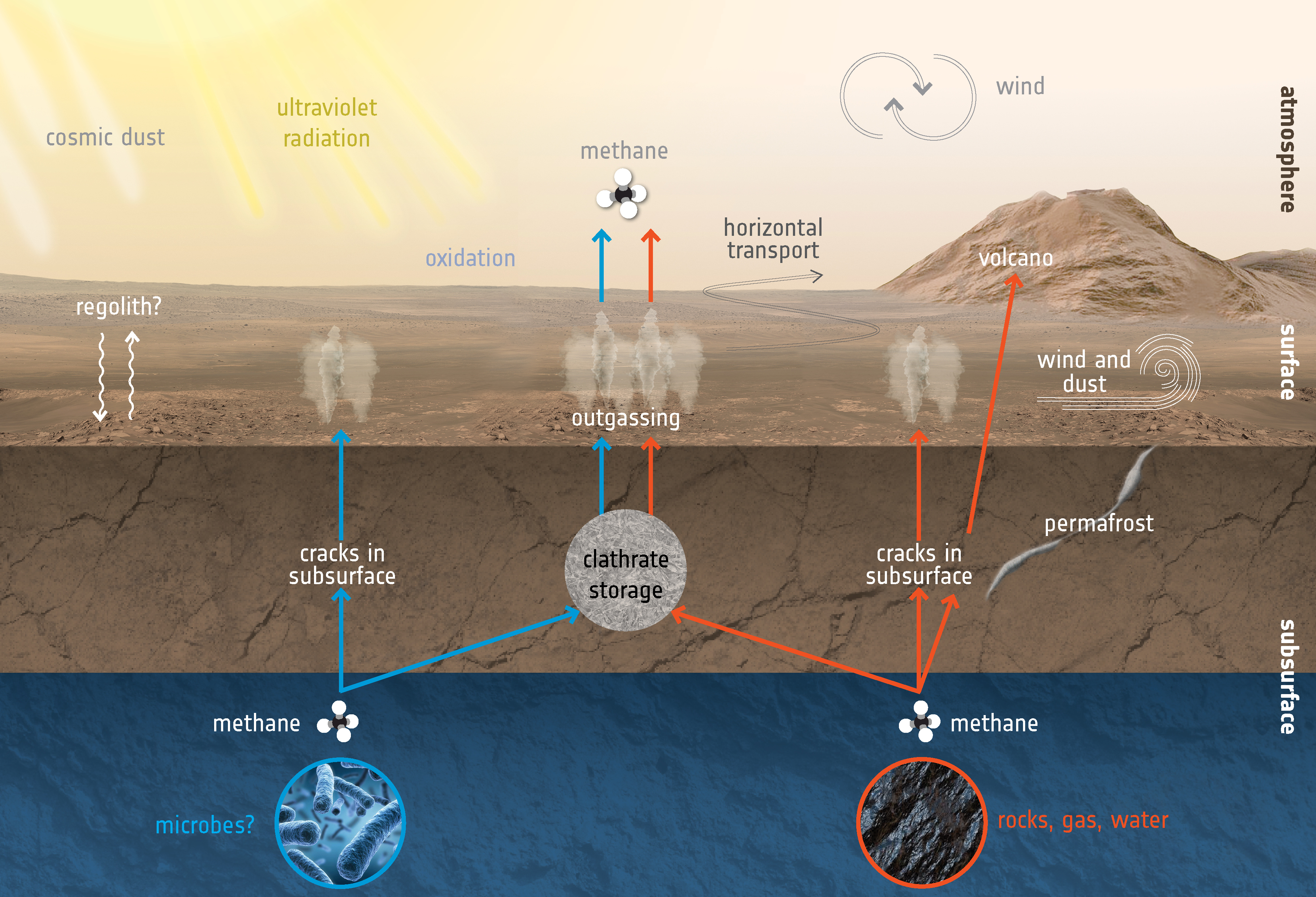
So, what could have made the methane on Mars? Methane is destroyed very quickly once it is exposed to even Mars’ thin atmosphere, meaning the gas detected by Curiosity and Mars Express must have been made or released very recently. One idea is that the methane was produced millions, or even billions of years ago. It could have been trapped underground for all this time, until it finally managed to get to the surface, where it was detected by our robotic explorers.

Another idea is that the methane could have been made by tiny lifeforms on Mars, producing methane as a waste product. This is an exciting possibility, but more evidence would need to be gathered before we could draw that conclusion!
Scientists currently favour geological explanations, rather than biological. Methane gas could be released from rocks all over Mars, in small amounts each time. Mars also has lots of ice, which could trap methane gas. When the ice melts or fractures, the gas could escape into the atmosphere.
The next step in this research is to look through more Mars Express data, searching for other times that methane could have been detected. Additionally, a new probe, the ESA-Roscosmos ExoMars Trace Gas Orbiter, is currently whizzing around Mars, studying its atmosphere. Who knows what it will discover!
Cool fact: Mars Express was launched in 2003, and took six months to travel to Mars. It is still operating all this time later, helping us to learn more about the Red Planet.