ESA ECSAT
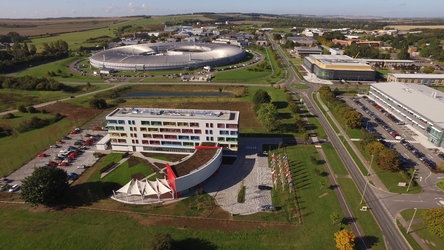
ESA’s European Centre for Space Applications and Telecommunications (ECSAT) is located at Harwell Science and Innovation Campus in the UK.
ECSAT has a focus on collaboration, supporting many cross-directorate activities, contributing strongly to the cooperative ethos at Harwell Campus, and working closely with communities from across ESA’s member states.
It hosts teams working in resilience, navigation, and connectivity, and commercialisation, as well as supporting Earth observation, exploration, and space technology engineering and quality.
The site comprises the ECSAT building, named after ESA’s first director general Roy Gibson, the Magali Vaissiere Conference Centre, and several facilities on the surrounding campus.
Resilience, navigation and connectivity
ECSAT supports the aims of ESA’s Directorate of Resilience, Navigation and Connectivity, which reflects ESA’s commitment to bolstering resilience and enhancing navigation and connectivity in line with the security and defence priorities of its Member States, the European Union and defence-related agencies in Europe.
Teams at ECSAT have a long-standing expertise in using space-enabled communications to securely connect everybody and everything everywhere and at any time. By facilitating research and development activities and by forging industrial partnerships, the directorate enables the digital transformation of society and empowers European autonomy, leadership and innovation in today’s interconnected world.
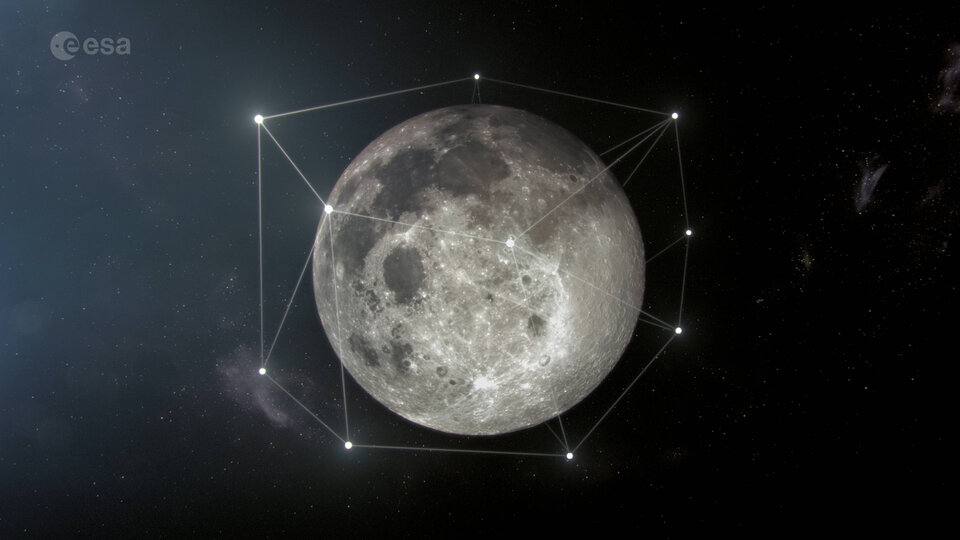
ECSAT is the home of ESA’s Moonlight programme. As part of Moonlight, the agency is working with industry to develop an infrastructure – including a dedicated constellation of lunar satellites – to deliver communications and navigation services for future lunar missions.
Moonlight’s services will enable more efficient lunar expeditions, as well as creating commercial opportunities for companies participating in missions to the Moon.
Commercialisation
ECSAT plays a key role in ESA’s Directorate of Commercialisation and Industry Partnership, which boosts the competitiveness and growth of the European space industry, and helps European businesses scale up in global markets.
ECSAT advances these aims by supporting European entrepreneurs in the development and commercialisation of space-enabled products and services.
ESA’s ACCESS programme, led from ECSAT, has helped thousands of companies from across the European economy to boost businesses by applying satellite technology to solve problems on Earth.
The ACCESS team coordinates ESA’s Business Incubation Centre UK, which supports fledgling companies in their efforts to bring ambitious satellite-enabled solutions to the market. ESA’s Business Incubation Centre UK has locations at Harwell Campus, Daresbury in the Liverpool City Region, Edinburgh and Leicester.
Advancing 5G and 6G

As part of ECSAT’s commercialisation activities, ECSAT hosts ESA’s flagship 5G/6G Hub, a research and demonstration facility that spurs industry collaboration to advance the 5G digital transformation and prepare for the development of 6G.
It features high-capacity converged networks, a demonstration room, a technical lab for application testing, and a Moon and Mars Connectivity Room that focuses on augmented reality technologies.
ESA's flagship 5G/6G Hub is setting a blueprint for innovation in telecommunications that is being replicated at ESA sites across Europe.
Tackling climate change
ECSAT is home to ESA's Actionable Climate Information Section, which is the focal point for ESA’s climate-related activities.
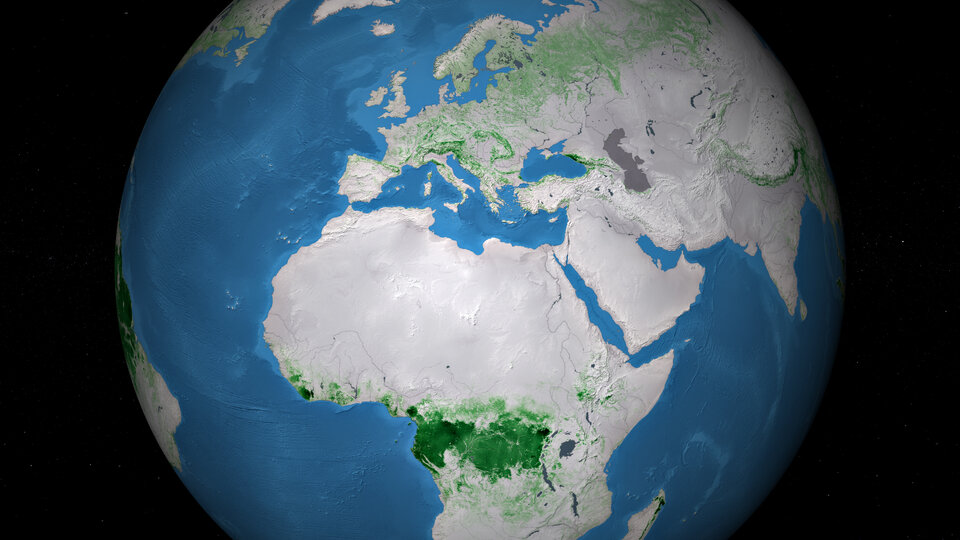
The section coordinates ESA’s Climate Change Initiative, which enables the transformation of satellite observations into information that is advancing global efforts to tackle the climate crisis, as well as helping governments, businesses and communities adapt to its impacts.
ECSAT also hosts a project office that coordinates a global climate modelling initiative called the Coupled Model Intercomparison Project (CMIP).
The CMIP international project office coordinates dozens modelling teams from across the world, with the aim of better understanding past, present, and future changes in the climate.
Supporting exploration and advanced manufacturing
Located a few hundred metres from ECSAT, ESA’s Vulcan Facility is home to a collection of terrestrial samples that simulate rock and dust found on other planets.
Scientists and engineers are using this collection to investigate technologies that will enable a long-term human and robotic presence in deep space.
In addition, the analogue samples are used to develop techniques and capabilities that will be employed in the eventual reception, handling and curation of extra-terrestrial samples sent to Earth as part of future sample return missions.
Spaceship ECSAT also has a key role for supporting ESA’s exploration activities. One of three ESA Spaceships located across Europe, Spaceship ECSAT provides a dynamic and collaborative environment that enables students to quickly investigate key challenges of human and robotic exploration. Each ESA Spaceship has its own areas of expertise, and Spaceship ECSAT focuses on robotics, virtual and augmented reality, and the development of systems to assist astronauts.
Located adjacent to ECSAT at the Science and Technology Facilities Council’s Rutherford Appleton Laboratory (RAL), the ESA–RAL Advanced Manufacturing Laboratory helps to understand the capabilities of 3D printing and other advanced manufacturing techniques for future space missions.
The facility is one of many such ESA laboratories located across Europe.
Harwell campus collaboration
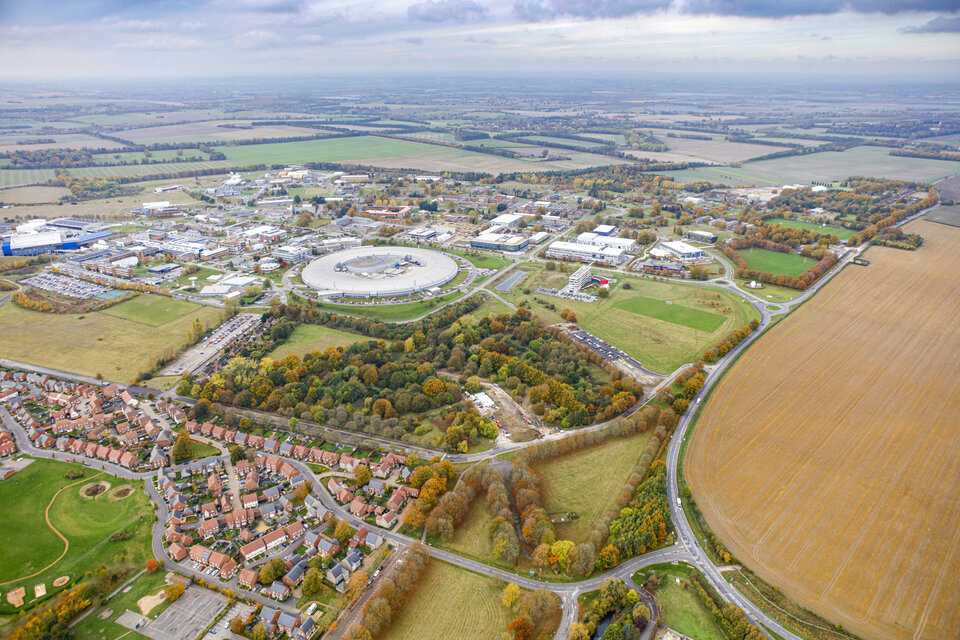
ECSAT is a key driver of the strong collaborative ethos at Harwell campus.
The thriving community of more than 100 commercial, public and academic enterprises that form Harwell’s space cluster include several ESA partner organisations, including Darwin Innovation Group, Oxford Space Systems, Astroscale, and many more.
ESA’s Magali Vaissiere Conference Centre, located beside ECSAT, adds to ESA’s existing contributions to Harwell.
The conference facility reinforces ties across Harwell’s health, quantum, energy and space clusters, as well as hosting events to showcase the global impact of European space activities.
Contact ECSAT
ESA ECSAT
Fermi Avenue
Harwell Campus
Didcot, Oxfordshire
OX11 0FD
United Kingdom
Media enquiries
Tel: +44 1235 444 200
General enquiries
Tel: +44 1235 444 200