Mir FAQs - Safety issues
Why won't MIR burn up completely on re-entry?
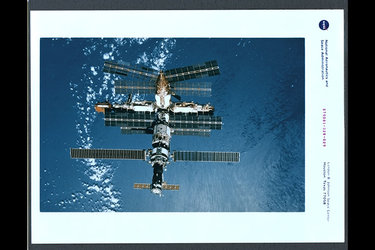
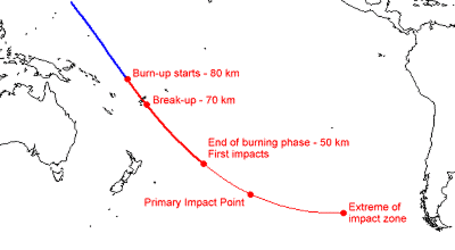
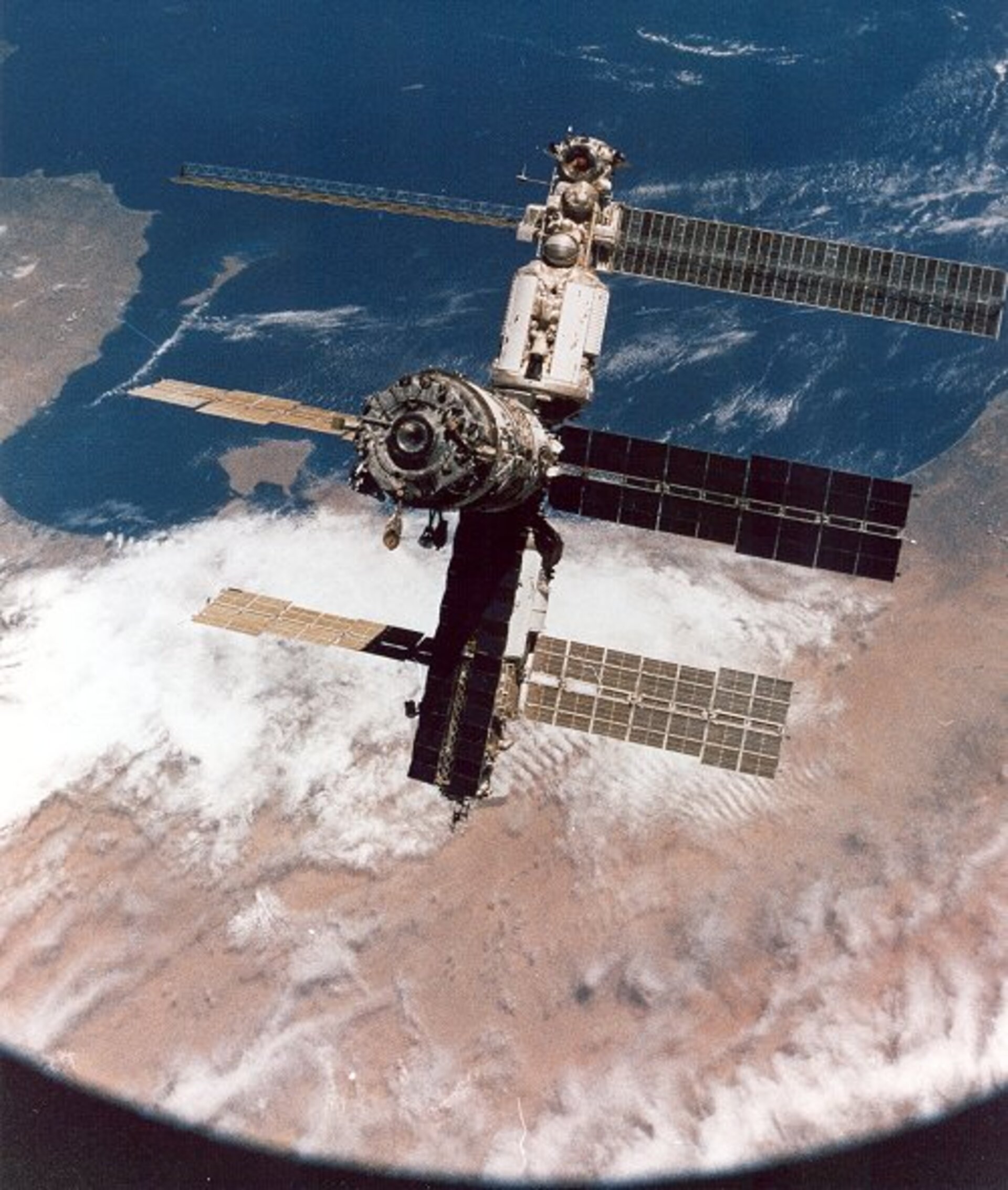
MIR is mainly composed of aluminium and lightweight materials that will burn up due to the strong aerodynamic stresses (friction will generate temperatures in excess of 1500ºC) caused by the high re-entry speed (28 000 km/h). However MIR contains robust elements such as steel and titanium to support manned occupation and the repeated docking process. These elements are the pieces most likely to survive re-entry heating. Mathematical models show that of the 135 tonnes in orbit mass, up to 30-40 tonnes (some 20-30% of the total mass) could survive re-entry heating and break into many smaller pieces. These pieces will slow down and fall to the Earth’s surface, in a well-defined remote area of the Pacific Ocean (some 1500-2000 km southeast of Australia) over an area 3-4000 km long and about 200 km wide.
Do we know where it will come down?
The Russian controllers of the MIR station have targeted the Pacific area 1500-2000 km southeast of Australia. This area, which has been used for all previous controlled de-orbiting of Progress vehicles, was chosen as it is the area with the lowest population density consistent with the need to make a final track in view of the Russian control centres.
Can it fall in Europe?
Although the intended target area is on the other side of the world, there is a remote possibility that MIR could fall in Europe up to a latitude of 51.6°N. This corresponds approximately to the area located south of the line London – Berlin - Warsaw. The Russians, who have a proven experience in de-orbiting Progress space vehicles, are confident that they will retain control of the station throughout the de-orbit process. As Europe is 20 000 km down-range from the target area, the probability of debris falling in Europe is extremely low. Added to this is the fact that in over 40 years of space activity, there have been no reported casualties anywhere in the world as a result of the daily return of objects from orbit.
What procedures are in place to protect us/respond to potential emergencies?
The Russian Aviation and Space Agency has agreed to keep ESA informed of the developing situation. ESA will, with its European partners, monitor the progress of the MIR re-entry. An official request from the Russian Aviation and Space Agency was made to ESA in mid-January to support re-entry activities with data coming from the FGAN radar of the German Ministry of Defense. Data will be relayed to Rosaviaskosmos’ TsUP Mission Control Centre in Korolev (near Moscow) through ESOC, ESA’s Control Centre in Darmstadt, Germany.
If the nominal re-entry manoeuvre is unsuccessful, then the trajectory of the station will be determined to predict its re-entry location into the Earth’s atmosphere. This information will then be relayed to the appropriate government entities in charge of security operations in the ESA Member States.
Can the impact location be predicted precisely?
The MIR station has a very complex shape and the state of the atmosphere at high altitude is very difficult to predict. Thus, motion of the station and its final trajectory cannot be predicted entirely accurately. In addition, as the station reaches lower altitudes it will begin to break up (deformation due to high heat starts at an altitude of approximately 150 km, while disintegration occurs between 90 and 60 km). The resulting debris footprint on the Earth may extend by something like 100-200 km across the object’s ground track and 3-4000 km along the track. This is why such a large empty target area is needed.
What if the final burn fails to occur?
The Russians have a very long experience in successfully de-orbiting Progress vehicles. However, should the burn not occur, MIR will remain in orbit a few more days (difficult to say exactly how long) and eventually re-enter the atmosphere in an uncontrolled manner. Most of the station will still burn up but there will be no control on the impact area of the debris.
Should the final burn be shorter or longer than expected, then MIR would fall some minutes earlier or later, i.e. in another area along the final orbit’s ground track. The impact area will be identified in near real-time by ground controllers at TsUP.
Why can't you avoid contaminating the oceans with this debris?
The de-orbiting of MIR into the Pacific Ocean will have less environmental impact than the sinking of a small boat.
How many objects have returned to Earth from space?
As of 1 January 2001 approximately 26 600 objects (grapefruit-sized or larger) have been sent into orbit, of which 17 000 have returned to Earth. On average one tracked object re-enters the Earth’s atmosphere every day.
Just as the Earth’s atmosphere protects us from naturally falling materials, so it also protects us from re-entering satellites. The majority burn up due to re-entry heating. Only a few space vehicles, such as the Space Shuttle, have heat shields that allow them to survive re-entry heating. In some cases, a stronger than normal portion of a large re-entering satellite may survive re-entry heating.