MONITORING THE STORMY SUN
Solar exploration has always played a key role in ESA’s space science programme and spacecraft built in Europe have a long and highly successful tradition in monitoring our star and exploring its environment.
Today, many missions study the Sun, our source of heat and energy that allows life to form and evolve on Earth. The joint ESA/NASA Ulysses mission provided us with the first-ever map of the heliosphere from the Sun’s equator to its poles. ESA’s four Cluster satellites are investigating the interaction between Earth’s magnetosphere and the solar wind.
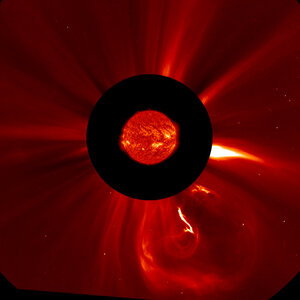
SOHO, stationed at a special point in space on the sunward side of Earth, sends images of solar explosions and probes the hidden interior of the Sun. Especially remarkable are its observations of coronal mass ejections, in which the Sun sends huge puffs of gas out into the Solar System.
Satellites and power and communications systems on the ground are vulnerable to this ‘space weather’, and their engineers can now be alerted in good time. Double Star, a mission in cooperation with China, also studies space weather.