Antarctica: below the surface

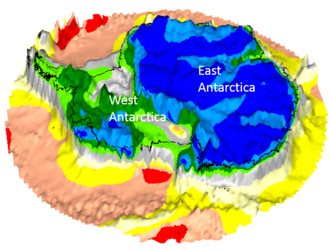
A paper, published recently in the Journal of Geophysical Research: Solid Earth, describes how scientists used gravity data from the GOCE satellite mission along with seismological models to reveal unprecedented insight into the crust and upper mantle, otherwise known as the lithosphere, below the frozen continent of Antarctica. For instance, these new findings reveal that under West Antarctica, Earth's crust is comparatively thin at about 25 kilometres, and the mantle is viscous at less than 100 kilometres. East Antarctica, on the other hand, is an old cratonic shield. Here, the mantle rock still has solid properties at a depth of more than 200 kilometres. There are also large variations in mantle temperature beneath the continent, which lead to the uplifting and subsiding of the ground with very different speeds across the continent. These new constraints on crustal and lithosphere thickness are also pivotal in the quest to estimate Antarctic geothermal heat flux and how it affects subglacial melting and ice sheet flow.