Intermediate eXperimental Vehicle for reentry technologies
Returning to Earth from space is a cornerstone for a wide range of applications in future space transportation, including next-generation launchers, planetary exploration, sample-return missions, space planes and crew and cargo transportation.
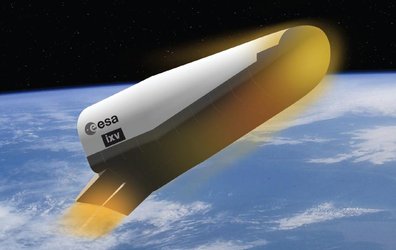
ESA accorded significant importance to the development of critical reentry technologies through several basic research and technology preparatory programmes. The flight verification of such technologies culminated in the Intermediate eXperimental Vehicle (IXV) mission that flew in 2015.
Several technologies contributed to the consolidation of the European knowledge base for future reentry missions. Among the most important ones:
- Aerothermodynamics – validation of design tools and improvement of design performance on phenomena occurring during reentry induces the need for additional design margins. When reentering from low Earth orbit (LEO) oxygen and nitrogen molecules in the air break apart to dissipate the high energies involved. When this happens, the ideal-gas laws normally used for simulations are replaced by complex, real-gas laws that are governed by phenomena that are difficult to predict.
- Guidance Navigation and Control (GNC) – improvement of the guidance algorithms, coupling of inertial measurement units with satellite navigation, exploration of the combination of flaps and thrusters for flight control, addressing complex GNC issues related to the hypersonic phase of a reentry from low Earth orbit.
- Thermal protection and hot structures – validation of the flight performance of thermal protection materials and complex design solutions (for example, thermal expansion, junctions between materials, seals, gaps, steps and singularities), addressing the complexities introduced by the severe thermo-mechanical environment for low Earth orbit reentry applications.
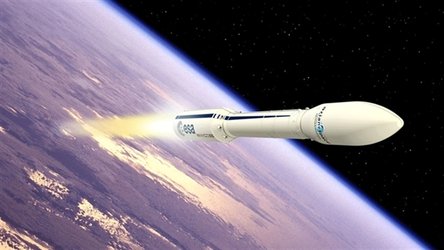
The Intermediate eXperimental Vehicle (IXV) project objectives tackled the basic European needs for reentry from low Earth orbit, consolidating the knowledge necessary for the development of any future European reentry system while limiting risk for future projects. The European mission on a Vega launcher occured in 2015.