

7th Student Parabolic Flight Campaign
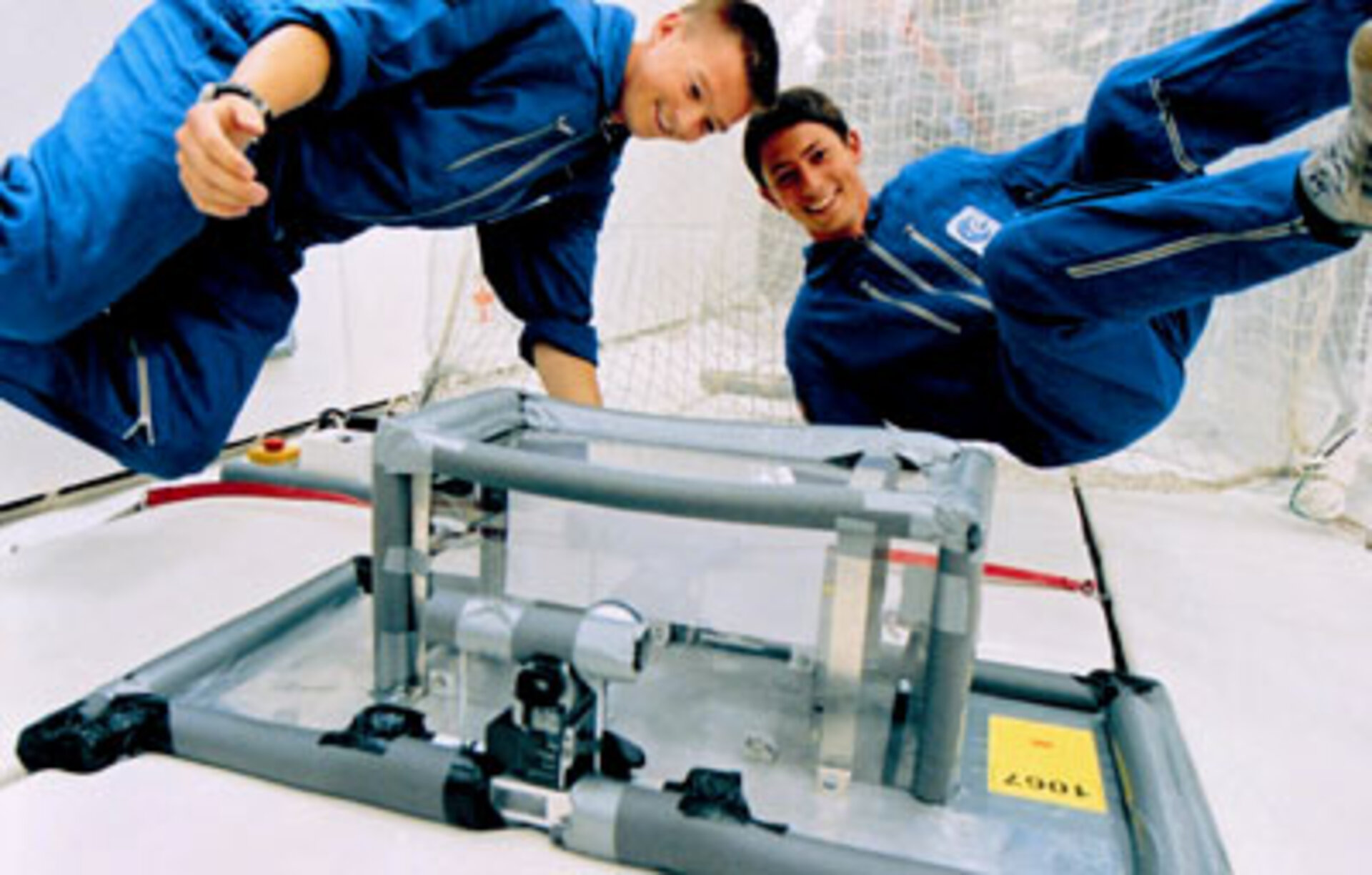
This week 124 excited students will gather in Bordeaux for what will be the opportunity of a lifetime – the chance to test their experiments in weightlessness during the 7th Student Parabolic Flight Campaign.
This year’s campaign will last for three weeks from 29 June to 16 July. The students will be split into four teams and each team will be able to fly their experiment twice. During each flight the A300 Zero-G will make 30 parabola, each providing around 20 seconds of weightlessness.
The students’ first experience of weightlessness will be during a familiarisation flight; this consists of five-parabola ‘only’. Hopefully this will allow them to become used to the trajectory of the plane and the sensation of ‘floating in space’, so that they can concentrate on their experiments during the 30-parabola flights.
Although the final selection was made in February some of the students started working on their experiments a year ago. In March the teams visited ESTEC, where they were able to learn more about the flights and discuss their experiments with experts. Since then they have all been working hard to finalise their projects in time for the campaign.

This year’s campaign includes experiments from a variety of scientific areas, including material science, life science and robotics. At the end of the campaign, the two experiments with the most potential will be given the chance to take part in one of ESA’s microgravity research parabolic flight campaigns.
Personal robotic assistants
Teams from France and Switzerland will both test personal robotic assistants, but each uses different technology. The robots should be able to follow astronauts in the ISS, hold objects such as a personal computer and be capable of fetching flying objects.
Both robots use fans as a method of propulsion. The French team will test the propulsion system of their robot Sphere and its ability to reach a specific target while the Swiss team will test their robot ZeroGraptor. This uses a hybrid propulsion system, consisting of ducted fans, to move in microgravity and a differential traction system to move in normal gravity.
Stabilising device
A Canadian team have designed and built a stabilising device for testing in weightlessness. Its purpose is to help astronauts by stabilising objects in the air without the need for human intervention. For example, it could stabilise a PC that provides information to an astronaut carrying out a specific task.
Body vibration exercises
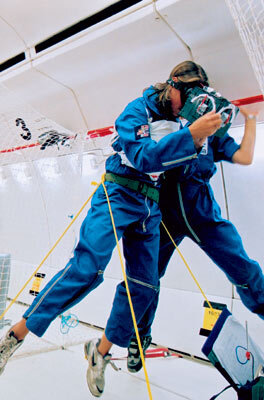
Whole body vibration exercises have been found to increase the strength, power and jumping ability of both athletes and non-athletes. Vibration exercises are being developed for astronauts to counteract loss in muscle and bone mass during spaceflight. A student team from Aberdeen will compare the effect of whole body vibration on muscle activity during exercises on Earth and in weightlessness by means of electromyography.
Behaviour of tilapia fry
The fry of tilapia, a freshwater fish that lives in Africa’s rivers, move collectively in both aquariums and under natural conditions, for reasons still unclear to biologists. Belgian students will examine the influence of a number of parameters that could disturb schools of fish, such as light, gravity and small shock waves.
Video on weightlessness
Spanish students are preparing a multimedia product for primary and secondary school students to explain the differences between gravity and weightlessness. They will do this by filming what happens to liquids in a container and fish in a fish tank – and by writing with different pens – while experiencing weightlessness.
Follow the campaign
Keep up to date with what is going on by reading the students’ diary that will be published on ESA’s Education and Human Spaceflight websites. In addition, ESA’s Student Parabolic Flight Campaign will publish interviews with the teams, debriefings videos and a description of the experiments.

