• → European Space Agency

      • Space for Europe
      • Space News
      • Space in Images
      • Space in Videos
    • About Us

      • Welcome to ESA
      • DG's News and Views
      • For Member State Delegations
      • Business with ESA
      • ESA Exhibitions
      • ESA Publications
      • Careers at ESA
    • Our Activities

      • Space News
      • Observing the Earth
      • Human Spaceflight
      • Launchers
      • Navigation
      • Space Science
      • Space Engineering
      • Operations
      • Technology
      • Telecommunications & Integrated Applications
    • For Public

    • For Media

    • For Educators

    • For Kids

    • ESA

    • ATV

    • International Space Station

    • Human Spaceflight and Exploration

    • Flight plan
    • ATV mission concept
    • ATV flight phases
    • ATV cargo capacity
    • Spacecraft
    • ATV configuration
    • ATV Integrated Cargo Carrier
    • ATV Service Module
    • ATV evolution
    • ATV Missions
    • ATV-1: Jules Verne
    • ATV-2: Johannes Kepler
    • ATV-3: Edoardo Amaldi
    • ATV-4: Albert Einstein
    • Operations
    • Flight operations
    • ATV Control Centre
    • Crew role
    • Industry
    • ESA's role
    • European industry
    • ATV Downloads

      • Downloads
      • ATV Edoardo Amaldi factsheet English (pdf)
      • ATV Edoardo Amaldi factsheet French (pdf)
      • ATV Edoardo Amaldi factsheet Italian (pdf)
      • ATV Edoardo Amaldi factsheet German (pdf)
      • ATV Edoardo Amaldi info kit English (pdf)
      • ATV Edoardo Amaldi info kit Italian (pdf)
      • ATV Edoardo Amaldi info kit French (pdf)
      • ATV Edoardo Amaldi info kit German (pdf)
      • ATV Edoardo Amaldi info kit Russian (pdf)
      • ATV: Servicing the International Space Station (pdf)
      • ATV-3 Poster
      • ATV-3 Panels
    • Multimedia gallery
    • ATV image gallery
    • ATV video gallery
    • ATV on Flickr
    • Services

    ESA > Our Activities > Human Spaceflight > ATV

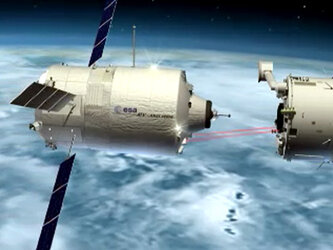
    ATV cargo capacity

    ATV2 Docking
    ATV Johannes Kepler approaching ISS

    Based on the current Ariane 5 launcher performance, the ATV can carry to the ISS slightly more than 6.6 tonnes of wet and dry cargo. In addition, for a typical mission profile (such as for the ATV-2 Johannes Kepler) ATV carries about 2.5 tonnes of fuel for its own use, i.e. for rendezvous and docking with the ISS, performing different manoeuvres on the way, and eventually deorbiting itself on conclusion of its mission.

    The weights are calculated for each mission depending on the cargo need, but in general the total ATV net cargo capacity can be allocated as follows (of course not all the maximum quantities presented here can be carried at once on the same flight):

    Wet cargo

    Propulsive support propellant (up to 4.0 tonnes)
    This takes up by far the largest proportion of the ATV cargo. This propellant is used by the ATV to reboost the ISS to a higher orbiting altitude in order to counter the effects of atmospheric drag, which cause the ISS to very slowly lose altitude, for ISS attitude control, and for ISS Debris Avoidance manoeuvres, whenever needed. The propellant consists of two different fluids: monomethylhydrazine (MMH) and mixed oxides of nitrogen (MON3).

    ATV Kepler tanking up
    ATV-2 being fuelled

    Refuelling propellant (up to 860 kg)
    Once attached to the Station, up to 860 kg of refuelling propellant can be transferred from the ATV to the ISS. This consists of two different fluids: the fuel unsymmetrical dimethylhydrazine (UDMH) and the oxidiser, nitrogen tetroxide (N2O4), which provides a source of oxygen so the fuel can ignite and burn in orbit. This is used by the ISS for orbit and attitude control with its own engines.

    Water (up to 855 kg)
    This is what is known as potable water for use by the crew for drinking, food rehydration and oral hygiene.

    Gases (up to 102 kg)
    Two out of three types of gases (oxygen, nitrogen and air) can be transported in order to resupply the atmosphere inside the ISS, which is similar to that on Earth.


    Dry cargo

    Up to 3.2 tonnes of dry cargo can be transported to the ISS inside the Integrated Cargo Carrier of the ATV. This may include food for the crew, spare parts, clothing, and a number of additional items.

    ATV-2 Johannes Kepler

    ATV late cargo loading
    Late cargo added to ATV-2

    ATV Johannes Kepler had a maximum launch mass of 20 010 kg. The total net cargo (fluid and dry) load to be transported to the ISS was 7085 kg, including 1170 kg dry cargo, 100 kg oxygen, 851 kg of refuel propellant and 4535 kg of fuel for propulsive support of the ISS.

    In addition, up to 430 kg of late cargo, packed in 28 bags, were lowered into ATV’s cargo compartment just before launch via a manually operated winch.

    Dry cargo includes one small cargo transfer bag (about 13 kg each), a ‘crew care package’, for each ISS astronaut. Bags are filled with personal items such as family photos, CDs with music, chocolate or other candy.

    The ATV-2 spacecraft itself has a 'dry mass' of about 9800 kg.

    Last update: 16 June 2011

    Rate this

    Views

    Share

    • Currently 0 out of 5 Stars.
    • 1
    • 2
    • 3
    • 4
    • 5
    Rating: 0/5 (0 votes cast)

    Thank you for rating!

    You have already rated this page, you can only rate it once!

    Your rating has been changed, thanks for rating!

    45
    facebook
    twitter
    reddit
    google plus
    digg
    tumbler
    digg
    blogger
    myspace
    • Related links
      • ATV mission scenario - picture report
        • ATV mission scenario - animation

    Connect with us

    • RSS
    • Youtube
    • Twitter
    • Flickr
    • Google Buzz
    • Subscribe
    • App Store
    • LATEST ARTICLES
    • · CryoSat hits land
    • · Ariane 5 completes seven launches …
    • · Measuring skull pressure without t…
    • · Malargüe station inauguration
    • · The solar wind is swirly
    • FAQ

    • Jobs at ESA

    • Site Map

    • Contacts

    • Terms and conditions