• → European Space Agency

      • Space for Europe
      • Space News
      • Space in Images
      • Space in Videos
    • About Us

      • Welcome to ESA
      • DG's News and Views
      • For Member State Delegations
      • Business with ESA
      • ESA Exhibitions
      • ESA Publications
      • Careers at ESA
    • Our Activities

      • Space News
      • Observing the Earth
      • Human Spaceflight
      • Launchers
      • Navigation
      • Space Science
      • Space Engineering
      • Operations
      • Technology
      • Telecommunications & Integrated Applications
    • For Public

    • For Media

    • For Educators

    • For Kids

    • ESA

    • ATV

    • International Space Station

    • Human Spaceflight

    • Flight plan
    • ATV mission concept
    • ATV flight phases
    • ATV cargo capacity
    • Spacecraft
    • ATV configuration
    • ATV Integrated Cargo Carrier
    • ATV Service Module
    • ATV evolution
    • ATV Missions
    • ATV-1: Jules Verne
    • ATV-2: Johannes Kepler
    • ATV-3: Edoardo Amaldi
    • ATV-4: Albert Einstein
    • ATV-5: George Lemaître
    • Operations
    • Flight operations
    • ATV Control Centre
    • Crew role
    • Industry
    • ESA's role
    • European industry
    • ATV-4 downloads

      • ATV-4 mission brochure English
      • ATV-4 mission brochure German
      • ATV-4 mission brochure French
      • ATV-4 mission brochure Italian
      • ATV-4 mission brochure Russian
    • Multimedia gallery
    • ATV image gallery
    • ATV video gallery
    • ATV on Flickr

    ESA > Our Activities > Human Spaceflight > ATV

    Automated Transfer Vehicle

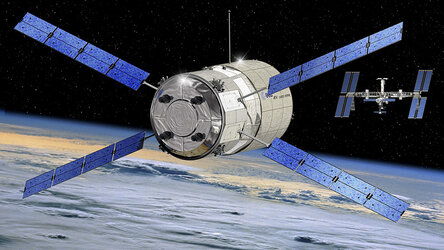
    The Automated Transfer Vehicle (ATV)

    The International Space Station depends on regular deliveries of equipment and spare parts as well as food, air and water for its crew. Since its first mission in 2008 Europe's Automated Transfer Vehicle (ATV) has been indispensable to the International Space Station.

    Every 12 months or so, ATV hauls 7.7 tonnes of cargo from its launch site in  Kourou, French Guiana to the Station 340 km above the Earth. High-precision navigation systems guide ATV on a rendezvous trajectory to the International Space Station where it automatically docks with the Station's Russian service module. ATV remains there as a pressurised and integral part of the Station for up to six months until its final mission: a fiery one-way trip into Earth's atmosphere to dispose of up to 6.4 tonnes of Station waste.

    Dimensions  
    Length: 9 794 mm
    Diameter: 4 480 mm
    Solar arrays span: 22 281 mm
    Mass
    Vehicle dry mass: 10 470 kg
    Vehicle consumables: 2 613 kg
    Total vehicle mass: 13 083 kg
    Total cargo upload capacity: 7 667 kg
    Mass at launch: 19 357 kg
    Waste download capacity: 6 400 kg


    Launch configuration  
    Cargo mass capabilities Dry supplies: 5 500 kg
    Drinking water: 840 kg
    Air (oxygen and nitrogen): 100 kg
    Refuelling propellant: 860 kg
    Reboost and attitude control propellant: 4 700 kg
    Total cargo upload capacity: 7 667 kg
    Launch vehicle Ariane 5 ES (inclination 51.6°, initial orbital altitude 260 km)
    ATV is launched with its solar panels folded
    Launch site Kourou, French Guiana
    First flight 9 March 2008

    Last update: 5 February 2013

    Rate this

    Views

    Share

    • Currently 5 out of 5 Stars.
    • 1
    • 2
    • 3
    • 4
    • 5
    Rating: 5/5 (1 votes cast)

    Thank you for rating!

    You have already rated this page, you can only rate it once!

    Your rating has been changed, thanks for rating!

    469
    Tweet
    • Automated Transfer Vehicle
    • Related documents
    • ATV facsheet italiano
    • Space pioneers
    • Edoardo Amaldi

    Connect with us

    • RSS
    • Youtube
    • Twitter
    • Flickr
    • G+
    • Facebook
    • Livestream
    • Subscribe
    • App Store
    • LATEST ARTICLES
    • · ESA astronaut Timothy Peake set fo…
    • · Space drives e-mobility
    • · Proba-V opens its eyes
    • · First new Galileo satellite arrive…
    • · Next destination: space
    • FAQ

    • Jobs at ESA

    • Site Map

    • Contacts

    • Terms and conditions