• → European Space Agency

      • Space for Europe
      • Space News
      • Space in Images
      • Space in Videos
    • About Us

      • Welcome to ESA
      • DG's News and Views
      • For Member State Delegations
      • Business with ESA
      • ESA Exhibitions
      • ESA Publications
      • Careers at ESA
    • Our Activities

      • Space News
      • Observing the Earth
      • Human Spaceflight
      • Launchers
      • Navigation
      • Space Science
      • Space Engineering
      • Operations
      • Technology
      • Telecommunications & Integrated Applications
    • For Public

    • For Media

    • For Educators

    • For Kids

    • ESA

    • Astrolab Mission

    • Human Spaceflight and Exploration

    • Astronauts

    • International Space Station

    • Astrolab Mission
    • About the mission
    • Why Astrolab?
    • Mission facts
    • Factsheets (pdf)
    • This week on ISS
    • Science programme
    • Human physiology
    • Biology
    • Radiation
    • Physics
    • Technology
    • Education
    • Meet the crew
    • Thomas Reiter
    • Léopold Eyharts
    • Michael E. Lopez-Alegria
    • Mikhail Tyurin
    • Expedition 13
    • Astrolab Mission live
    • ESA Television
    • NASA TV live
    • Reiter EVA blog
    • Multimedia
    • Multimedia gallery
    • Services

    ESA > Our Activities > Human Spaceflight > Astrolab

    Education programme

    Thagard -  Sleep Station STS-71.
    Looking at reasons and patterns of astronaut sleep disruption

    CASPER
    The objective of the CASPER (Cardiac Adapted Sleep Parameter Electrocardiogram Recorder) experiment is to test and evaluate a method of monitoring sleep disturbance and sleep stability in weightlessness. CASPER combines objective physiological data and subjective inputs. Physiological data is obtained through a specially adapted vest, worn by the astronaut, with embedded sensors and cabling that connects ECG electrodes, for measuring heart rate, to a PDA for storing the heart rate data. Subjective inputs are obtained via a questionnaire, that runs on the same PDA. One questionnaire is completed both prior to and after each sleep period, during which the heart rate is measured.

    Data collected on this mission can help to establish and distinguish the reasons and patterns of astronaut sleep disruption and facilitate the development of relevant countermeasures to monitor and ensure astronaut sleep stability during long-term spaceflight.

    Ready for business
    Measuring background radiation inside the Space Station

    UTBI - Under the Background Influence
    During the UTBI (Under The Background Influence) experiment, the background radiation is measured inside the modules of the International Space Station using a new type of radiation sensor. Radiation models, that predict these radiation levels, will be verified and, if necessary, corrected with the experimental data.

    The new type of sensor that measures the radiation is made of an alloy of Cadmium, Zinc and Tellurium. The advantage of this specific detector is that it is compact and does not require cryogenic cooling. The UTBI experiment will demonstrate this specific sensor technology for the first time in space and possibly act as a precursor for an instrument of ESA’s Atmospheric-Space Interaction Monitor (ASIM), which is planned to be accomodated on an external payload adapter on the outside surface of the European Columbus laboratory once it is launched to the ISS.

    Radiation can have severe health consequences for astronauts. Understanding radiation, its inter-action with the ISS and its impact on the human body shall therefore be considered as an important factor that has to be taken into account for longer duration flights around the Earth as well as flights and stays towards and on the Moon and Mars.


    mISSione possibile question
    Competition winners will talk to Thomas Reiter using amateur radio

    ARISS
    ARISS is an international association of national amateur radio societies of the countries participating in the ISS programme. For this mission, the specific objectives of ARISS are: to provide real time radio transmissions from the ISS, during which pupils in selected German, and Swiss primary schools will put questions to the ESA astronaut; and to build, develop and maintain the amateur radio activities on board the ISS. Among the children chosen, are the winners of national space-oriented competitions set up by ESA’s ISS Education Office. The ground stations will be provided by local amateur radio clubs.

    ERA transports small cargo
    DVD Lesson 4 will be about robotics

    DVD-4 - Lesson from space
    To demonstrate the use of robotic applications in weightlessness by means of filming with basic robotic demonstrations using a model of the European Robotic Arm (ERA) and other equipment on the ISS. This includes the Robotic Work Station of the Space Station’s robotic arm (Canadarm) in the US segment of the ISS, and different features and functions of the NASA SPHERES experiment.

    Footage of the demonstrations will be used to produce a DVD Lesson on robotics for use by teachers and their pupils aged 12-18 years across ESA Member States.

    Interactive lecture
    A live audio/video link-up with Thomas Reiter on the ISS

    E-learning session
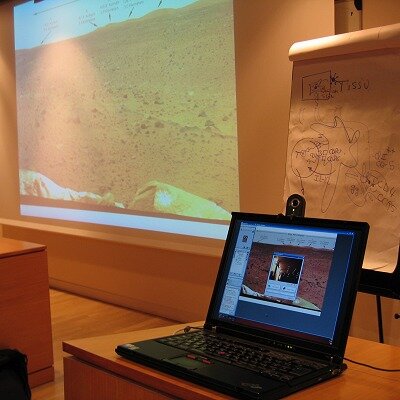
    The e-learning session is currently scheduled as an "Earth-based" lecture during which there will be a live audio/video link-up with ESA astronaut, Thomas Reiter, on board the ISS. The lecture will be presented to European university students following the EuMAS Masters Programme in Aeronautics and Space by Dr. Hubertus Thomas of the Max-Planck-Institute in Garching, Germany. The lecture will be on plasma crystals and complex plasmas, with reference to the PK-3+ plasma crystal experiment that will be performed during the Astrolab mission.

    During the live link-up with the ISS, Thomas Reiter will demonstrate the PK-3+ hardware, and the students will have to possibility to put questions to Thomas Reiter in real time and receive feedback.

    Oil emulsion experiment
    Highlighting how an oil/water emulsion behaves differently in weightlessness and in normal gravity

    Oil Emulsion
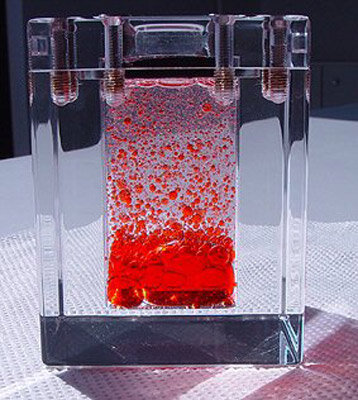
    This experiment will be carried out by school pupils (11-14 years old) on Earth and by Thomas Reiter during his long-duration mission on board the ISS. The space section of ‘Oil Emulsion’ will be filmed and downlinked. This experiment will highlight how an oil/water emulsion behaves differently in weightlessness and under gravity conditions respectively. A sealed container holding two immiscible fluids, clear oil and ink-coloured water, will be shaken until the two fluids are slightly mixed. The fluids’ behavior in space will be filmed within defined time slots during a maximum of two weeks. The data will be down linked and the results will be shown in a specialized childrens programme on German public TV. The different kinds of segregation that occur during the experiment, in space and on Earth, can be observed and then explained by the teacher. This experiment can form the basis of further physics lessons, (concerning weightlessness, density, other fluid parameters) and maybe even lessons in other scientific areas. The Oil Emulsion experiment was introduced by DLR and is a cooperation between the German and the European Space Agencies.

    Last update: 20 June 2006

    Rate this

    Views

    Share

    • Currently 0 out of 5 Stars.
    • 1
    • 2
    • 3
    • 4
    • 5
    Rating: 0/5 (0 votes cast)

    Thank you for rating!

    You have already rated this page, you can only rate it once!

    Your rating has been changed, thanks for rating!

    17
    facebook
    twitter
    reddit
    google plus
    digg
    tumbler
    digg
    blogger
    myspace

    Connect with us

    • RSS
    • Youtube
    • Twitter
    • Flickr
    • Google Buzz
    • Subscribe
    • App Store
    • LATEST ARTICLES
    • · CryoSat hits land
    • · Ariane 5 completes seven launches …
    • · Measuring skull pressure without t…
    • · Malargüe station inauguration
    • · The solar wind is swirly
    • FAQ

    • Jobs at ESA

    • Site Map

    • Contacts

    • Terms and conditions