• → European Space Agency

      • Space for Europe
      • Space News
      • Space in Images
      • Space in Videos
    • About Us

      • Welcome to ESA
      • DG's News and Views
      • For Member State Delegations
      • Business with ESA
      • ESA Exhibitions
      • ESA Publications
      • Careers at ESA
    • Our Activities

      • Space News
      • Observing the Earth
      • Human Spaceflight
      • Launchers
      • Navigation
      • Space Science
      • Space Engineering
      • Operations
      • Technology
      • Telecommunications & Integrated Applications
    • For Public

    • For Media

    • For Educators

    • For Kids

    • ESA

    • Human Spaceflight

    • Astronauts

    • International Space Station

    • Research

    • Education

    • Exploration

    • How to become an astronaut
    • European astronauts
    • The European astronaut corps
    • European astronaut charta
    • Astronaut gallery
    • Astronaut biographies

      • Jean-François Clervoy
      • Samantha Cristoforetti
      • Frank De Winne
      • Pedro Duque
      • Léopold Eyharts
      • Christer Fuglesang
      • Alexander Gerst
      • André Kuipers
      • Andreas Mogensen
      • Paolo Nespoli
      • Luca Parmitano
      • Timothy Peake
      • Thomas Pesquet
      • Hans Schlegel
      • Roberto Vittori
    • European astronauts in space
    • European astronauts in new functions
    • Astronaut training

      • Related articles
      • The challenges of astronaut training
      • Basic training
      • Advanced training
      • Increment-specific training
      • Neutral buoyancy EVA training
      • ATV training
    • European Astronaut Centre
    • The European Astronaut Centre
    • Organisation and structure
    • Mission participation and support
    • Getting to EAC
    • Contact us
    • Living in space

      • Living in space
      • Learning to live with the laws of motion
      • Daily life
    • Services
    • Calendar
    • Subscribe
    • RSS feeds

    ESA > Our Activities > Human Spaceflight > Astronauts

    Basic training

    Training starts at EAC

    Every ESA astronaut starts the training cycle by completing the 16-month 'Basic training' at the European Astronaut Centre (EAC) in Cologne, Germany.

    Basic training provides an overall familiarization with the future career as an astronaut. It consists of four main training blocks:

    1. Introduction

    Provides a first orientation for the newly hired astronaut candidates. They receive an overview of the major spacefaring nations, their space agencies (with special emphasis on the European Space Agency) as well as of the major manned and unmanned space programmes. Space law and intergovernmental agreements governing the worldwide cooperation in space complete this first training block.

    2. Fundamentals

    Provides basic knowledge on various technical and scientific disciplines. This block brings all new astronaut candidates, who have different professional backgrounds and expertise, to a common minimum knowledge base in subjects of relevance for their future astronaut career.

    It deals with technical disciplines such as spaceflight engineering, electrical engineering, aerodynamics, propulsion, orbit mechanics, materials and structures and it also includes an introduction to science disciplines like research under weightlessness (in human physiology, biology and material sciences), Earth observation, astronomy and others.
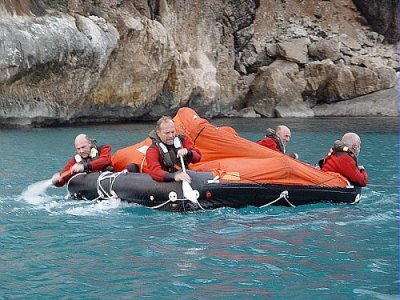
    Training for sea survival
    Training for sea survival

    3. Space systems and operations

    Provides a detailed overview of all Space Station onboard systems (e.g. ISS structure and design, guidance navigation & control, thermal control, electrical power generation and distribution, command and tracking, life support systems, robotic systems, systems for extra-vehicular activities, payload systems), as well as on the major systems of those spacecraft which service the ISS (e.g. Shuttle, Soyuz, Progress, ATV and HTV) and also includes ground systems like development and test sites, launch sites, training and control centres.

    4. Special skills

    Focuses on the training of important special skills such as generic robotic operations, rendezvous and docking, Russian language, human behaviour and performance and finally SCUBA diving as a first preparation for Extra Vehicular Activities (EVA or spacewalk) training.


    SCUBA diving is part of the basic training
    SCUBA diving is part of the basic training programme

    ESA astronaut and former Belgian Air Force pilot Frank De Winne says, "You get some general ideas during the basic training; what is the ISS, what is it like to be an astronaut and what will my tasks be up there."

    "To learn how to behave underwater is part of the basic skills that you need to do an EVA, or spacewalk. Every person who has to do an EVA needs to have a basic diving certificate because the conditions you work under when you are doing a spacewalk are similar to those you experience when you are diving," says De Winne.

    For more about the SCUBA diving and EVA training, see the Neutral buoyancy EVA training article

    Last update: 15 November 2012

    Rate this

    Views

    Share

    • Currently 0 out of 5 Stars.
    • 1
    • 2
    • 3
    • 4
    • 5
    Rating: 0/5 (0 votes cast)

    Thank you for rating!

    You have already rated this page, you can only rate it once!

    Your rating has been changed, thanks for rating!

    202
    facebook
    twitter
    reddit
    google plus
    digg
    tumbler
    digg
    blogger
    myspace
    • Related articles
      • Neutral buoyancy EVA training

    Connect with us

    • RSS
    • Youtube
    • Twitter
    • Flickr
    • Google Buzz
    • Subscribe
    • App Store
    • LATEST ARTICLES
    • · CryoSat hits land
    • · Ariane 5 completes seven launches …
    • · Measuring skull pressure without t…
    • · Malargüe station inauguration
    • · The solar wind is swirly
    • FAQ

    • Jobs at ESA

    • Site Map

    • Contacts

    • Terms and conditions