

Flight day 6
Second spacewalk
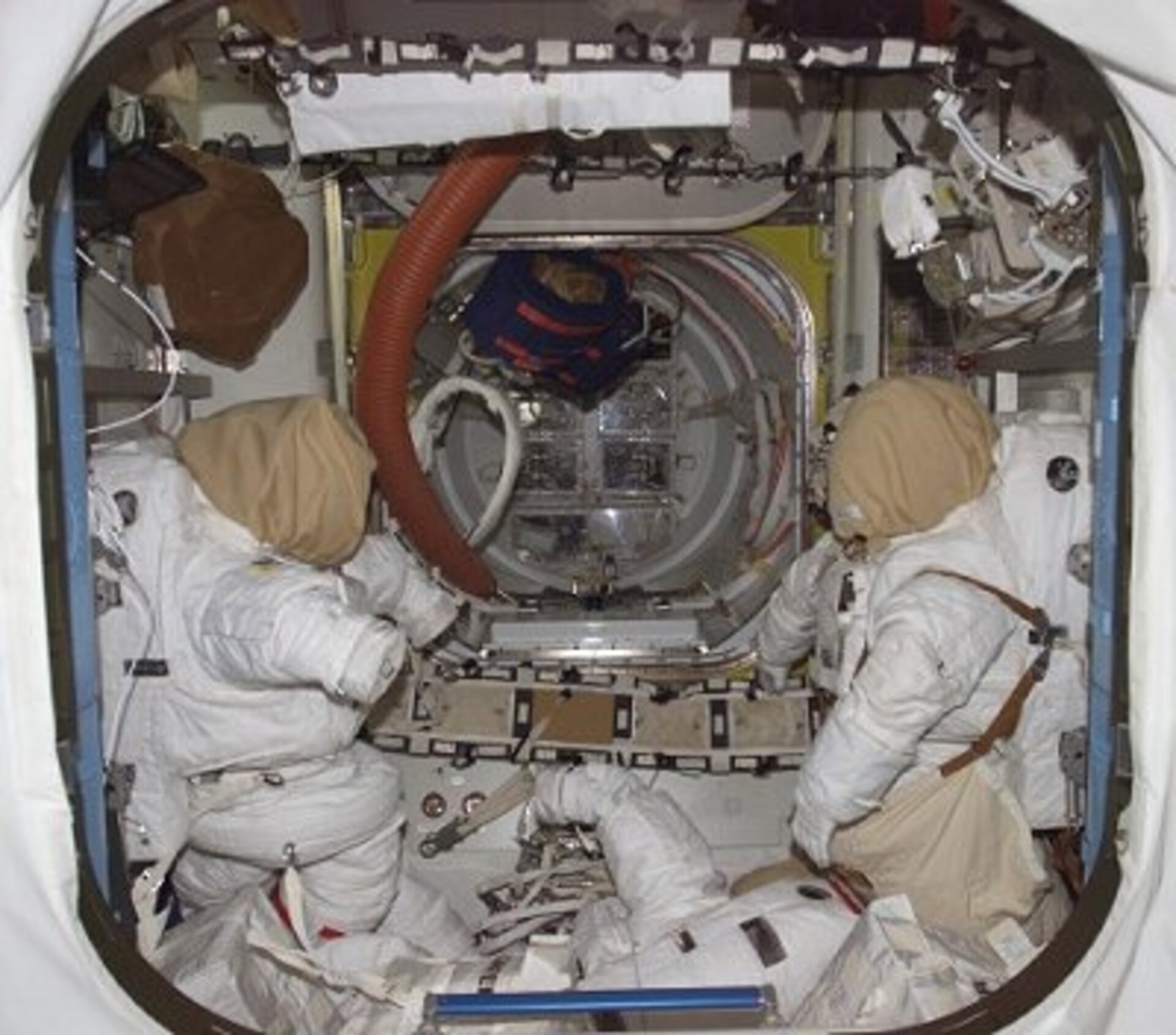
EVA2 is prepared for in the same way as the first walk, that is Beamer and I sleep in the Space Station’s airlock again.
The spacewalk itself begins with us changing many electrical connectors at several sites on the outside of the ISS. Of the Station’s four power channels, we re-connect two today. During this time almost half of the Station must be switched off. It isn’t as drastic as it might sound, as the majority of functions – and especially the crucial ones – have one or two back-up's that run on different power channels. However, this is still something that Ground Control have dreaded for many years and if something doesn’t go as it should it could be a major nuisance.
When we have completed the connections, the apparatus and units that have been waiting on the truss for several years should finally start up and, if they don't work properly, we might have to uncouple them again and/or replace some of the units. We have trained underwater for having to change plans in the middle of a spacewalk and to carry out repair work, in certain cases even with the help of the robotic arm.
On the truss, which, when it is completed is 100 m long, there is a track and a wagon runs on this, the MT (Mobile Transporter). Amongst other things, the robotic arm can be placed on the MT, and in this way provide access to practically the whole of the Space Station, except for the Russian part where eventually an ESA-built robotic arm will be placed.

On the track, however, there are also two carts (CETA-cart; Crew Equipment Translation Aid). In contrast to the MT, the carts don’t have a motor, but instead are dragged by a person or coupled to the MT. We now have to transfer the carts from the starboard side of the MT to its port side, in order to get to all the worksites for EVA3.
To do this, I first install a foothold mounting on Canadarm2 and jump onto it. Joanie steers the arm to fly me round to the outer cart, which I grab hold of. Beamer uncouples the cart from the track and then Joanie transports me over to the other side of the MT with the cart in my hands, where Beamer receives and connects up the cart. Then we repeat the whole procedure with the other cart.
Radiation
A little experiment I will carry out in conjunction with the spacewalks is to measure the radiation. There are many particles in the space around the ISS and they present a certain radiation risk. The intensity inside the ISS is on average approximately 50 times greater than on the surface of the Earth, but can be multiplied several fold during solar storms.
All astronauts are equipped with a passive dosimeter which we carry on us at all times. It of course doesn't protect against anything, but in this way one can at least monitor the size of the dose everyone is exposed to. Up until now us Europeans have only had American or Russian dosimeters, depending on who we have flown with, but now a few of us have seen to it that there is a programme for ESA to have their own dosimeters etc.
I myself actually have five dosimeters with me: four from ESA and one from NASA. The one from NASA I have so that we can compare the measurement readings. I leave two ESA ones inside, while I carry the other two with me during the spacewalks: one on my chest and one on my leg.
The radiation is significantly greater outside the ISS than inside it and as my total spacewalk time is about 13 hours, out of a total time in space of 260 hours, I hope to be able to determine how large the extra radiation dose is during the time spent outside of the ISS.

