Mission objectives
The main objectives of the Columbus Mission were:
Columbus laboratory installation
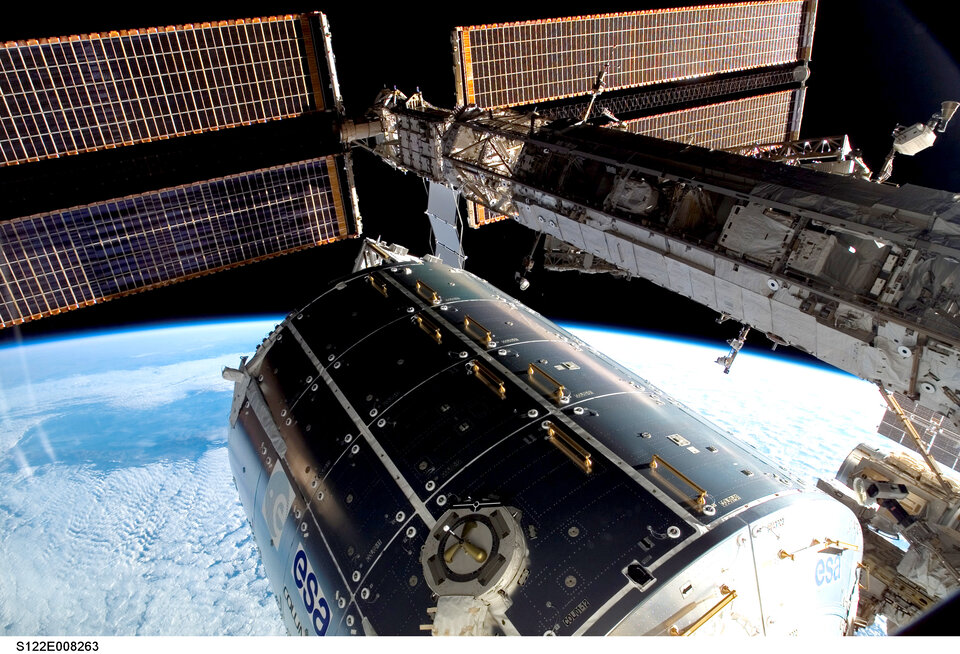
Columbus was transported to the Station inside the Shuttle’s cargo bay. It was installed on the starboard side of the Harmony module on 11 February 2008 during the first spacewalk of the mission. NASA astronauts Rex Walheim and Stanley Love participated in the spacewalk. ESA astronaut Hans Schlegel assisted NASA astronaut Alan Poindexter coordinating the spacewalk from inside the International Space Station. ESA astronaut Léopold Eyharts operated the Station's robotic arm together with NASA astronaut Leland Melvin.
Columbus activation and commissioning of experiment facilities and systems
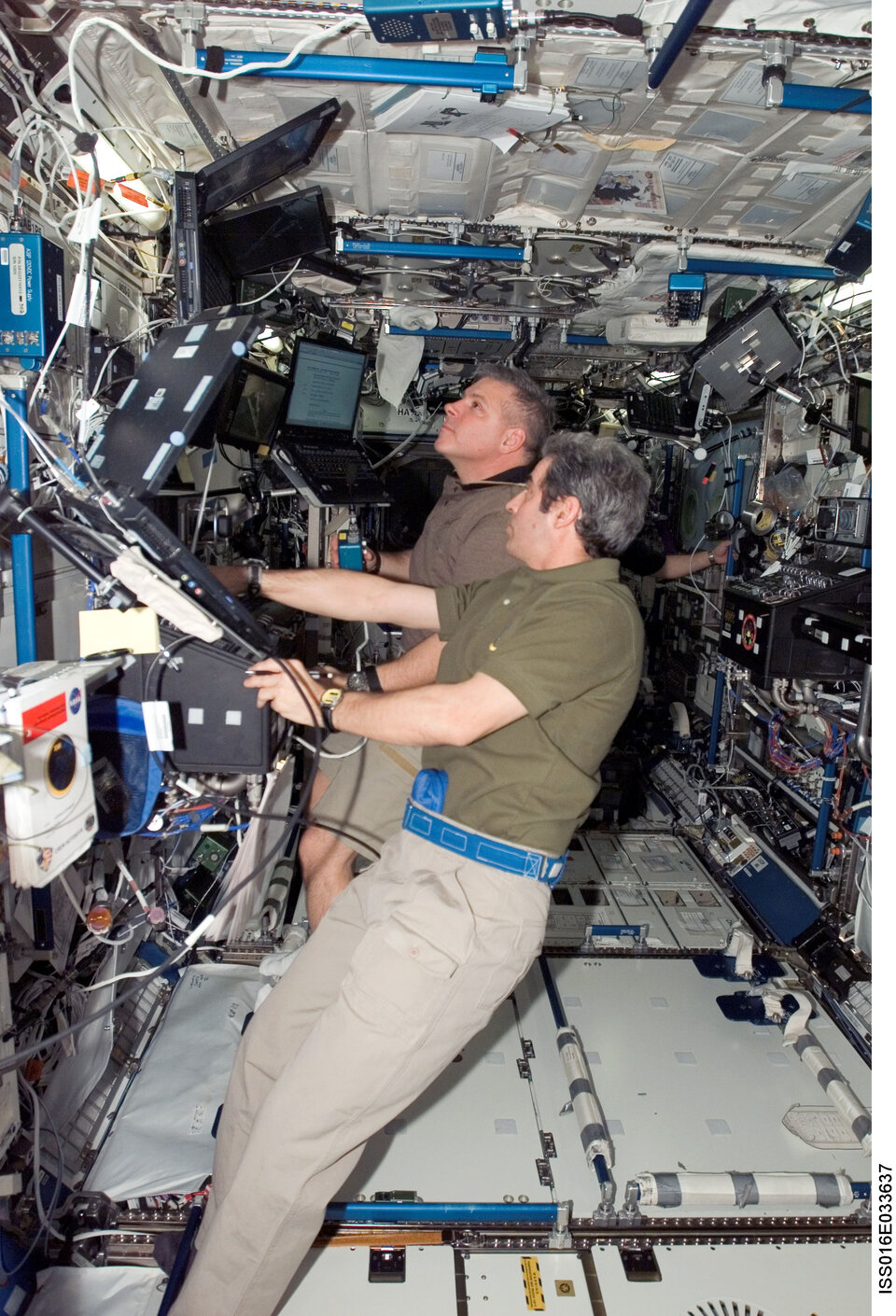
Once Columbus was attached, Hans and Léopold were the principal astronauts involved with activating and commissioning the laboratory. Columbus was first connected to the Space Station's systems for power, data and thermal control. The pressurised laboratory was entered for the first time on 12 February 2008. On-orbit activities involved reconfiguring internal facilities from the launch configuration to their on-orbit configuration.
Commissioning the laboratory was a complex task. Léopold continued commissioning activities together with the Expedition 16 crew after the 13-day STS-122 mission.
Installation of European external payloads on Columbus
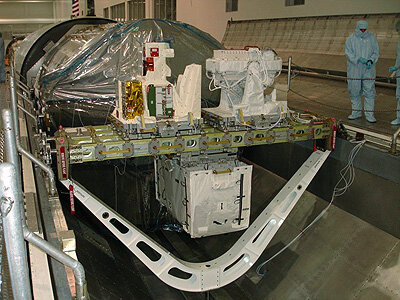
Two European external experiment facilities, EuTEF and SOLAR, were installed on the outside of the Columbus laboratory during the third STS-122 spacewalk. ESA astronaut Léopold Eyharts and NASA astronaut Leland Melvin operated the Station's robotic arm, transporting one of the spacewalkers between the Shuttle cargo bay (where EuTEF and SOLAR were stowed) and the Columbus laboratory's External Payload Facility (where they were installed).
EuTEF housed many different experiments including a variety of exobiology experiments. SOLAR carries out in-depth studies of the Sun.
Exchange Expedition crew member
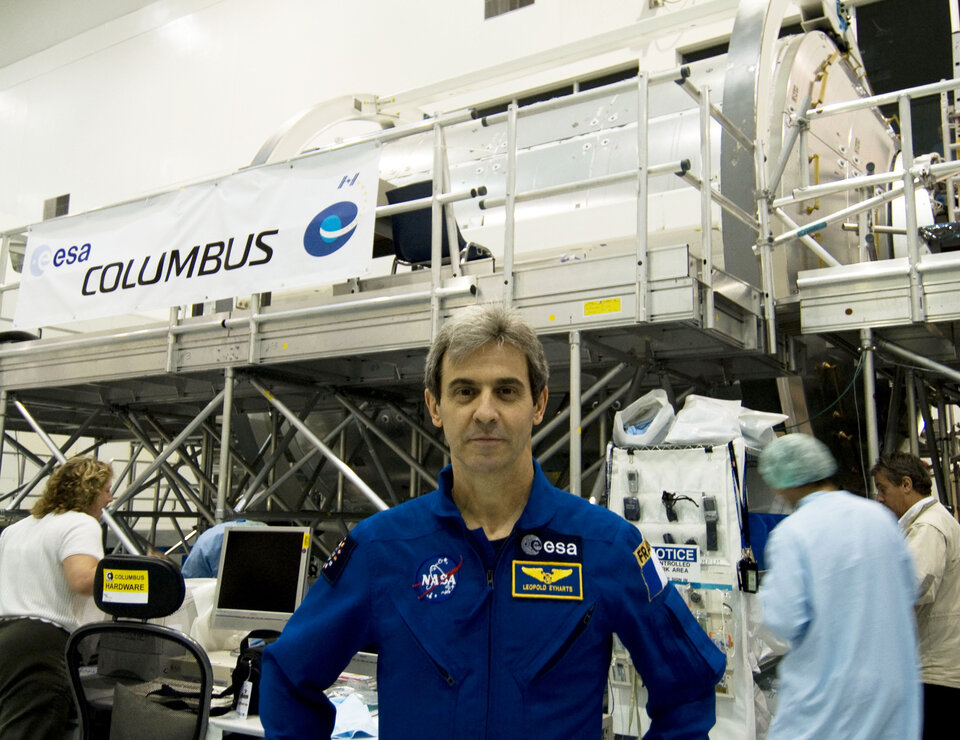
ESA astronaut Léopold Eyharts became the second ESA astronaut to join a long-duration Expedition crew shortly after arriving with the STS-122 flight. He remained on the Space Station for nearly 7 weeks, flying back on the STS-123 flight on 23 March 2008. Eyharts replaced NASA astronaut Daniel Tani as Expedition 16 Flight Engineer 2.
Undertake a European experiment programme
Léopold and Hans undertook a number of experiments for the European scientific community, including runs of the first experiments in the experiment facilities in Columbus. Cosmonaut Yuri Malenchenko carried out additional European experiments. Léopold also carried out a number of educational activities.

The experiments requiring the weightless environment inside the International Space Station are in the areas of human physiology and biology, fluid science and radiation dosimetry. The experiments that need exposure to the open space environment outside the Station cover a number of scientific areas including exobiology, solar science and material science, in addition to various monitoring and sensor technologies.
Return of Control Moment Gyroscope
During the third STS-122 spacewalk a failed Control Moment Gyroscope was placed in the Shuttle's cargo bay to return to Earth. The Control Moment Gyroscopes are used to control the Space Station's orientation.
Replacement of Nitrogen Tank Assembly
During the second STS-122 spacewalk, ESA astronaut Hans Schlegel and NASA astronaut Rex Walheim removed and replaced a Nitrogen Tank Assembly on the P1 truss section.
The tank forms part of the external thermal control system of the International Space Station. The old Nitrogen Tank Assembly was placed in the Shuttle’s cargo bay for return to Earth.
Delivery of supplies and equipment
As well as bringing standard logistics supplies for the Shuttle and Expedition crews, the mission also delivered equipment to the Station, which is needed to fit Columbus inside and outside as well as additional equipment for installation during the spacewalks.
The European Flywheel Exercise Device was also delivered by STS-122. This is a resistance exercise device that counters muscle atrophy, bone loss, and impairment of muscle function in astronauts.