• → European Space Agency

      • Space for Europe
      • Space News
      • Space in Images
      • Space in Videos
    • About Us

      • Welcome to ESA
      • DG's News and Views
      • For Member State Delegations
      • Business with ESA
      • ESA Exhibitions
      • ESA Publications
      • Careers at ESA
    • Our Activities

      • Space News
      • Observing the Earth
      • Human Spaceflight
      • Launchers
      • Navigation
      • Space Science
      • Space Engineering
      • Operations
      • Technology
      • Telecommunications & Integrated Applications
    • For Public

    • For Media

    • For Educators

    • For Kids

    • ESA

    • Delta Mission

    • Human Spaceflight and Exploration

    • Astronauts

    • International Space Station

    • DELTA Mission
    • About the mission
    • Why DELTA?
    • Mission facts
    • Behind the scenes
    • Soyuz spacecraft
    • Soyuz launcher
    • Factsheets (pdf)
    • Science programme
    • Experiment overview
    • Physiology
    • Biology
    • Microbiology
    • Physical science
    • Earth observation
    • Technology
    • Education
    • Meet the crew
    • André Kuipers
    • Gennadi Padalka
    • Mike Fincke
    • Expedition Eight
    • DELTA Mission live
    • Live webstreaming
    • ESA Television
    • Mission briefings
    • Multimedia
    • Image gallery
    • DELTA: Video gallery
    • Soyuz training with Frank De Winne
    • Soyuz mission: to ISS and back
    • Services
    • Mailing list

    ESA > Our Activities > Human Spaceflight > Delta Mission

    André Kuipers' diary

    André Kuipers
    André Kuipers

    My name is André Kuipers and I have been a member of the European Astronaut Corps since 1999. After having worked on a number of other missions, including those of my fellow ESA astronauts Frank De Winne and Pedro Duque, in April it will be my turn. I will fly on my first mission into space.

    The mission is named DELTA. It has a number of goals. First of all, the delivery of a new permanent crew to the International Space Station: my Russian Soyuz commander, Gennadi Padalka, and the American astronaut Mike Fincke. I will return to Earth with the present crew, who by then will have lived on the ISS for six months. In addition, the Soyuz spacecraft, which serves as a lifeboat, will be replaced

    International Space Station 20 August 2001
    The International Space Station (ISS)

    Experiments

    During my eight days on the Space Station I will carry out Dutch and European experiments. For example, I will be testing a vibrating vest that helps to get your sense of direction in space and may help to counter space sickness. I will also study a new generation of light bulbs, which are not yet functioning at their best on Earth.

    Contact with various schools in the Netherlands forms an important part of the mission. Some schools are taking part in the 'Seeds in Space' experiment, in which salad mustard is grown simultaneously on Earth and in space. We will see whether this 'rucola' grows upwards because of the light or in response to gravity.

    In my free time, I will be able to 'phone my girlfriend, my parents or my two daughters, and to email friends. This is all possible from space.
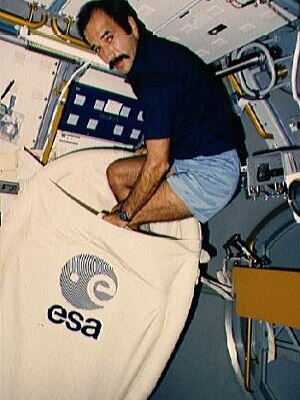

    ESA astronaut Wubbo Ockels getting ready to sleep
    The first Dutch astronaut, Wubbo Ockels, during his space mission in October 1985

    Study

    After Wubbo Ockels, I will be the second Dutch astronaut to go into space. When he was chosen to be an ESA astronaut in 1978, I had just started studying medicine. Since that time, I have been preoccupied with space travel.

    As a doctor, I collaborated in medical experiments looking at the effects of space flight. I studied lung function under weightless conditions and flew several times, in the capacity of doctor, researcher and test subject, on the parabolic flights that ESA carries out twice a year.

    Soyuz training Kuipers
    Learning about the Soyuz rocket during my training at Star City in Russia

    Training

    Training for the DELTA Mission mainly takes place at Star City, near Moscow. There I learn, for example, how the Soyuz rocket works and how to survive under extreme conditions. I also get lessons in Russian every week, because you have to have a good command of the language as a cosmonaut on board a Russian spacecraft.

    Training for my mission is hard work, but pleasurable. There is something special and also mysterious about space travel. It must be a fantastic experience to see the Earth from space. That is why I am looking forward to it so much… In the run-up to my mission, I will report my experiences in this weekly diary.

    I hope you enjoy reading it!
    André Kuipers

    Part 1: Back in the Netherlands for scientific experiments »»

    Rate this

    Views

    Share

    • Currently 0 out of 5 Stars.
    • 1
    • 2
    • 3
    • 4
    • 5
    Rating: 0/5 (0 votes cast)

    Thank you for rating!

    You have already rated this page, you can only rate it once!

    Your rating has been changed, thanks for rating!

    12
    facebook
    twitter
    reddit
    google plus
    digg
    tumbler
    digg
    blogger
    myspace
    • Diary André Kuipers
    • Part 17: Rest, Baikonur and quarantine
    • Part 16: Last lessons, final exams and traditions
    • Part 15: Press visit, TsUP and exams
    • Part 14: Shep's Bar, tips and results of medical
    • Part 13: Online chat, medical exam and farewell to my daughters
    • Part 12: Winter survival training and measuring blood pressure
    • Part 11: Farewell to the Netherlands. The G-force game.
    • Part 10: Training in Houston II
    • Part 9: Training in Houston
    • Part 8: New crew and a memorial service
    • Part 7: Vibration test and parabolic flights
    • Part 6: Testing the spacesuit
    • Part 5: Training in the Soyuz
    • Part 4: The last holiday for a while
    • Part 3: Russian culture and Jules Unlimited
    • Part 2: Medical examination; six crowns
    • Part 1: Back in the Netherlands for scientific experiments
    • Enjoy reading it!

    Connect with us

    • RSS
    • Youtube
    • Twitter
    • Flickr
    • Google Buzz
    • Subscribe
    • App Store
    • LATEST ARTICLES
    • · CryoSat hits land
    • · Ariane 5 completes seven launches …
    • · Measuring skull pressure without t…
    • · Malargüe station inauguration
    • · The solar wind is swirly
    • FAQ

    • Jobs at ESA

    • Site Map

    • Contacts

    • Terms and conditions