DELTA Mission scientific experiments: how did they perform?
After the safe landing of André Kuipers on 30 April 2004, most scientists involved in the research on the DELTA Mission have started their analysis to see how their experiment performed. For a few experiments the scientific data still needs to be brought back to Earth.
According to Marc Heppener, ESA's Mission Scientist, most experiments performed well, but there were a few problems: "It's too early now to expect scientific results, but we have a good overview now of the technical performance of the experiments. Of all European Soyuz missions DELTA had clearly the most ambitious scientific programme yet. The physics experiments, as well as the technological and medical experiments have generally performed very well, but the biological experiments unfortunately suffered some technical problems. The educational experiments were hugely successful".

The experiment with energy saving lamps, ARGES, in which electronics company Philips and Eindhoven Technical University are participating, has yielded very promising results. According to university researcher Kroesen very useful data have been obtained that will help in the development of stable and small-sized plasma lamps, which was the objective of the experiment. "The first results indicate that the flickering of the lamps, one of the main problems, is induced by gravity. We can probably correct this with an improved design".
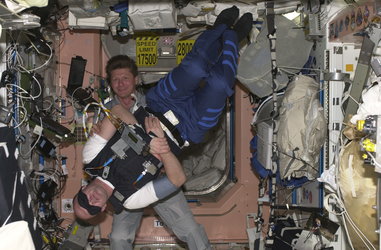
The execution of the SUIT experiment went according to plan, although Kuipers reported that it wasn't always pleasant to perform the experiment. During the execution of the technological experiment HEAT, relevant for the thermal control of satellites, there was a problem with the cooling, so that the experiment was only partially performed. However, the HEAT equipment is still on board the International Space Station and it is now being investigated as to whether the permanent crew can repeat the experiment. The execution of the technological experiment MOT and the Earth observation experiment LSO went according to plan.

The medical experiments - HEART, OLP, MUSCLE and MOP - performed perfectly. For the medical experiment CIRCA some scientific data still need to be brought back to Earth, so there the analysis will take somewhat longer.
Kuipers collected bacterial samples from specified locations throughout the Space Station for the SAMPLE experiment, which investigates how bacteria spread in space. The samples have in the meantime been sent to the researchers at the University of Groningen for analysis.
Problems were experienced with the biological experiments. As a result of technical problems the experiments FLOW (on bone formation) and KAPPA (dealing with the immune system) should be considered lost. The TUBUL (plant cells) and ACTIN (mammalian cells) experiments were also affected, but the scientists are hopeful that they be able will get some results. The experiment with the small worms, ICE-first, was successful.

The exact cause of the problems is currently being investigated. Consideration is being given to asking the current crew of the ISS to examine the equipment that is still on board in order to identify what caused the problems. More information is expected in June.
Without exception the educational experiments were performed very successfully. Although they may not belong to the 'hard sciences', the education experiments were part of the scientific programme. The execution of the student experiments BugNRG and GraPhoBox went perfectly. Likewise the educational experiment VIDEO-3, during which the astronauts recorded a lesson on video, went according to plan. The children's experiment "Seeds in Space" was a huge success, and with more than 100 000 participants it exceeded all expectations and gained national fame.
More information:
Marc Heppener, ESA Mission Scientist
071-565 5117