• → European Space Agency

      • Space for Europe
      • Space News
      • Space in Images
      • Space in Videos
    • About Us

      • Welcome to ESA
      • DG's News and Views
      • For Member State Delegations
      • Business with ESA
      • ESA Exhibitions
      • ESA Publications
      • Careers at ESA
    • Our Activities

      • Space News
      • Observing the Earth
      • Human Spaceflight
      • Launchers
      • Navigation
      • Space Science
      • Space Engineering
      • Operations
      • Technology
      • Telecommunications & Integrated Applications
    • For Public

    • For Media

    • For Educators

    • For Kids

    • ESA

    • Human Spaceflight

    • Astronauts

    • International Space Station

    • Research

    • Education

    • About the International Space Station
    • Pushing the boundaries of science and technology
    • Current status
    • Where is the International Space Station?
    • Building the International Space Station
    • International collaboration
    • International Space Station legal framework
    • Europe's partners
    • European participation
    • Space Station elements
    • Control centres
    • How much does it cost?

    ESA > Our Activities > Human Spaceflight > International Space Station

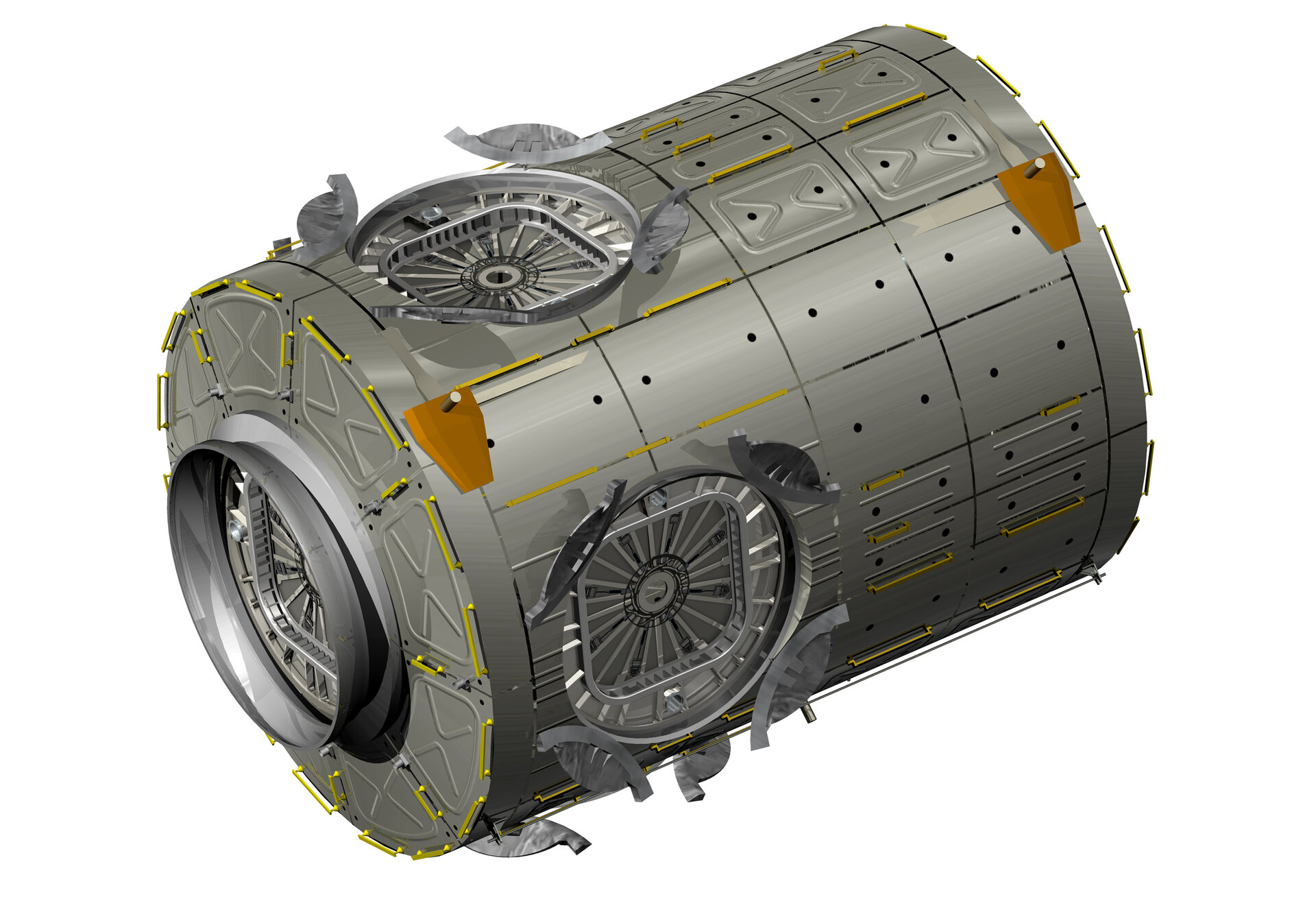
    The Node 2 connecting module
    The Node 2 connecting module

    Node 2: Connecting Module

    Node 2 is a pressurised module which serves as a connecting passage between the European Columbus laboratory, the US laboratory Destiny and the Japanese laboratory Kibo.

    Node 2 also provides a docking port for the discontinued Space Shuttle and the Japanese HII transfer vehicle, while it also served as an attachment point for the Multi-Purpose Logistics Modules. Node 2 is a working base point for the Space Station robotic arm, Canadarm 2.

    Node 2 was developed for NASA under an ESA contract with European industry, with Alcatel-Alenia Space as the prime contractor. Responsibility for Node 2 development was assigned to the Italian space agency, ASI. The structural design is based on that of the Multi-Purpose Logistics Modules and the European Columbus laboratory.

    NASA held a competition amongst schoolchildren in the United States to find a name for the Node 2 module. On 15 March 2007 the new name Harmony was announced.

    Node 2, or Harmony, was launched in October 2007 on Space Shuttle flight STS-120 (ISS Assembly Flight 10A).

    Node 2 specifications
    Dimensions
    Length 6706 mm
    Diameter 4480 mm
    Pressurised volume 70 m3
    Mass budget
    Launch mass 14 500 kg
    On orbit payload mass 15 300 kg

    Last update: 5 February 2013

    Rate this

    Views

    Share

    • Currently 4 out of 5 Stars.
    • 1
    • 2
    • 3
    • 4
    • 5
    Rating: 4/5 (1 votes cast)

    Thank you for rating!

    You have already rated this page, you can only rate it once!

    Your rating has been changed, thanks for rating!

    305
    Tweet
    • Created by Italdesign SpA on a sponsorship agreement with ASI
      Created by Italdesign SpA on a sponsorship agreement with ASI
      Esperia Mission

    Connect with us

    • RSS
    • Youtube
    • Twitter
    • Flickr
    • G+
    • Facebook
    • Livestream
    • Subscribe
    • App Store
    • LATEST ARTICLES
    • · ESA astronaut Timothy Peake set fo…
    • · Space drives e-mobility
    • · Proba-V opens its eyes
    • · First new Galileo satellite arrive…
    • · Next destination: space
    • FAQ

    • Jobs at ESA

    • Site Map

    • Contacts

    • Terms and conditions