• → European Space Agency

      • Space for Europe
      • Space News
      • Space in Images
      • Space in Videos
    • About Us

      • Welcome to ESA
      • DG's News and Views
      • For Member State Delegations
      • Business with ESA
      • ESA Exhibitions
      • ESA Publications
      • Careers at ESA
    • Our Activities

      • Space News
      • Observing the Earth
      • Human Spaceflight
      • Launchers
      • Navigation
      • Space Science
      • Space Engineering
      • Operations
      • Technology
      • Telecommunications & Integrated Applications
    • For Public

    • For Media

    • For Educators

    • For Kids

    • ESA

    • Lunar Lander

    • Human Spaceflight and Exploration

    • About Lunar Lander
    • Europe’s first Lunar Lander
    • Next-generation landing technology
    • Science on the Moon
    • Lunar Lander flight phases
    • Exploring the lunar South Pole
    • Lander configuration
    • Lunar Lander on the surface
    • Multimedia
    • Lunar Lander gallery

    ESA > Our Activities > Human Spaceflight > Lunar Lander

    Europe’s first Lunar Lander

    Lunar Lander

    After more than 30 years, the Moon is once again in the spotlight of space agencies worldwide, as a destination for both robotic missions and human explorers. Europe’s ambitions for lunar exploration begin with a lander on the Moon in 2018.

    Lunar Lander is a robotic explorer that will demonstrate key European technologies and conduct science experiments. The mission is a forerunner to future human and robotic exploration of the Moon and Mars. It will establish European expertise to allow strong international partnerships in exploration.

    Lunar Lander’s primary goal is to demonstrate the advanced technologies needed to land precisely and safely. The spacecraft will find its landing site without human intervention, recognising and avoiding hazards such as craters and boulders autonomously.
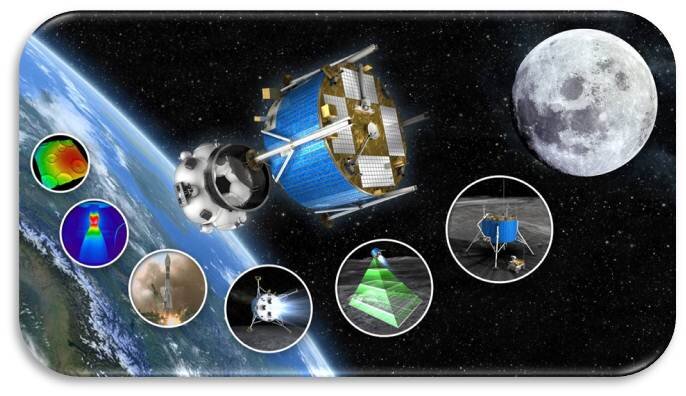
    Lunar Lander flight phases

    On the Moon, it will prove European technologies for surviving and working while exploring the environment around the landing site.

    Before operating more ambitious equipment and conducting human activities on the Moon, many questions need to be answered. How hazardous is lunar dust to equipment and astronauts? Does the Moon offer resources that could be used by future missions?

    Lunar Lander will touch down near to the Moon’s south pole, an interesting location for future exploration missions, where no craft has landed before. The technologies developed to reach this site, together with a deeper understanding of this challenging environment, will equip Europe’s scientists and engineers for future cooperation on even more ambitious exploration missions.

    Last update: 9 July 2012

    Rate this

    Views

    Share

    • Currently 5 out of 5 Stars.
    • 1
    • 2
    • 3
    • 4
    • 5
    Rating: 5/5 (1 votes cast)

    Thank you for rating!

    You have already rated this page, you can only rate it once!

    Your rating has been changed, thanks for rating!

    82
    facebook
    twitter
    reddit
    google plus
    digg
    tumbler
    digg
    blogger
    myspace
    • Related News
      • Lunar lander firing up for touchdown
      • Related Links
      • NASA moon landings
      • NASA Lunar Reconnaissance Orbiter
      • JAXA Kaguya
      • Automated Transfer Vehicle

    Connect with us

    • RSS
    • Youtube
    • Twitter
    • Flickr
    • Google Buzz
    • Subscribe
    • App Store
    • LATEST ARTICLES
    • · CryoSat hits land
    • · Ariane 5 completes seven launches …
    • · Measuring skull pressure without t…
    • · Malargüe station inauguration
    • · The solar wind is swirly
    • FAQ

    • Jobs at ESA

    • Site Map

    • Contacts

    • Terms and conditions