• → European Space Agency

      • Space for Europe
      • Space News
      • Space in Images
      • Space in Videos
    • About Us

      • Welcome to ESA
      • DG's News and Views
      • For Member State Delegations
      • Business with ESA
      • ESA Exhibitions
      • ESA Publications
      • Careers at ESA
    • Our Activities

      • Space News
      • Observing the Earth
      • Human Spaceflight
      • Launchers
      • Navigation
      • Space Science
      • Space Engineering
      • Operations
      • Technology
      • Telecommunications & Integrated Applications
    • For Public

    • For Media

    • For Educators

    • For Kids

    • ESA

    • Lunar Lander

    • Human Spaceflight and Exploration

    • About Lunar Lander
    • Europe’s first Lunar Lander
    • Next-generation landing technology
    • Science on the Moon
    • Lunar Lander flight phases
    • Exploring the lunar South Pole
    • Lander configuration
    • Lunar Lander on the surface
    • Multimedia
    • Lunar Lander gallery

    ESA > Our Activities > Human Spaceflight > Lunar Lander

    Lander configuration

    Lunar Lander engine
    Thruster

    Lunar Lander has a mass of around 2500 kg on its launcher. The whole spacecraft lands on the Moon – there is no propulsion stage that is discarded in lunar orbit. The voyage and landing will reduce its mass to 800 kg on the Moon.

    The drum-shaped vehicle, with four legs, is built around four large propellant tanks. Power is generated from solar panels on the cylindrical body, feeding batteries for periods when the Sun is not available.

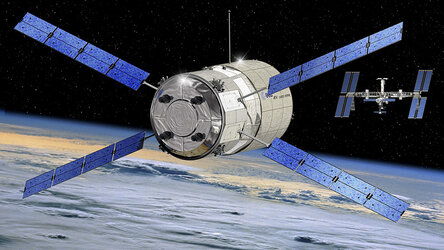
    Five braking engines clustered under the main body can deliver 500 N of thrust each. Six smaller thrusters, modified from ESA’s Automated Transfer Vehicle, provide 220 N each. These fire in short bursts to steer Lunar Lander to a safe touchdown, as well as contributing to braking it out of orbit. Sixteen 22 N thrusters provide attitude control.

    Lunar Lander fuel tanks and engines
    Fuel tanks and thrusters

    Critical hardware sensitive to low temperatures – such as batteries and electronics – is cocooned in the craft’s centre. There, it will be protected from the cold on the Moon when the Sun disappears below the horizon and the surface temperature drops to –170°C.

    The lander has several ’eyes’ such as its landing camera and lidar mounted on the bottom platform. The top platform holds the external equipment such as the scientific instruments, the panoramic camera and a deployable antenna to communicate with Earth.


    Lunar Lander
    Lunar Lander configuration

    Rate this

    Views

    Share

    • Currently 0 out of 5 Stars.
    • 1
    • 2
    • 3
    • 4
    • 5
    Rating: 0/5 (0 votes cast)

    Thank you for rating!

    You have already rated this page, you can only rate it once!

    Your rating has been changed, thanks for rating!

    38
    facebook
    twitter
    reddit
    google plus
    digg
    tumbler
    digg
    blogger
    myspace
    • Related News
      • Lunar lander firing up for touchdown
        • Laser radar illuminates the way to deep space
        • Related Links
        • Automated Transfer Vehicle

    Connect with us

    • RSS
    • Youtube
    • Twitter
    • Flickr
    • Google Buzz
    • Subscribe
    • App Store
    • LATEST ARTICLES
    • · CryoSat hits land
    • · Ariane 5 completes seven launches …
    • · Measuring skull pressure without t…
    • · Malargüe station inauguration
    • · The solar wind is swirly
    • FAQ

    • Jobs at ESA

    • Site Map

    • Contacts

    • Terms and conditions