Next-generation landing technology
This page has been archived. See our Argonaut page for more information on Europe's lunar lander programme.
Landing a robotic spacecraft on the Moon is not easy. The Americans and the Soviets did it in the 1960s and 1970s, but there are many different ways of landing and exploration today poses a very different challenge from those faced by the Apollo or Luna missions.
Future exploration require major technological advances in the landing spacecraft:
- Accuracy: landers will need to target well-illuminated landing sites and areas of special scientific interest as well as rendezvous with other spacecraft.
- Safety: landers will have to land softly on potentially hazardous terrain so as not to damage sensitive equipment
- Payload capability: landing more cargo will be necessary to increase mission returns and to start building things on the target site.
- Autonomy: landers will need to operate independently of humans, taking decisions in real time.
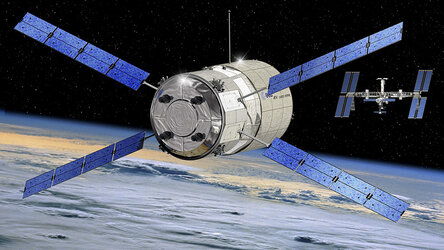
In addition to new techniques, the mission uses proven European technologies from previous missions as much as possible. For example, it includes engines modified from the Automated Transfer Vehicle.
Finding its bearings
ESA has been developing Lunar Lander’s guidance, navigation and control for several years.
In the same way that computer-driven cars may soon become a reality on Earth, a European Lunar Lander may soon land on the Moon with high precision and no human intervention.
The spacecraft needs to know its position very accurately from the moment its mission starts. Whereas previous missions were satisfied with a landing accuracy of kilometres, Lunar Lander will have an accuracy of a few hundred metres.
As there is no satellite navigation on the Moon and relying on Earth-based or inertial navigation is not enough, these traditional techniques will be complemented with an image-based solution.
An optical navigation system processes images of the lunar surface using a powerful computer on the spacecraft. The system identifies landmarks such as craters during descent and matches them with a set of landmarks stored in a database on the spacecraft. This will significantly improve the lander’s ability to locate its position. The database is created from data from missions such as NASA’s Lunar Reconnaissance Orbiter and Japan’s Kaguya.
The navigation system will also use the motion of the terrain observed by the camera to improve its estimate of the lander’s velocity.
Making sure these systems work correctly is difficult because it requires near-perfect images of the Moon’s surface that the lander will see during its real flight. Of course, many simulations and tests are planned.
Avoiding hazards
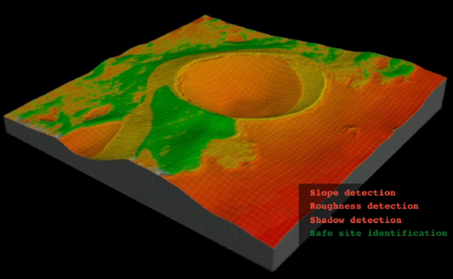
Two minutes before touchdown, the landing site will come into Lunar Lander’s field of view and the computer’s detailed analysis begins.
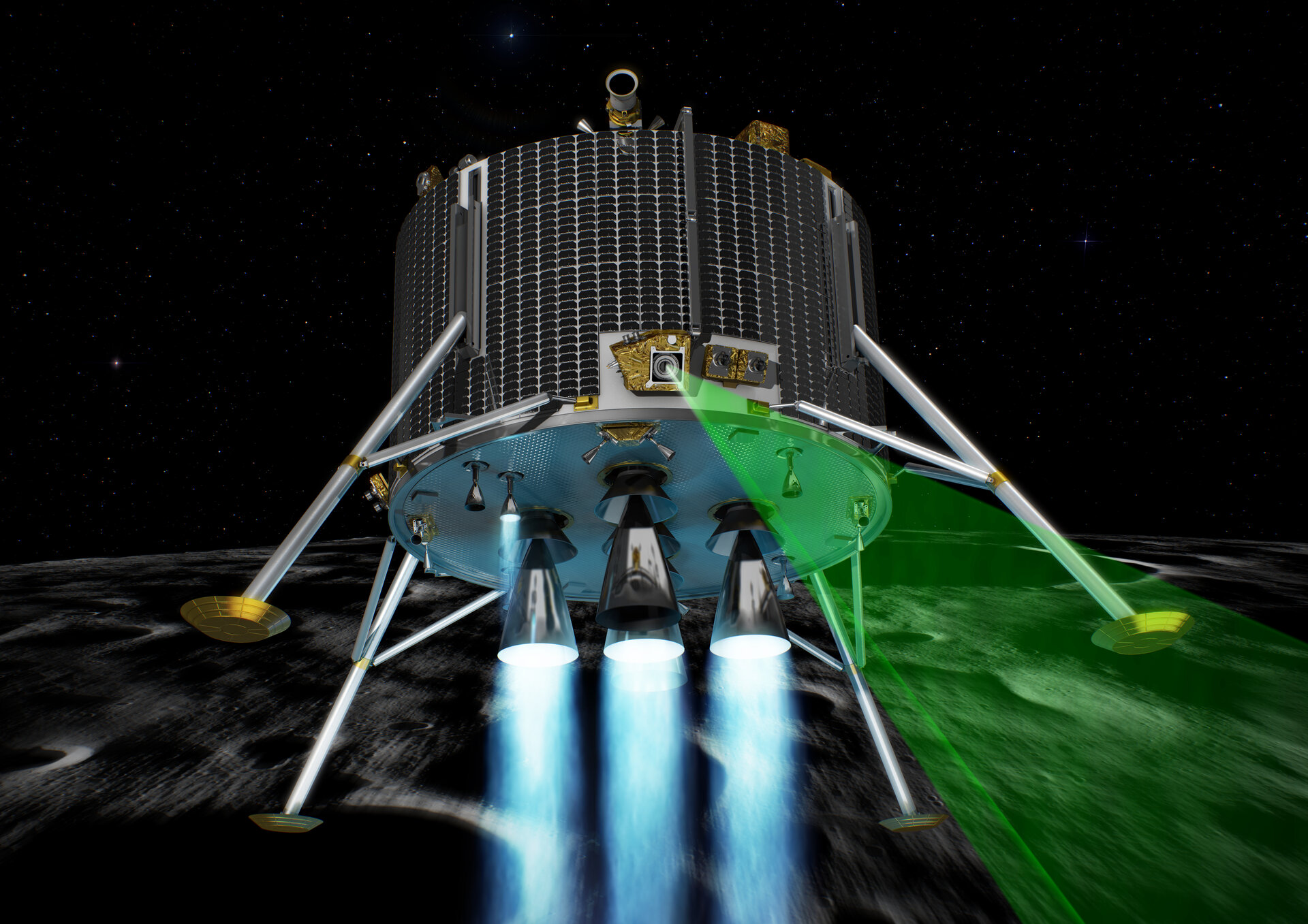
At this stage, the navigation camera will be supported by a scanning lidar sensor, which uses laser pulses to reconstruct landing site topography.
Whereas the camera needs light to capture images of the Moon, the lidar is impervious to the harsh lighting conditions in the South Pole region.
Many questions need to be answered by Lunar Lander’s computer. Is the designated landing site sunlit or in the shade? Are there large boulders, craters or slopes that could threaten a safe touchdown? Is enough fuel left to change course and reach a safer site?
Based on information from the camera and lidar, Lunar Lander will assess the situation and take action to ensure a safe landing.
Manoeuvring
The spacecraft’s intelligent systems will make decisions and command the engines to control its trajectory. Twenty-seven thrusters, adapted from other European missions, will work together to ensure that Lunar Lander brakes from its orbital velocity of 6000 km/h down to a few km/h while staying on course to its landing site.
Lunar Lander will be making all these decisions on its own, more than 350 000 km from Earth. Once the landing sequence is triggered, mission control can only sit back and watch, relying on Lunar Lander’s technology and its powerful computer to come to rest on the stark surface.