• → European Space Agency

      • Space for Europe
      • Space News
      • Space in Images
      • Space in Videos
    • About Us

      • Welcome to ESA
      • DG's News and Views
      • For Member State Delegations
      • Business with ESA
      • ESA Exhibitions
      • ESA Publications
      • Careers at ESA
    • Our Activities

      • Space News
      • Observing the Earth
      • Human Spaceflight
      • Launchers
      • Navigation
      • Space Science
      • Space Engineering
      • Operations
      • Technology
      • Telecommunications & Integrated Applications
    • For Public

    • For Media

    • For Educators

    • For Kids

    • ESA

    • Human Spaceflight and Exploration

    • Node-3 & Cupola

    • Columbus

    • International Space Station

    • Astronauts

    • General info
    • Node-3, the most modern module of the ISS
    • Cupola, ISS Observation Module
    • Node-3 systems and internal racks
    • STS-130 flight timeline
    • Technical info
    • Node-3
    • Cupola
    • Water Recovery System Racks
    • Oxygen Generation System Rack
    • Air Revitalization System
    • Waste and Hygiene Compartment
    • T2 Colbert Treadmill
    • advanced Resistive Exercise Device
    • Europe and ISS
    • ISS and Europe’s Major Contributions
    • Taking the ISS to the next level: ISS exploitation and ELIPS
    • Downloads
    • Information Kit (pdf)
    • STS-130 Daily Activities (pdf)
    • Multimedia
    • Image gallery
    • Video gallery
    • Services

    ESA > Our Activities > Human Spaceflight > Node-3 & Cupola

    Oxygen Generation System Rack

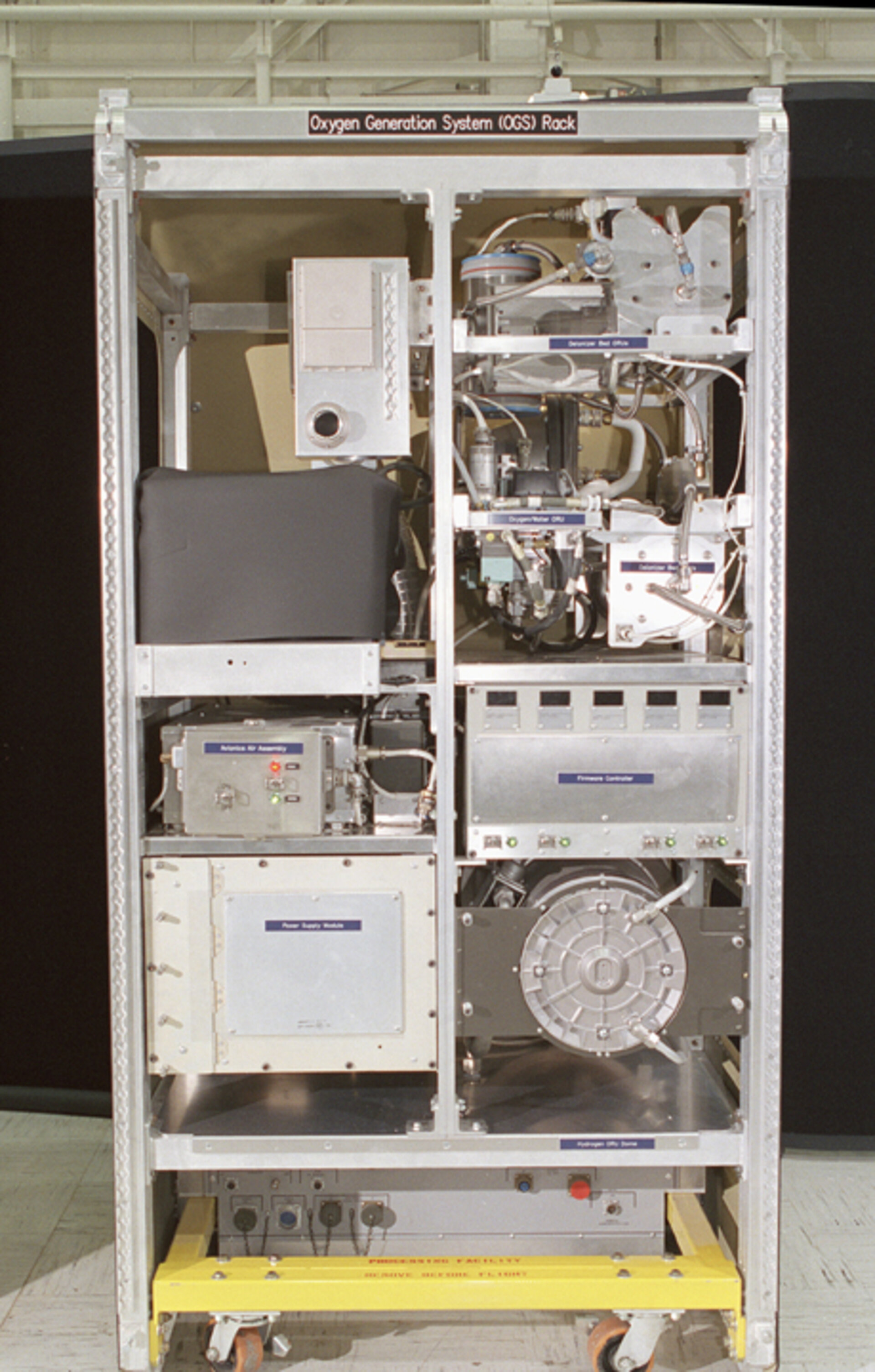
    Mockup of the Oxygen Generation System Rack

    The Oxygen Generation System produces oxygen for breathing by the crew and laboratory animals, as well as for replacement of oxygen lost due to experiment use, airlock depressurisation, module leakage and carbon dioxide venting. The system consists mainly of the Oxygen Generation Assembly and a Power Supply Module.

    The Oxygen Generation Assembly electrolyses water provided by the Water Recovery System, yielding oxygen and hydrogen. The oxygen is delivered to the cabin atmosphere, and the hydrogen is vented overboard. The Power Supply Module provides the power needed to electrolyse the water.

    The Oxygen Generation System is designed to generate oxygen at a selectable rate and is capable of operating both continuously and cyclically. It provides up to 9 kg of oxygen per day during continuous operation and a normal rate of about 5.5 kg of oxygen per day during cyclic operation.
    Last update: 29 January 2010

    Rate this

    Views

    Share

    • Currently 0 out of 5 Stars.
    • 1
    • 2
    • 3
    • 4
    • 5
    Rating: 0/5 (0 votes cast)

    Thank you for rating!

    You have already rated this page, you can only rate it once!

    Your rating has been changed, thanks for rating!

    13
    facebook
    twitter
    reddit
    google plus
    digg
    tumbler
    digg
    blogger
    myspace
    • Node-3 & Cupola
    • Node-3 and Cupola interviews
      • A room with a view for the International Space Station: Completion of the Cupola observation module
      • Also visit
      • Thales Alenia Space
      • Building the ISS
      • Where is ISS now?

    Connect with us

    • RSS
    • Youtube
    • Twitter
    • Flickr
    • Google Buzz
    • Subscribe
    • App Store
    • LATEST ARTICLES
    • · CryoSat hits land
    • · Ariane 5 completes seven launches …
    • · Measuring skull pressure without t…
    • · Malargüe station inauguration
    • · The solar wind is swirly
    • FAQ

    • Jobs at ESA

    • Site Map

    • Contacts

    • Terms and conditions