• → European Space Agency

      • Space for Europe
      • Space News
      • Space in Images
      • Space in Videos
    • About Us

      • Welcome to ESA
      • DG's News and Views
      • For Member State Delegations
      • Business with ESA
      • ESA Exhibitions
      • ESA Publications
      • Careers at ESA
    • Our Activities

      • Space News
      • Observing the Earth
      • Human Spaceflight
      • Launchers
      • Navigation
      • Space Science
      • Space Engineering
      • Operations
      • Technology
      • Telecommunications & Integrated Applications
    • For Public

    • For Media

    • For Educators

    • For Kids

    • ESA

    • PromISSe

    • Delta Mission

    • Human Spaceflight and Exploration

    • About PromISSe
    • The PromISSe mission
    • PromISSe mission key data
    • André's tasks in space
    • André's spaceflight experience
    • André in training
    • Science aboard
    • Traffic at the Station
    • Facts about the Soyuz
    • About the PromISSe mission name and logo
    • Support from the ground
    • Way back to Earth
    • Educational projects
    • Spaceship Earth
    • Mission-X: Train Like an Astronaut
    • PromISSe educational experiments
    • Meet the crew
    • André Kuipers
    • Oleg Kononenko
    • Don Pettit
    • Behind the scenes
    • Expedition 30
    • Expedition 31
    • Crew schedule
    • Downloads
    • PromISSe Information Kit, English (pdf, low)
    • PromISSe Information Kit, English (pdf, high-resolution)
    • PromISSe Information Kit, Dutch (pdf, low)
    • PromISSe Information Kit, Dutch (pdf, high-resolution)
    • Multimedia
    • ESA Multimedia gallery
    • ESA Video archive
    • PromISSe at ESA's Webstreaming network
    •  ESA on YouTube

    ESA > Our Activities > Human Spaceflight > PromISSe

    Way back to Earth

    After living and working on the ISS for 193 days, spanning both Expeditions 30 and 31, André returned to the Soyuz capsule with his crewmates. The spacecraft undocked from the Station on 1 July 2012. The closure of the Soyuz hatch signaled the end of the PromISSe mission, and the astronauts landed back on Earth only a few hours later.

    Reentry and landing on the steppes of Kazakhstan is a relatively quick procedure, taking no longer than three and a half hours. Shortly after undocking, the Soyuz spacecraft separates into its three parts. The orbital and service modules burn up on reentry in the denser layers of Earth’s atmosphere.

    The descent module rotates and places the strongest parts of the heatshield towards the reentry direction, so that it can absorb most of the heat. Reentry occurs at an altitude of approximately 120 kilometres, when the speed is reduced dramatically and the crew is pushed back into their seats by a force of 4–5 g. This is equivalent to four to five times their own body weight.
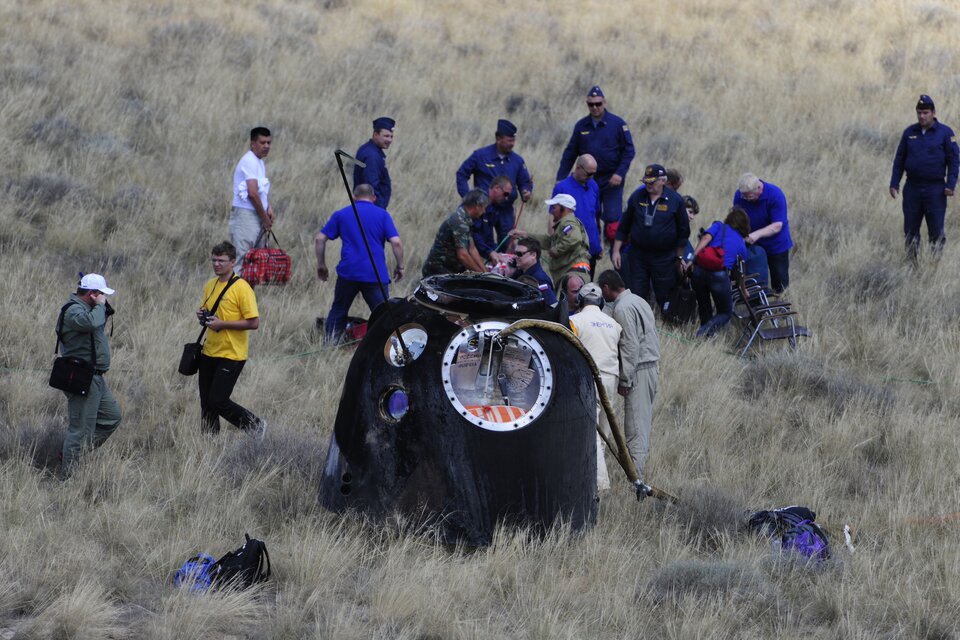
    ESA astronaut André Kuipers
    Soyuz landing

    The parachutes and the Soyuz’s shock-absorbing seats soften the landing, together with retro-rockets firing just before touchdown. The descent module usually touches down at a speed of less than 2 metres per second, or around 5 km per hour.

    After landing, the crew deploy a communication antenna, so that the rescue teams can pinpoint their precise location. The Soyuz capsule is not reusable.

    Once retrieved from their landing site, André was taken directly back to Houston from Baikonur, for rehabilitation and post-flight body data collection.


    Undocking and landing timeline

    Soyuz leaving the Station

    00:00 min – Separation command
    Separation command to begin opening hooks and latches, which hold the Soyuz spacecraft on a docking port on the Space Station

    +00:03 min – Separation from ISS
    Hooks opened. Soyuz begins physical separation from the docking compartment at 0.1 m/s.

    +00:06 min – Separation burn from ISS
    A 15-second separation burn when the Soyuz is about 20 m from the Station

    +02:29 min – Deorbit burn
    When the Soyuz is at a distance of about 19 km from the ISS, the engines fire for almost five minutes

    +02:57 min – Separation of modules
    The unoccupied Orbital Module separates from the Descent Module and burns up on reentry into the atmosphere

    +03:00 min – Entry Interface
    The Soyuz reaches Entry Interface at 122 km altitude

    +03:08 min – Opening parachutes
    Parachutes are commanded to deploy:
    1. Two pilot parachutes.
    2. Drogue chute. It slows the spacecraft’s descent from a rate of 230 m/s to 80 m/s.
    3. Main parachute. It slows the Soyuz to a descent rate of 7.2 m/s. The Soyuz descends at an angle of 30 degrees to cool, then the main parachute shifts it to a straight vertical descent.

    +03:22 min – Soft landing engine firing
    Six soft-landing engines fire to slow the vehicle’s descent rate to 1.5 m/s just 1 m above the ground

    +03:23 min – Touchdown
    Soyuz lands on Earth

    Last update: 27 July 2012

    Rate this

    Views

    Share

    • Currently 0 out of 5 Stars.
    • 1
    • 2
    • 3
    • 4
    • 5
    Rating: 0/5 (0 votes cast)

    Thank you for rating!

    You have already rated this page, you can only rate it once!

    Your rating has been changed, thanks for rating!

    14
    facebook
    twitter
    reddit
    google plus
    digg
    tumbler
    digg
    blogger
    myspace
    • Follow André!
    • Follow André's mission
    • PromISSe mission logo text part only
      PromISSe mission logo text part only
    • André's blog
    • PromISSe blog
    • Related links
    • ISS Expedition 30 (NASA)
    • ISS Expedition 31 (NASA)
    • Future ISS Expeditions (NASA)
    • Roscosmos (Russia)
    • Astronauts of the European Space Agency (ESA)
      Astronauts of the European Space Agency (ESA)
      Europe's astronauts
    • Columbus
    • Follow @astro_andre
    • André on Flickr
    •  ESA on YouTube
    • ESA on Flickr
    • ESA on Twitter

    Connect with us

    • RSS
    • Youtube
    • Twitter
    • Flickr
    • Google Buzz
    • Subscribe
    • App Store
    • LATEST ARTICLES
    • · CryoSat hits land
    • · Ariane 5 completes seven launches …
    • · Measuring skull pressure without t…
    • · Malargüe station inauguration
    • · The solar wind is swirly
    • FAQ

    • Jobs at ESA

    • Site Map

    • Contacts

    • Terms and conditions