ESA microgravity research takes flight
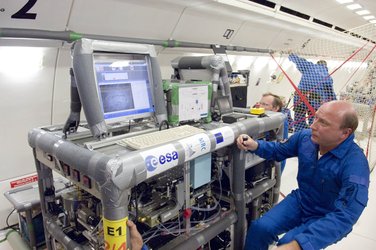
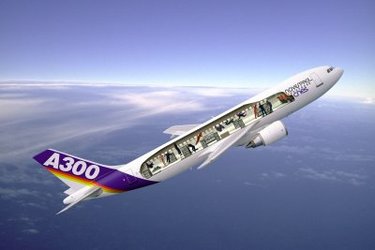
Only one month after the successful completion of ESA's 46th parabolic flight campaign, the next in the series is about to take place. Once again, a suite of 13 microgravity experiments has been selected to fly on board a modified Airbus A-300 aircraft that provides frequent, repeated periods of weightlessness.
On this occasion, the payload on board the Airbus will include nine physical sciences experiments, three life sciences experiments and one technology test. The experiments are currently being loaded onto the aircraft in Bordeaux, France, for the flight campaign to be held 18 – 20 December.
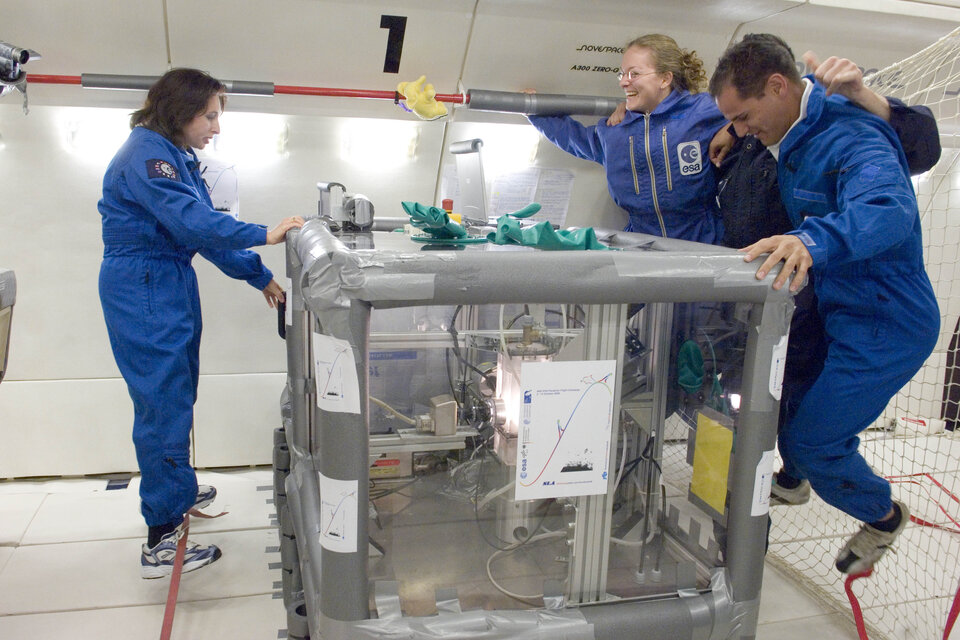
One of the most significant areas under investigation is heat-mass transfer. Improving our understanding of the process of transferring or removing heat in microgravity conditions is considered to be so important that the 48th ESA parabolic flight campaign scheduled for next year will be devoted entirely to this area of research.
"Different experiments are looking at different methods, including liquid films, liquid and gas flow to study convective boiling," said Vladimir Pletser, Project Manager of the ESA Parabolic Campaigns. "Such research is important because we need to understand and improve heat removal from integrated circuit boards or other spacecraft systems."
Many of the investigations that are conducted on parabolic flights are related to industrial processes, and this campaign is no exception. One example is an Italian-German experiment to study liquid sprays, in which finely dispersed droplets are used to coat solid surfaces. This will involve use of a specially developed microgravity drop generator to collect information about the low velocity impact of individual drops of liquid onto solid surfaces.
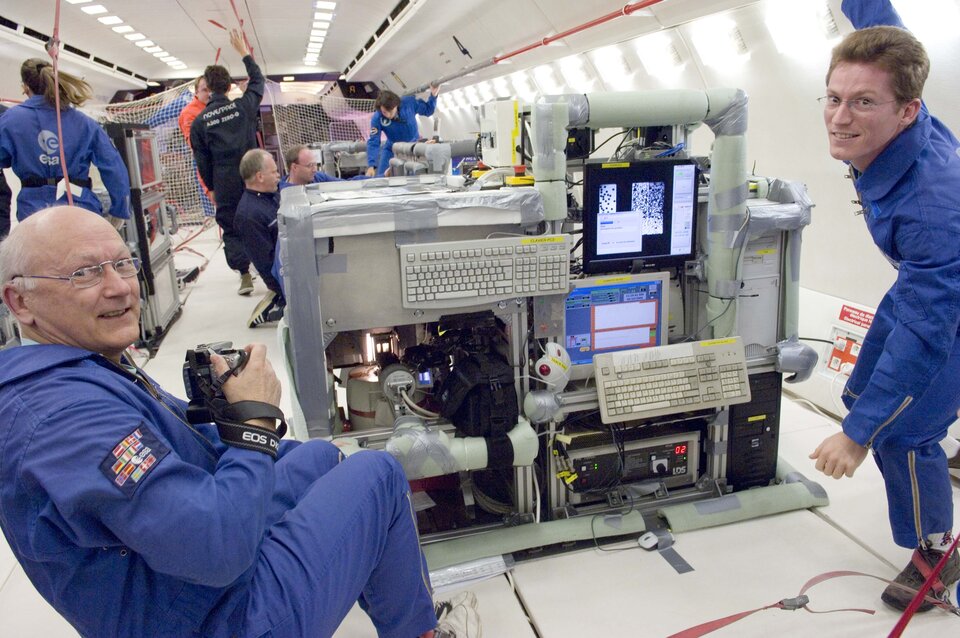
Among the experiments that have flown on previous parabolic flights is a European – Chinese collaboration to learn how to 'manage' grains in space by using vibrations to move them into place.
By subjecting small, marble-like spheres inside cells to vibrations at different frequencies, the experiment will study how they collide and rearrange themselves. A similar experiment is expected to fly on a Chinese satellite next year.
The life science experiments include a long-term Belgian investigation into the influence of varying degrees of gravity on human hand – eye co-ordination.
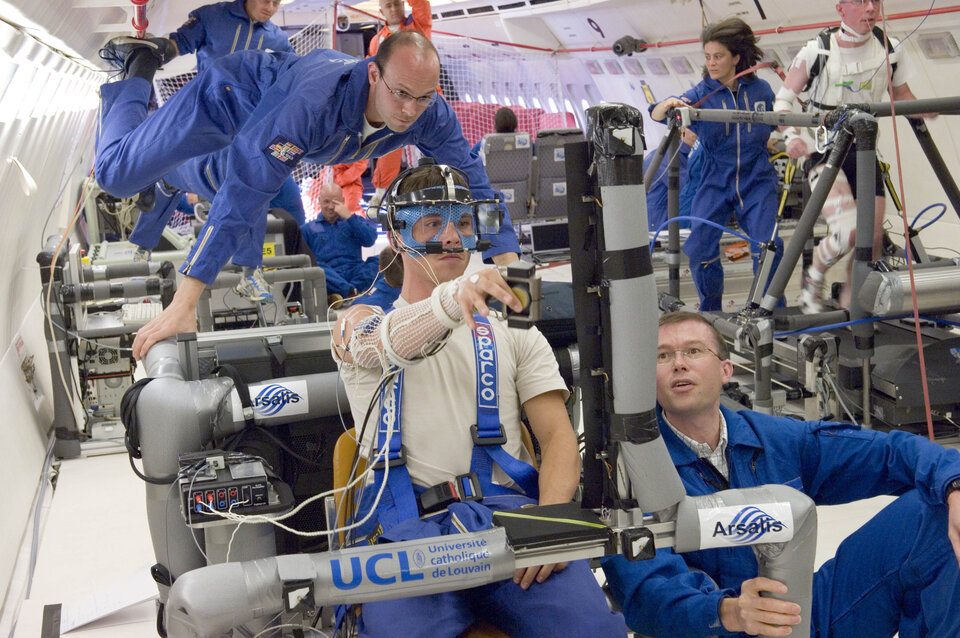
The experiment involves a comparison between a test subject who has never experienced microgravity and another who is familiar with the unusual environment.
Each subject will be asked to align an object gripped between the thumb and forefinger with a visual target that is switched on and off at random. Eye movements and muscle activity are monitored during the experiment.
Also on board the Airbus is a German study on the impact of altered gravity on the leg movements of four crickets, in order to find out how the insects adapt while walking on a large wheel.
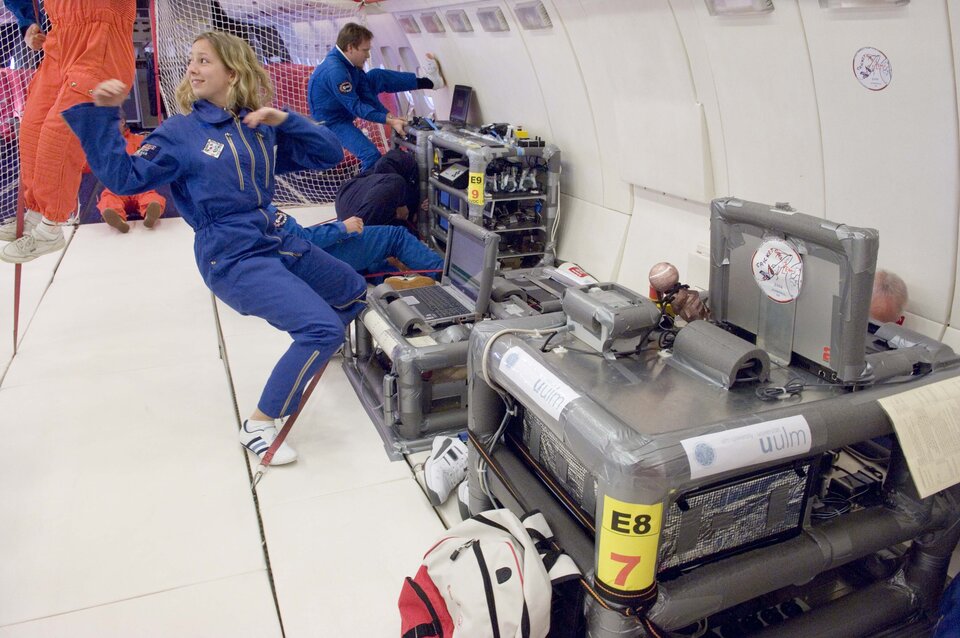
One of the most unusual investigations is a futuristic experiment to investigate the power of thought. The study involves a person wearing a cap fitted with electrodes that measure electrical activity in the brain during brain-controlled operations.
For this purpose an experimental subject is asked to perform a simple task on a computer screen using a brain-computer interface while his brain activity is recorded and analysed.
Preparations for the flight campaign began on 10 December. After completion of the final ground preparations, the experiments will be installed in the aircraft, with final safety checks on 17 December.
Over the next three days, the Airbus is scheduled to take off from Bordeaux-Mérignac airport and head out over the Bay of Biscay – weather permitting. Once the first 'warm up' ascent and descent is completed, the experimental schedule will begin.

Over the next three hours, the aircraft and its occupants will experience 30 parabolas. Each parabola lasts about one minute, of which the microgravity phase lasts some 20 seconds. Before and after this brief experience of weightlessness, the experimenters will experience up to 2 g (twice normal gravity) during the steep climb and around 1.8 g during the descent.
French company Novespace owns and operates the A300 Zero-G aircraft, and is in charge of the preparation of the flight campaigns. ESA sponsors the flight opportunity.
ESA has a permanent offer of opportunity open for researchers wanting to take advantage of the agency's parabolic flight campaigns. Applications may be put forward at any time. The proposals undergo a peer review by experts from outside ESA and are selected on scientific merit.
The next ESA Parabolic Flight Campaign is scheduled to take place in March 2008.