• → European Space Agency

      • Space for Europe
      • Space News
      • Space in Images
      • Space in Videos
    • About Us

      • Welcome to ESA
      • DG's news and views
      • For Member State Delegations
      • Business with ESA
      • Law at ESA
      • ESA Exhibitions
      • ESA Publications
      • Careers at ESA
    • Our Activities

      • Space News
      • Observing the Earth
      • Human Spaceflight
      • Space Transportation
      • Navigation
      • Space Science
      • Space Engineering & Technology
      • Operations
      • Telecommunications & Integrated Applications
      • Preparing for the Future
    • Careers at ESA

    • For Media

      • Media
      • ESA TV
      • Videos for professionals
      • Photos
    • For Educators

    • For Kids

    • ESA

    • Human Spaceflight

    • Astronauts

    • International Space Station

    • Research

    • Education

    • About research in space
    • Research areas
    • Human health
    • Aging
    • Plants
    • Life support
    • Exobiology
    • Physics and materials
    • Radiation
    • Technology
    • Platforms and facilities
    • International Space Station
    • Sounding rockets
    • Parabolic flights
    • Drop towers
    • Bedrest and ground studies
    • Hypergravity
    • Research activities
    • Research Announcements
    • Experiment archive
    • Multimedia
    • Images
    • Videos
    • Web Streaming Network
    • Printed products
    • Brochures
    • European user guide to low gravity platforms
    • Space for life newsletter

    ESA > Our Activities > Human Spaceflight > Research

    International Space Station

    International Space Station

    The first module of the International Space Station was launched in 1998 and Expedition 1 arrived at the orbital outpost in 2000. Since then, humanity’s only permanent microgravity laboratory has been available to scientists from all over the world.

    Unity, Zarya and Zvezda

    The Station has grown and now offers three dedicated laboratory modules. Alongside the European Columbus laboratory, the US Destiny laboratory module and Japan’s Kibo laboratory hold hardware to accommodate research in a multitude of fields.

    Research on the Space Station focuses on achieving scientific discoveries, developing applications and benefitting people on Earth while preparing for future space exploration.

    From metal furnaces to space gardens and –80°C freezers, the Station has it all. These facilities are available to scientists across a wide range of disciplines to conduct research that cannot possibly be done on Earth.

    On the outside, the Columbus laboratory has four mounting points for experiments. Exposed to the vacuum of space and with an unhindered view of Earth, science packages can investigate anything from the ability of bacteria to survive on an artificial meteorite to volcanic activity on our planet from above.

    Far-out research

    Night work on Station

    Weightlessness offers the perfect environment to study fluids, freed from the constraints of gravity. Scientists can simulate Earth in Columbus to study the flow of molten rock that is moving beneath our feet.

    Studying colloids – tiny particles in liquids – is one area of research hampered by gravity. Colloids are found in many liquids such as milk, paint and even in our bodies, yet they are so small you need an electron microscope to study them. At this scale, gravity will always influence the results, but in space experiments can be run repeatedly without interference.
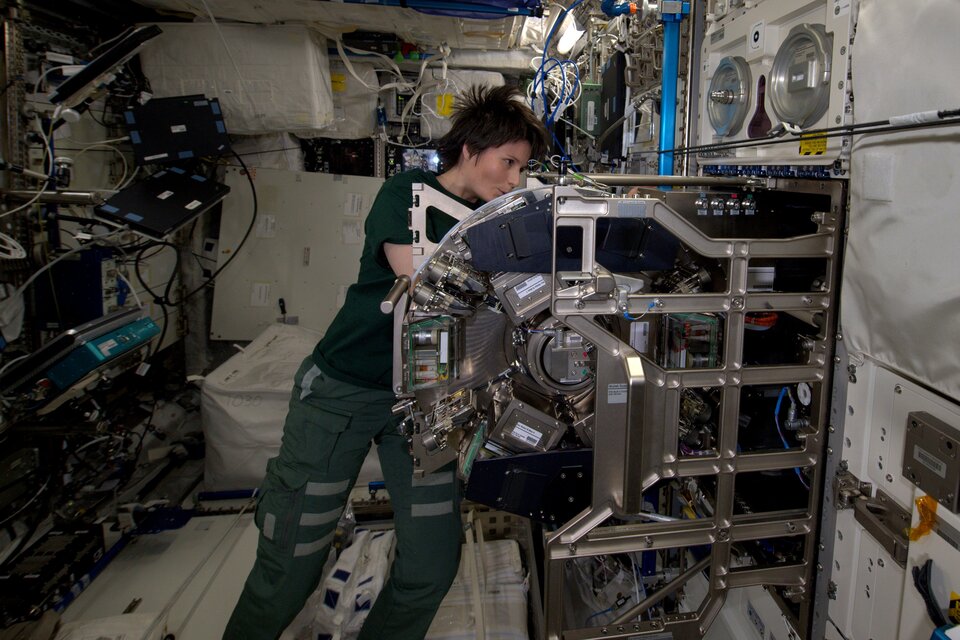
    Working on Biolab

    An experiment on Columbus has shown how ‘quantum forces’ can be used to control colloid structures. It confirmed the effect of these forces as predicted theoretically for over 30 years, but observed for the first time in 2008. The findings are part of the building blocks for creating nanomaterials.

    Research inside Columbus is also helping scientists to understand the human body. Astronauts in space absorb more salt without absorbing more fluids – contradicting generally accepted medical knowledge.

    It turns out that high-salt diets seem to contribute to bone loss in astronauts. Until now, bone loss was thought to be caused by the physical effect of living in weightlessness. This new result has implications for people suffering from osteoporosis on Earth.

    Cell research

    Delving deeper, cell research is offering clues on how to control ageing. A biology experiment revealed that certain enzymes in our immune systems are more active in space, showing scientists on the ground where to look to combat premature cell death.

    The data for these experiments are coordinated and processed through ESA’s Columbus control centre in Germany and the User Support and Operations Centres around Europe. Experienced ESA staff guide experiments and check their feasibility and safety before being included in the flight manifest for any Expedition.

    ESA astronaut Luca Parmitano in Cupola module

    Last update: 8 May 2015

    Rate this

    Views

    Share

    • Currently 4 out of 5 Stars.
    • 1
    • 2
    • 3
    • 4
    • 5
    Rating: 4.1/5 (8 votes cast)

    Thank you for rating!

    You have already rated this page, you can only rate it once!

    Your rating has been changed, thanks for rating!

    3202
    Tweet

    Related articles

    The next generation of Space Station experiments20 March 2015

    The next generation of Space Station experiments20 March 2015 From how astronauts perceive time to whether parts of their brains shrink in space, the next round of experiments to be performed on the International Space Station has been chosen from more than 200 proposals.

    ISS as seen from Soyuz TMA-20

    Calling scientists: send your experiment out of this world28 February 2014

    ISS as seen from Soyuz TMA-20

    Calling scientists: send your experiment out of this world28 February 2014 ESA is selecting new experiments to float in microgravity, 400 km above the planet on the International Space. Sounds out of your reach? Submit an exciting science proposal and your experiment could be on the orbital complex as early as 2016.

    Shining light on elusive dark matter03 April 2013

    Shining light on elusive dark matter03 April 2013 The antimatter hunter AMS-02 on the International Space Station is searching for the missing pieces of our Universe. The project’s first results published today are hinting at a new phenomenon and revealing more about the invisible ‘dark matter’.

    Finding the key to immunity04 February 2013

    Finding the key to immunity04 February 2013 Living in space weakens astronauts’ immune systems, researchers have discovered. The findings are providing clues on how to tackle diseases on Earth before symptoms appear.

    Five years of unique science on Columbus12 February 2013

    Five years of unique science on Columbus12 February 2013 Since Europe’s Columbus laboratory module was attached to the International Space Station five years ago, it has offered researchers worldwide the opportunity to conduct science beyond the effects of gravity.

    Microgravity Science Glovebox

    Hooray for glovebox milestone – and faster computers31 October 2011

    Microgravity Science Glovebox

    Hooray for glovebox milestone – and faster computers31 October 2011 It is the Microgravity Science Glovebox and it comes from Europe. And it has now logged 10 000 hours of research in space. But there is no time for a celebration: it is now busy pointing the way to a new generation of speed-of-light computers.

    Andre Kuipers completing ROALD-2

    Keeping immune cells alive and kicking08 May 2012

    Andre Kuipers completing ROALD-2

    Keeping immune cells alive and kicking08 May 2012 New results from research on the International Space Station are offering clues on why astronauts’ immune systems don’t work as well in space. The findings may benefit the elderly on Earth.

    Lichen

    The toughest life on Earth22 June 2012

    Lichen

    The toughest life on Earth22 June 2012 You can freeze it, thaw it, vacuum dry it and expose it to radiation but still life survives. ESA’s research on the International Space Station is giving credibility to theories that life came from outer space – as well as helping to create better sun...

    Paolo Nespoli in the European Columbus laboratory on ISS

    Astronaut Cruise control27 February 2013

    Paolo Nespoli in the European Columbus laboratory on ISS

    Astronaut Cruise control27 February 2013 Astronauts on the International Space Station are testing new ways of following complex procedures, freeing up their hands and time to get work done while giving the Columbus module a spring clean in the process.

    European space agencies inaugurate altered-gravity aircraft08 May 2015

    European space agencies inaugurate altered-gravity aircraft08 May 2015 ESA, France’s space agency CNES and the German aerospace centre DLR inaugurated the Airbus A310 ZERO-G refitted for altered gravity by running 12 scientific experiments this week.

    • Experiment archive
    • International Space Station Benefits for Humanity
    • European space laboratory Columbus
    • ESA user guide to low gravity platforms
    • App Store
    • Subscribe
    • mobile version
    • LATEST ARTICLES
    • · Counting calories in space
    • · How to rescue a Moonwalker in need
    • · See our seasons change from space
    • · Preparing for Mercury: BepiColombo…
    • · Giant iceberg in the making
    • FAQ

    • Site Map

    • Contacts

    • Terms and conditions