• → European Space Agency

      • Space for Europe
      • Space News
      • Space in Images
      • Space in Videos
    • About Us

      • Welcome to ESA
      • DG's news and views
      • For Member State Delegations
      • Business with ESA
      • Law at ESA
      • ESA Exhibitions
      • ESA Publications
      • Careers at ESA
    • Our Activities

      • Space News
      • Observing the Earth
      • Human Spaceflight
      • Space Transportation
      • Navigation
      • Space Science
      • Space Engineering & Technology
      • Operations
      • Telecommunications & Integrated Applications
      • Preparing for the Future
    • Careers at ESA

    • For Media

      • Media
      • ESA TV
      • Videos for professionals
      • Photos
    • For Educators

    • For Kids

    • ESA

    • Human Spaceflight

    • Astronauts

    • International Space Station

    • Research

    • Education

    • About research in space
    • Research areas
    • Human health
    • Aging
    • Plants
    • Life support
    • Exobiology
    • Physics and materials
    • Radiation
    • Technology
    • Platforms and facilities
    • International Space Station
    • Sounding rockets
    • Parabolic flights
    • Drop towers
    • Bedrest and ground studies
    • Hypergravity
    • Research activities
    • Research Announcements
    • Experiment archive
    • Multimedia
    • Images
    • Videos
    • Web Streaming Network
    • Printed products
    • Brochures
    • European user guide to low gravity platforms
    • Space for life newsletter

    ESA > Our Activities > Human Spaceflight > Research

    Loading...
    Seedlings grown in darkness in space
    Access the video

    Plants

    Cultivating plants for food was a significant step in the history of mankind. Growing plants for food in space and on other planets will be necessary for exploration of our Universe.

    Stems and leaves grow towards the light and against gravity, while roots follow gravity. What role does gravity play in this process and what can we learn from growing plants in weightlessness? Which unknown aspects of plants will be discovered by this kind of research?

    Arabidopsis thaliana root tip

    Research in space focuses on the Arabidopsis thaliana plant, a model plant used as a reference for biologists. It has already been shown that plants 'feel' gravity at a cellular level, mainly in cells located at the tip of the root. Experiments on the International Space Station are investigating how this process works, from the primary step of sensing gravity to investigating how the whole plant responds.

    One of the experiments flown on the Space Station, GRAVI-1, looked at the smallest level of gravity a plant can sense. The results imply that plant's sense of gravity is amplified, because they react to very-low gravity levels.

    The Tropi experiments used weightlessness to examine how plants react to different light wavelengths. On Earth this research is not possible because gravity skews the results. The experiment showed that they react strongly to red light – a throwback from ancient genes that may still exist and influence modern plants.

    Arabidopsis thaliana

    Hormones play a central role in plant development and observing how plants react to the stress of altered gravity is providing clues as to how these hormones influence plant behaviour.

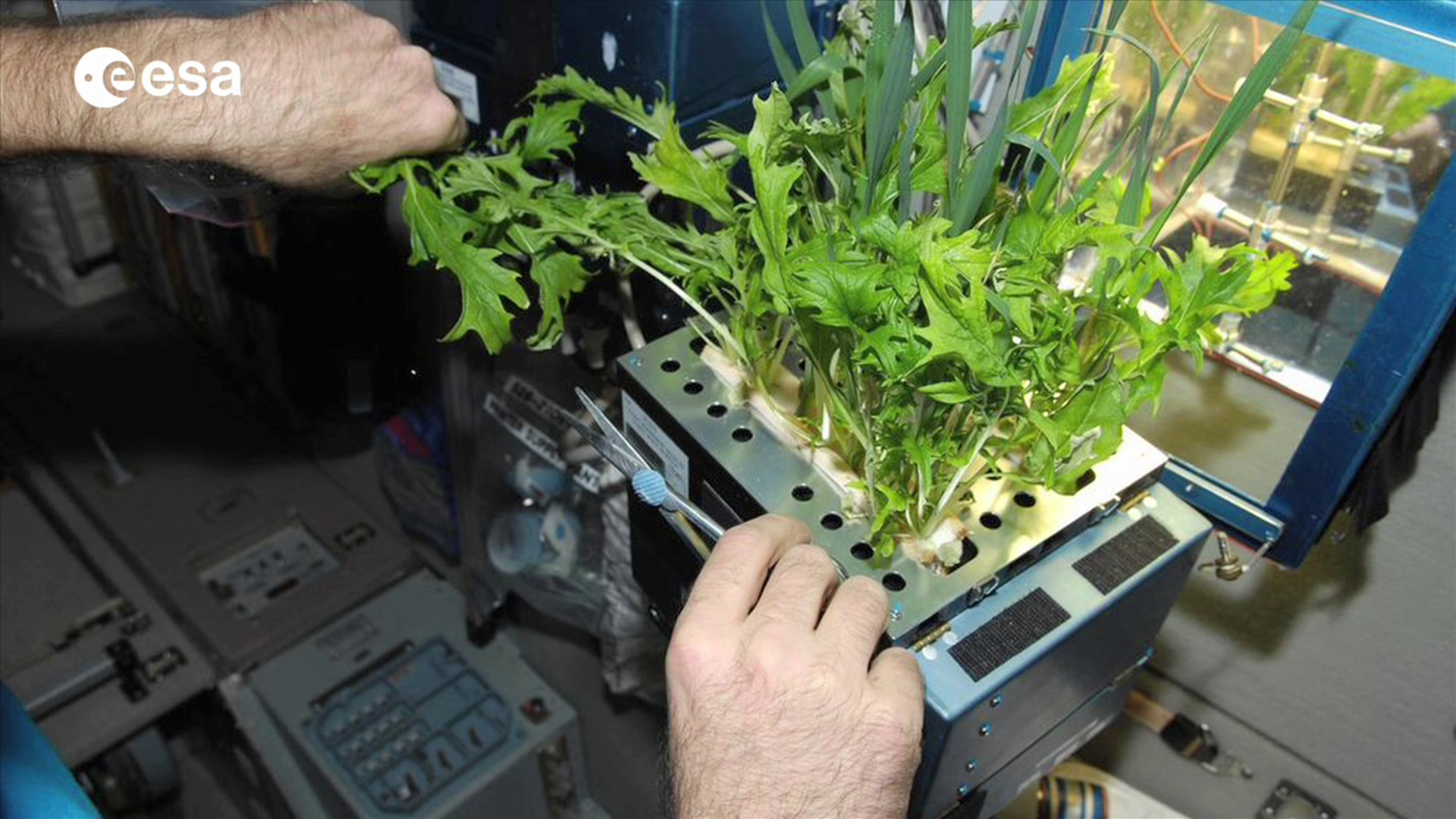
    Further ESA experiments using plants are set to head to the International Space Station. This research is providing basic information to prepare humans harvesting crops from space gardens on long trips from Earth. Closer to home, the information is helping us to create more efficient greenhouses, with plants that can grow in areas with little space or light.

    ESA has a dedicated facility on the Space Station to grow seedlings for several days with proper light and nutrients. In addition parabolic flights are run each year offering high-quality research studying the effects of rapid changes in gravity on plant growth.
    Last update: 24 April 2015

    Rate this

    Views

    Share

    • Currently 4.5 out of 5 Stars.
    • 1
    • 2
    • 3
    • 4
    • 5
    Rating: 4.3/5 (18 votes cast)

    Thank you for rating!

    You have already rated this page, you can only rate it once!

    Your rating has been changed, thanks for rating!

    4014
    Tweet

    Related articles

    ESA’s weightless plants fly on a Dragon22 April 2014

    ESA’s weightless plants fly on a Dragon22 April 2014 It is a race against time for ESA’s Gravi-2 experiment following launch last Friday on the Dragon space ferry. Stowed in Dragon’s cargo are lentil seeds that will be nurtured into life on the International Space Station.

    ISS as seen from Soyuz TMA-20

    Calling scientists: send your experiment out of this world28 February 2014

    ISS as seen from Soyuz TMA-20

    Calling scientists: send your experiment out of this world28 February 2014 ESA is selecting new experiments to float in microgravity, 400 km above the planet on the International Space. Sounds out of your reach? Submit an exciting science proposal and your experiment could be on the orbital complex as early as 2016.

    Five years of unique science on Columbus12 February 2013

    Five years of unique science on Columbus12 February 2013 Since Europe’s Columbus laboratory module was attached to the International Space Station five years ago, it has offered researchers worldwide the opportunity to conduct science beyond the effects of gravity.

    Waving and coiling in Arabidopsis seedlings

    Plant growth experiment starts in Columbus29 February 2008

    Waving and coiling in Arabidopsis seedlings

    Plant growth experiment starts in Columbus29 February 2008 ESA astronaut Léopold Eyharts has activated the first experiment inside the European Columbus laboratory. The WAICO experiment, which investigates the effect of gravity on plant root growth, has started inside the module's Biolab facility.

    Biolab

    Biolab18 July 2001

    Biolab

    Biolab18 July 2001 Biological experiment facility in Columbus Biolab supports biological experiments on micro-organisms, cells, tissue cultures, small plants and small invertebrates. Performing life science experiments in space identifies the role that weightlessness p...

    • Experiment archive
    • International Space Station Benefits for Humanity
    • European space laboratory Columbus
    • App Store
    • Subscribe
    • mobile version
    • LATEST ARTICLES
    • · Counting calories in space
    • · How to rescue a Moonwalker in need
    • · See our seasons change from space
    • · Preparing for Mercury: BepiColombo…
    • · Giant iceberg in the making
    • FAQ

    • Site Map

    • Contacts

    • Terms and conditions