• → European Space Agency

      • Space for Europe
      • Space News
      • Space in Images
      • Space in Videos
    • About Us

      • Welcome to ESA
      • DG's News and Views
      • For Member State Delegations
      • Business with ESA
      • ESA Exhibitions
      • ESA Publications
      • Careers at ESA
    • Our Activities

      • Space News
      • Observing the Earth
      • Human Spaceflight
      • Launchers
      • Navigation
      • Space Science
      • Space Engineering
      • Operations
      • Technology
      • Telecommunications & Integrated Applications
    • For Public

    • For Media

    • For Educators

    • For Kids

    • ESA

    • Human Spaceflight and Exploration

    • Space Shuttle

    • 50 years of humans in space

    • ESA History

    • The Space Shuttle
    • Space Shuttle timeline
    • Space Shuttle fleet
    • Space Shuttle missions
    • Shuttle technical facts
    • Spacelab
    • Tribute to the Space Shuttle
    • A remarkable flying machine
    • Europe’s involvement: Spacelab
    • From Spacelab to Columbus
    • Birth of an international spirit
    • A veritable work horse
    • After the Shuttle
    • European astronauts about the Shuttle
    • Jean-François Clervoy
    • Christer Fuglesang
    • Ulf Merbold
    • Ernst Messerschmid
    • Claude Nicollier
    • Thomas Reiter
    • Gerhard Thiele
    • Michel Tognini
    • Roberto Vittori
    • Ulrich Walter
    • Other European Shuttle astronauts
    • Downloads
    • Thirty Years of Partnership: The Shuttle, the ISS and Europe (pdf)
    • Spacelab (pdf)
    • Multimedia
    • Europe and The Space Shuttle
    • ESA Online videos
    • ESA Multimedia gallery
    • Further reading
    • More reading about the Space Shuttle

    ESA > Our Activities > Human Spaceflight > Space Shuttle

    Shuttle technical facts

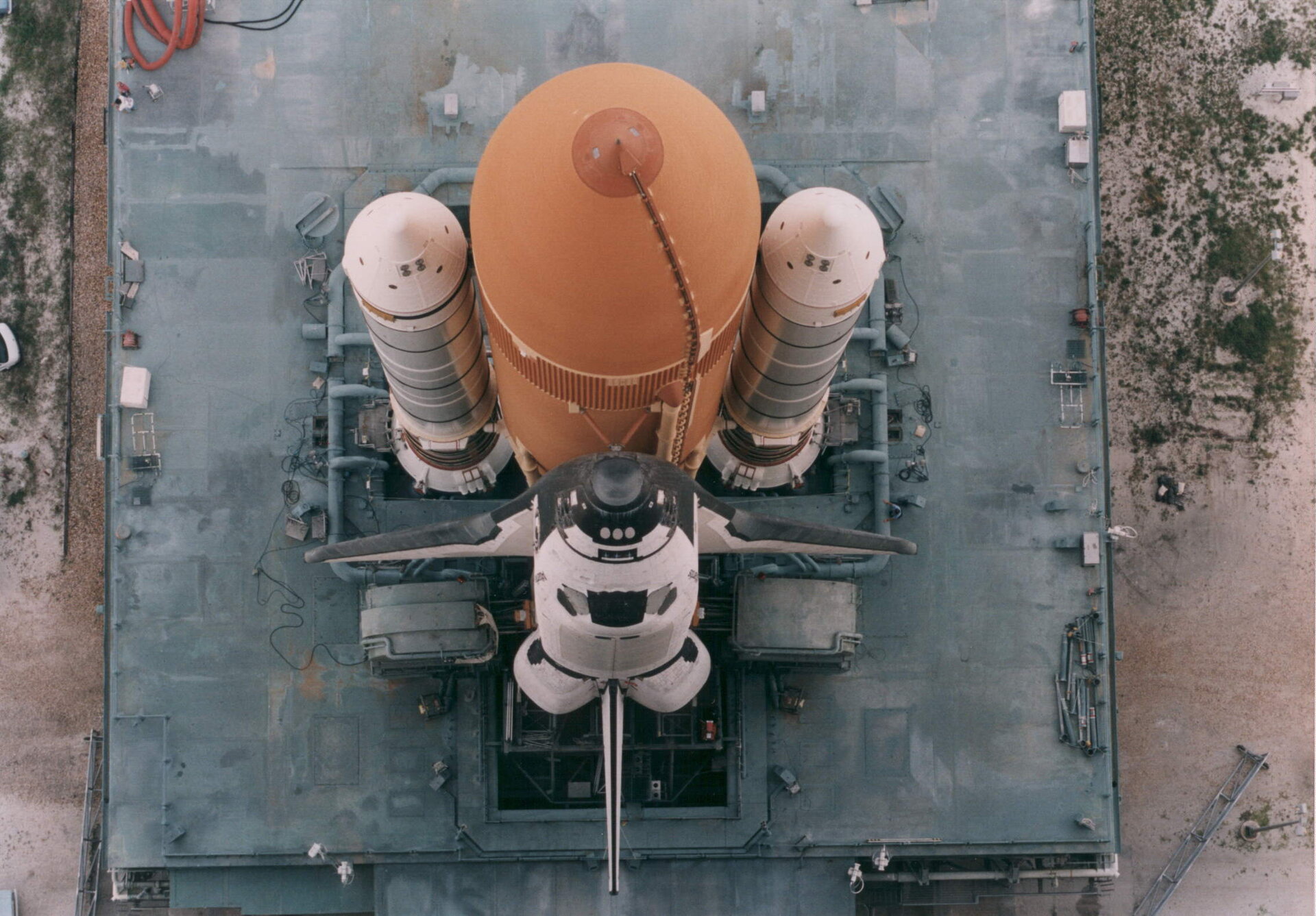
    The Space Transportation System (STS) is the formal name of NASA’s Space Shuttle, consisting of an aircraft-like orbiter, two boosters and a huge external tank.

    The stack, as the composite of orbiter, tank and boosters is called, has a gross liftoff weight of 2000 tonnes. Its height is 56 m and the boosters with the three Space Shuttle Main Engines generate 30.16 MN of thrust.

    Shuttle is able to loft about 24 tonnes of cargo to low orbit and transport typically seven astronauts.

    Orbiter
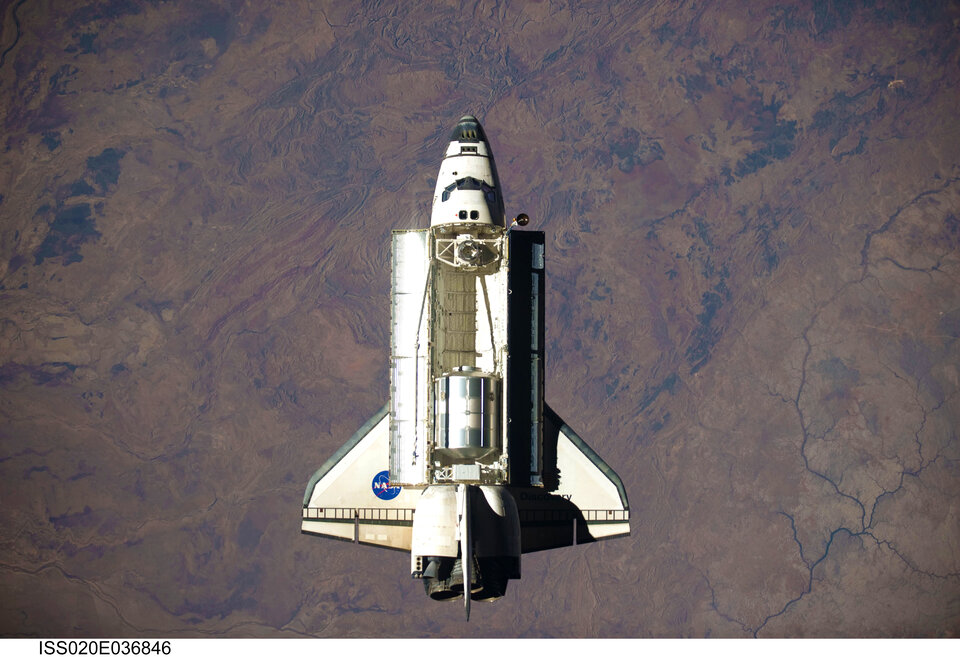
    The Orbiter is about the size of an Airbus A320 airliner, but sports the double-delta wings of a fighter. It has a crew compartment in the nose section, followed by a large payload bay and finally three main rocket engines in the aft fuselage.

    The Orbiter structure is primarily aluminum alloy, with the engine structure primarily titanium alloy. The whole underbelly is covered by ceramic tiles protecting the Orbiter from the extreme heating of reentry. Each orbital vehicle was designed for 100 flights.

    Specifications of Endeavour (OV-105)

    Length: 37.237 m
    Wingspan: 23.79 m
    Height: 17.86 m
    Empty weight: 78 000 kg
    Gross liftoff weight: 110 000 kg
    Maximum landing weight: 100 000 kg
    Maximum payload: 25 060 kg
    Payload to low Earth orbit: 24 310 kg
    Payload bay dimensions: 4.6 x 18 m
    Operational orbit altitude: 190 to 960 km
    Orbital speed: 7743 m/s (27 870 km/h)
    Crew: minimum of two, typically seven, maximum 11


    Space Shuttle Main Engine (SSME)

    Each Orbiter has three Rocketdyne Block II SSMEs, each with a sea level thrust of 1.752 MN at 104% power. The total thrust of three engines at liftoff is 5.255 MN.

    The engines run on liquid oxygen and liquid hydrogen carried in the External Tank. The burn time of the engines is 480 seconds.

    External Tank

    The main role of the External Tank is to supply the liquid oxygen and hydrogen propellants to the main engines, but it also holds the attachment points for the two Solid Rocket Boosters and the Orbiter itself. The External Tank is the only non-reusable part of the Space Shuttle system.

    Length: 46.9 m
    Diameter: 8.4 m
    Propellant volume: 2025 m3
    Empty weight: 26 535 kg
    Gross liftoff weight: 756 000 kg

    Solid Rocket Boosters

    Two solid rocket boosters (SRBs) each generate 12.5 MN of thrust at liftoff, totalling up to 83% of the total thrust needed. After two minutes of flight, the boosters are jettisoned at a height of about 45 km. They separate from the Shuttle, deploy parachutes and fall into the Atlantic Ocean for recovery.

    The boosters have a very heavy-duty construction with steel cases about 13 mm thick. They are reused many times: as one example, an SRB segment from STS-1 flew six times in the following years plus one ground test.

    The propellant mixture in the boosters consists of ammonium perchlorate (oxidiser), aluminum (fuel), iron oxide (a catalyst), a polymer that holds the mixture together and acts as secondary fuel and an epoxy curing agent.

    Length: 45.46 m
    Diameter: 3.71 m
    Empty weight of one booster: 68 000 kg
    Gross liftoff weight of one booster: 571 000 kg
    Thrust at liftoff of one booster (at sea level): 12.5 MN
    Burn time: 124 s

    Rate this

    Views

    Share

    • Currently 0 out of 5 Stars.
    • 1
    • 2
    • 3
    • 4
    • 5
    Rating: 0/5 (0 votes cast)

    Thank you for rating!

    You have already rated this page, you can only rate it once!

    Your rating has been changed, thanks for rating!

    54
    facebook
    twitter
    reddit
    google plus
    digg
    tumbler
    digg
    blogger
    myspace
    • A video to the Space Shuttle from the European astronauts
    • Tribute to the
      Space Shuttle
    • Human Spaceflight
      Human Spaceflight
      Human Spaceflight
    • History of Europe in Space
    • Space Shuttle logo
      Space Shuttle logo
      NASA: Space Shuttle
    • Space Shuttle Era
    • The Space Shuttle Interactive
    • The Space Shuttle in Pictures
    • NASA Shuttle missions
    • Space Shuttle Reference Manual (NASA)
    • Spacelab (NASA)

    Connect with us

    • RSS
    • Youtube
    • Twitter
    • Flickr
    • Google Buzz
    • Subscribe
    • App Store
    • LATEST ARTICLES
    • · CryoSat hits land
    • · Ariane 5 completes seven launches …
    • · Measuring skull pressure without t…
    • · Malargüe station inauguration
    • · The solar wind is swirly
    • FAQ

    • Jobs at ESA

    • Site Map

    • Contacts

    • Terms and conditions
