• → European Space Agency

      • Space for Europe
      • Space News
      • Space in Images
      • Space in Videos
    • About Us

      • Welcome to ESA
      • DG's News and Views
      • For Member State Delegations
      • Business with ESA
      • ESA Exhibitions
      • ESA Publications
      • Careers at ESA
    • Our Activities

      • Space News
      • Observing the Earth
      • Human Spaceflight
      • Launchers
      • Navigation
      • Space Science
      • Space Engineering
      • Operations
      • Technology
      • Telecommunications & Integrated Applications
    • For Public

    • For Media

    • For Educators

    • For Kids

    • ESA

    • Home

    • Launch vehicles

    • Europe's Spaceport

    • New Technologies

    • Strategy for launchers
    • Launcher strategy
    • Future Launchers Preparatory Programme
    • International cooperation
    • Launchers and industry
    • Launcher history
    • A look at the past
    • Ariane 1, 2, 3
    • Ariane 4
    • Launches
    • Previous launches
    • Launch schedule
    • Multimedia
    • Image gallery
    • Video gallery
    • RSS feeds
    • Flyers
    • Vega - Europe's small launcher
    • Soyuz - Europe's medium launcher
    • IXV - Intermediate Experimental Vehicle
    • NGL - Europe's Next-Generation Launcher
    • Launchers on your desktop
    • Screensavers and wallpaper
    • Services
    • Glossary
    • Frequently asked questions
    • Comments

    ESA > Our Activities > Launchers

    Ariane 5 ECA carries record payload mass to GTO

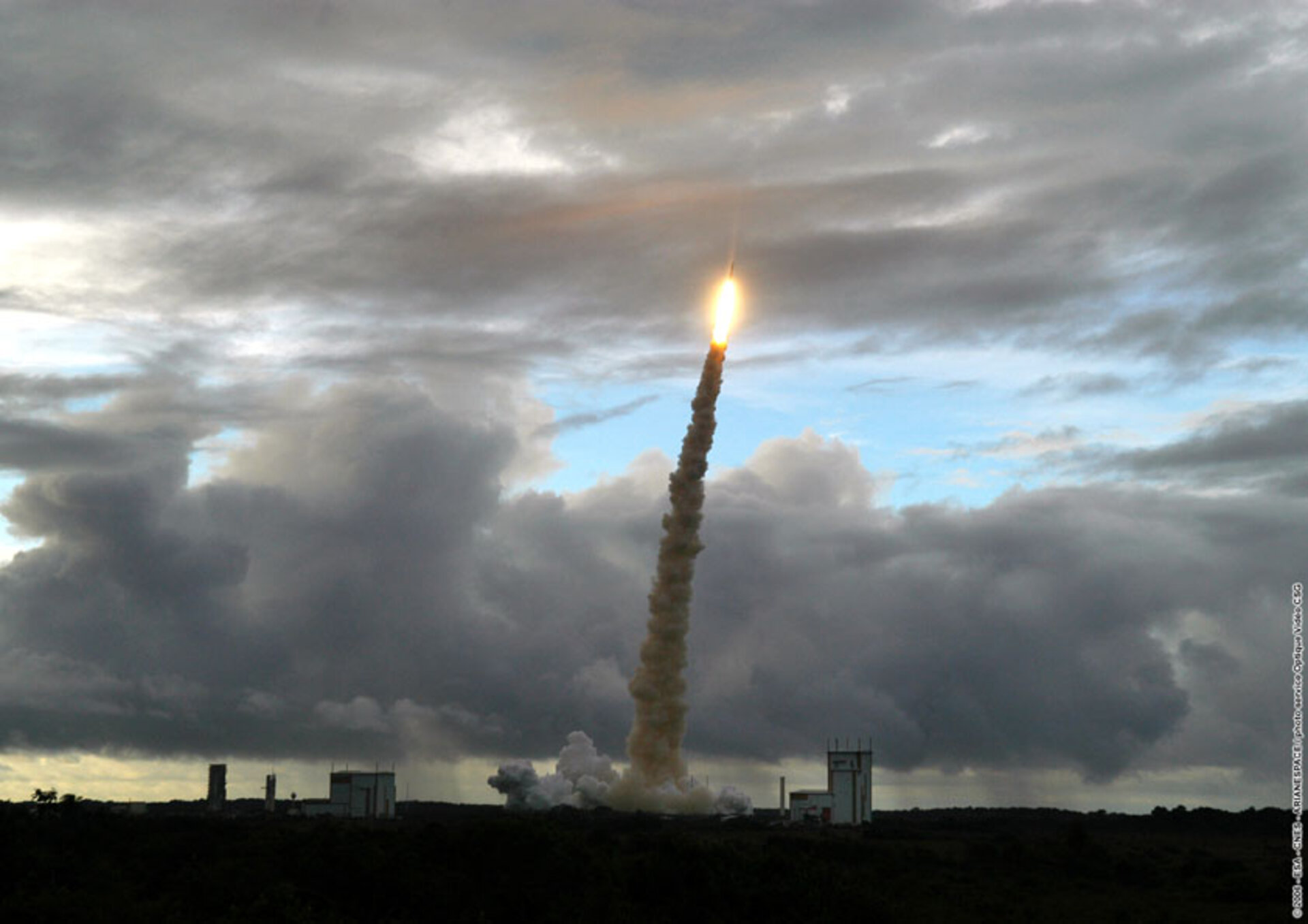
    Ariane 5 ECA climbs into the evening sky
    28 May 2006

    On the evening of 27 May, an Ariane 5 ECA launcher lifted off from Europe’s Spaceport in French Guiana on its mission to place two telecommunications satellites into geostationary transfer orbit. Lift-off took place at 18:09 French Guiana time (21:09 GMT/UTC, 23:09 CEST/Paris).

    The 50.5-metre tall launch vehicle was carrying the Satmex 6 telecommunications satellite for the Mexican operator Satelites Mexicanos SA de CV and the Thaicom 5 telecommunications satellite for Thailand's Shin Satellite Public Company Limited. With a combined mass of around 8300 kg, the two satellites set a record for the largest payload mass carried into geostationary transfer orbit.
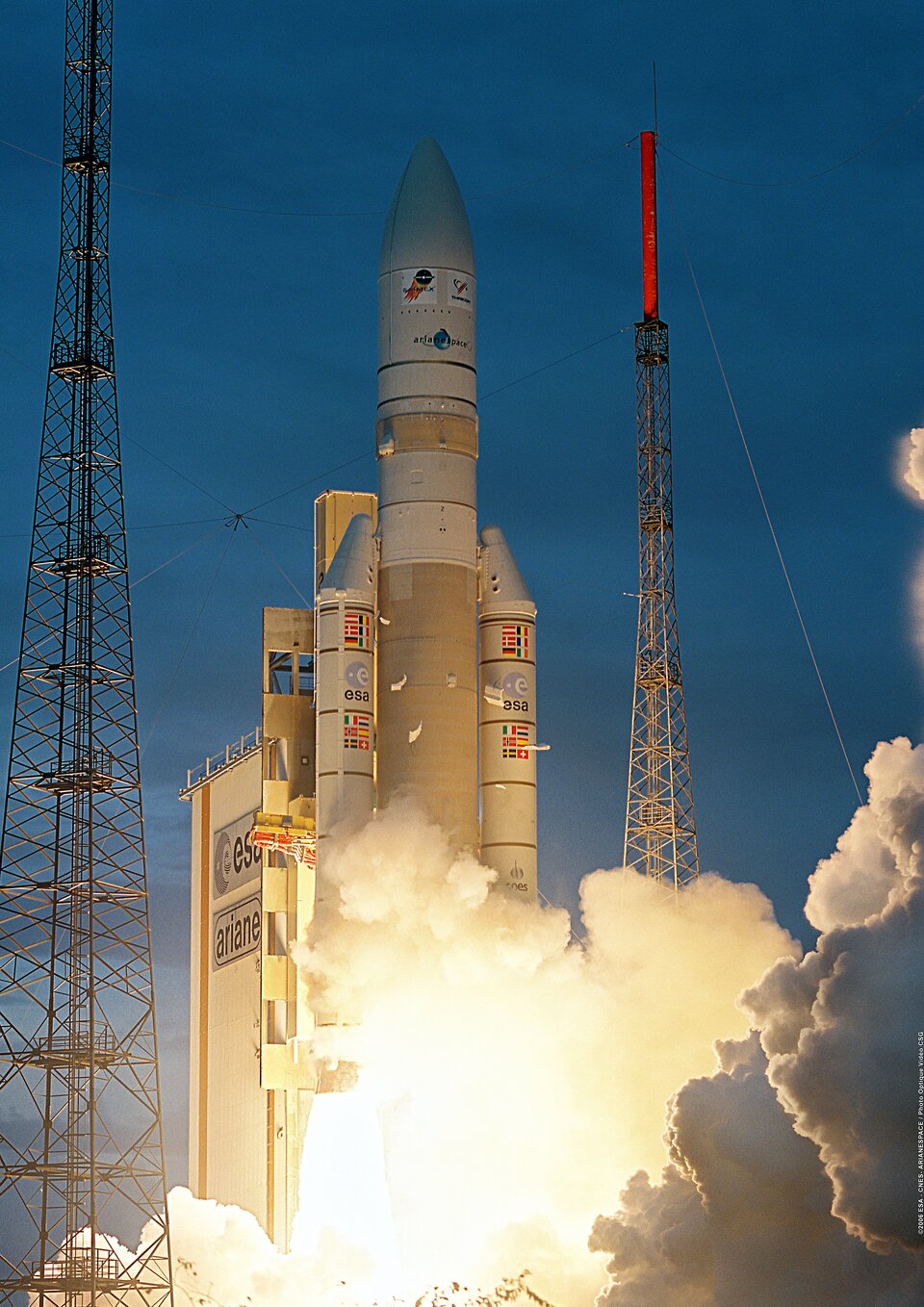
    Ariane 5 ECA lift-off
    Ariane 5 ECA lift-off

    The upper stage cryogenic engine was shut down 24m51s after lift-off. By this time the launch vehicle upper composite had attained a velocity of approximately 9400 metres per second (almost 33 900 km/h) and the conditions for geostationary transfer orbit injection had been achieved.

    Satmex 6 was the first satellite to separate, followed by Thaicom 5. Injection into the target geostationary transfer orbit for the two spacecrafts was achieved with very high precision.

    Rate this

    Views

    Share

    • Currently 0 out of 5 Stars.
    • 1
    • 2
    • 3
    • 4
    • 5
    Rating: 0/5 (0 votes cast)

    Thank you for rating!

    You have already rated this page, you can only rate it once!

    Your rating has been changed, thanks for rating!

    39
    Tweet
    • Related articles
      • Ariane 5 ECA carries record payload mass to GTO
      • Ariane 5 ECA - V171 launch in pictures
      • Visit Kourou
      • Countdown
      • Build a launcher

    Connect with us

    • RSS
    • Youtube
    • Twitter
    • Flickr
    • G+
    • Facebook
    • Livestream
    • Subscribe
    • App Store
    • LATEST ARTICLES
    • · ESA astronaut Timothy Peake set fo…
    • · Space drives e-mobility
    • · Proba-V opens its eyes
    • · First new Galileo satellite arrive…
    • · Next destination: space
    • FAQ

    • Jobs at ESA

    • Site Map

    • Contacts

    • Terms and conditions
