• → European Space Agency

      • Space for Europe
      • Space News
      • Space in Images
      • Space in Videos
    • About Us

      • Welcome to ESA
      • DG's News and Views
      • For Member State Delegations
      • Business with ESA
      • ESA Exhibitions
      • ESA Publications
      • Careers at ESA
    • Our Activities

      • Space News
      • Observing the Earth
      • Human Spaceflight
      • Launchers
      • Navigation
      • Space Science
      • Space Engineering
      • Operations
      • Technology
      • Telecommunications & Integrated Applications
    • For Public

    • For Media

      • Media
      • ESA TV
      • Videos for professionals
      • Photos
    • For Educators

    • For Kids

    • ESA

    • Home

    • Launch vehicles

    • Europe's Spaceport

    • New Technologies

    • Strategy for launchers
    • Launcher strategy
    • Future Launchers Preparatory Programme
    • International cooperation
    • Launchers and industry
    • Launcher history
    • A look at the past
    • Ariane 1, 2, 3
    • Ariane 4
    • Launches
    • Previous launches
    • Launch schedule
    • Multimedia
    • Image gallery
    • Video gallery
    • RSS feeds
    • Flyers
    • Vega - Europe's small launcher
    • Soyuz - Europe's medium launcher
    • IXV - Intermediate Experimental Vehicle
    • NGL - Europe's Next-Generation Launcher
    • Launchers on your desktop
    • Screensavers and wallpaper
    • Services
    • Glossary
    • Frequently asked questions
    • Comments

    ESA > Our Activities > Launchers

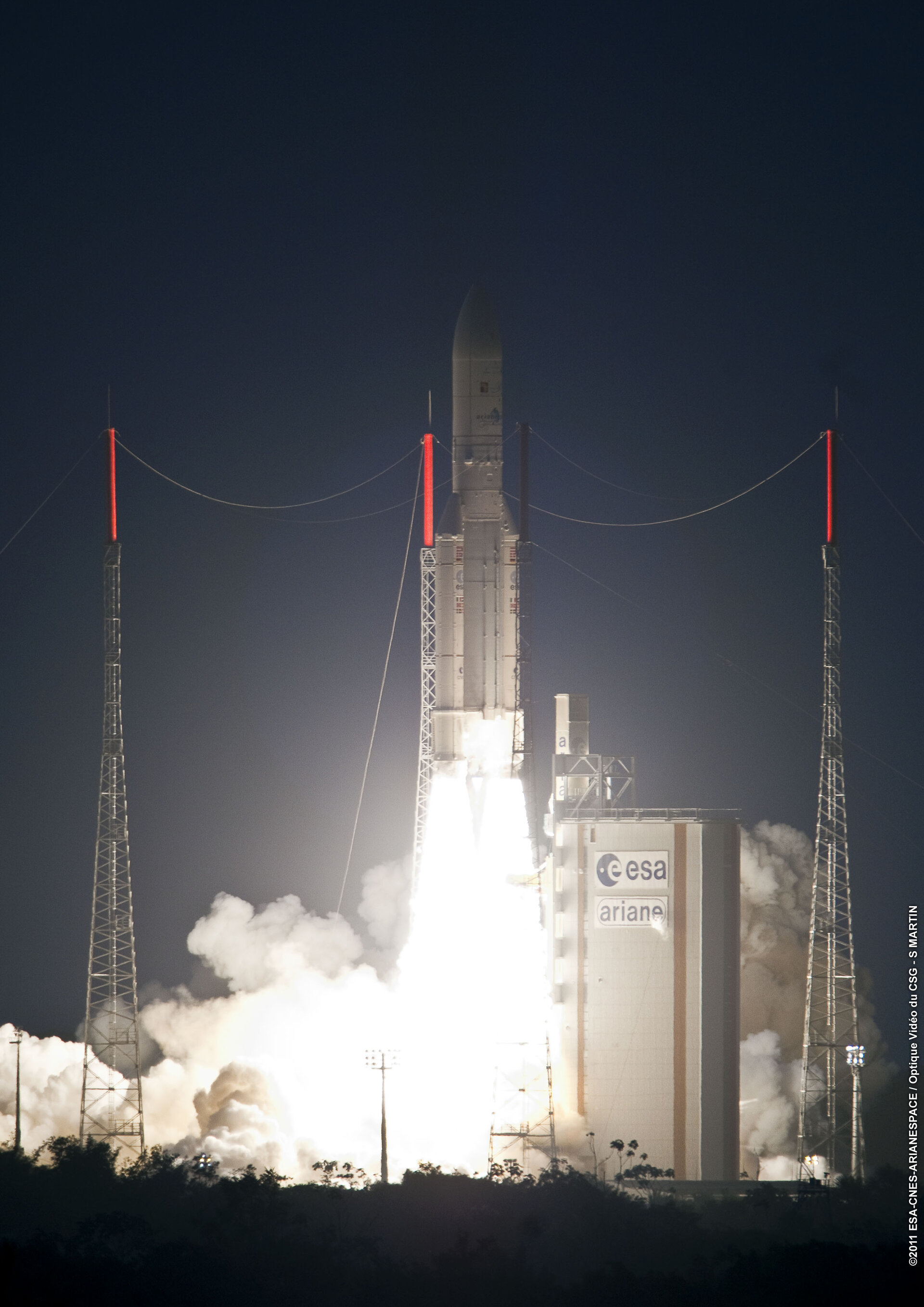
    Ariane 5’s second launch of 2011

    Ariane 5 flight VA201 liftoff
    23 April 2011

    Last night, an Ariane 5 launcher lifted off from Europe’s Spaceport in French Guiana on its mission to place two telecommunications satellites, Yahsat Y1A and Intelsat New Dawn, into their planned transfer orbits. Flight VA201 was the second Ariane 5 launch of 2011.

    Liftoff of the 57th Ariane 5 mission came at 23:37 CEST (21:37 GMT; 18:37 French Guiana). The target injection orbit had a perigee altitude of 250 km, an apogee altitude at injection of 35 962 km and an inclination of 6º.

    The satellites were accurately injected into their transfer orbits about 27 minutes and 35 minutes after liftoff, respectively.

    Yahsat Y1A will be positioned above the equator at 52.5°E. It will provide innovative broadband solutions for Internet, business data and high-definition television services to institutional and commercial customers in the Middle East, Africa, Europe and Southeast Asian.

    Intelsat New Dawn, to be positioned over 32.8°E, will offer a wide range of services to Africa, including telephony, Internet, media and data networks.

    The payload mass for this launch was 10 064 kg; the satellites totalled 8965 kg, with payload adapters and dispensers making up the additional 1099 kg.

    With a total mass of over 10 t, it is the heaviest payload ever launched by an Ariane 5 ECA. This was made possible by detailed post-flight analyses to fully exploit the propulsion potential of each stage. Further performance increases are in the pipeline to keep up with the trend towards heavier telecom satellites.

    Ariane 5 flight VA201

    Arianespace and Europe’s Spaceport are planning four more Ariane launches in 2011, maintaining the heavy-lift vehicle’s flight rate.


    VA201 flight timeline

    The Ariane 5’s cryogenic, liquid-propellant main engine was ignited first. Seven seconds later, the solid-propellant boosters also fired, and the vehicle lifted off a fraction of a second later.

    The solid boosters were jettisoned 2 min 20 sec after main engine ignition, and the fairing protecting the payload during the climb through Earth’s atmosphere was discarded at 3 min 11 sec.

    The launcher’s main engine was shut down at 8 min 53 sec; six seconds later, the main cryogenic stage separated from the upper stage and its payload.

    Four seconds after main stage separation, the engine of the cryogenic upper stage was ignited to continue the journey. The engine was shut down at 25 min 21 sec into the flight, at which point the vehicle was travelling at 9354 m/s (33 674 km/h) at an altitude of 656.7 km. The conditions for geostationary transfer orbit injection had been achieved.

    At 27 min 27 sec after main engine ignition, Yahsat Y1A separated from the upper stage, followed by Intelsat New Dawn at 35 min 03 sec. Ariane 5’s flight operations were completed 46 min 03 sec after main engine ignition.

    Rate this

    Views

    Share

    • Currently 0 out of 5 Stars.
    • 1
    • 2
    • 3
    • 4
    • 5
    Rating: 0/5 (0 votes cast)

    Thank you for rating!

    You have already rated this page, you can only rate it once!

    Your rating has been changed, thanks for rating!

    68
    Tweet
    • Related news
      • Europe’s ATV Johannes Kepler supply ship on its way to Space Station
        • Ariane 5’s sixth launch of 2010
          • Hylas-1 in orbit brings Europe broadband from space
            • Ariane 5’s fourth launch of 2010
              • Ariane 5’s third launch of 2010
              • Visit Kourou
              • Countdown
              • Build a launcher
              • Ariane 5
              • Vega
              • Soyuz
              • External links
              • Arianespace

    Connect with us

    • RSS
    • Youtube
    • Twitter
    • Flickr
    • G+
    • Facebook
    • Livestream
    • Subscribe
    • App Store
    • LATEST ARTICLES
    • · Rare merger reveals secrets of gal…
    • · Watching for hazards: ESA opens as…
    • · ESA astronaut Timothy Peake set fo…
    • · Space drives e-mobility
    • · Proba-V opens its eyes
    • FAQ

    • Jobs at ESA

    • Site Map

    • Contacts

    • Terms and conditions