


Ariane's Vulcain-2 engine ready for a new test flight
EuroNews Space magazine recently visited the engine maker Snecma Moteurs at Vernon on the outskirts of Paris on the occasion of one of the final ground test firings of the powerful Vulcain-2.
Ever since the maiden flight failure of the more powerful Heavy Ariane 5 launcher (also known as the ECA 'ten tonne' version), European engineers have spared no effort to get back on track in view of an upcoming new qualification flight.
The principal cause of the failure on 11 December 2002 lay in the launcher's main engine Vulcain-2, whose exhaust nozzle was not robust enough and was deformed by unexpectedly high temperatures.
The manufacturer's General Manager for Large Liquid Propulsion recalled the reasons for the failure of flight 157. "External pressure on the nozzle at ground level was no longer there when the launcher had risen into space," explained Guy Corteel. "The top part of the nozzle was submitted to unexpected upward strains and was substantially deformed. This structural change altered the thermal flow and the excessive temperatures melted the nozzle. The launcher's trajectory could no longer be controlled and flight safety officers had to destroy it."

Once these causes were established, Snecma Moteurs and all its European partners involved in the design of Vulcain-2 nozzle got down to the task of improving the engine.
"We have strengthened the structure by adding a certain number of soldered reinforcements over the upper part of the nozzle," says M. Corteel. "The cooling system, using very cold hydrogen flowing through the tubular structure of the nozzle, has also been improved and a thermal barrier coating has been implemented on the inner face of the nozzle".
The robustness of the improved engine has had to be confirmed with repeated ground firings. The test bench is situated in a secluded and high-security area at Vernon. The Vulcain-2 is placed at the base of an imposing tall tower-like building, firmly anchored in the ground.

Three hours before the test, all the engineers withdraw into a bunker. The countdown proceeds exactly as in Kourou. The tension is visible on all the faces. Dozens of firings have taken place but there is always the same vigilance and concentration.
On the screens, the engine ignites. Exhaust gases billow out of the flame trenches into the air over the surrounding woods. The 135 tonne thrust of the Vulcain-2 is astounding: turbo-pumps turning at up to 36,000 rpm. force the liquid oxygen and liquid hydrogen into the combustion chamber. Some four and a half million horsepower is generated, enough energy to supply electricity to 28,000 households.
After approximately 10 minutes, it is over. The test director and his colleagues spot-check the data. Once again the figures are satisfactory, the Vulcain-2 has performed correctly.
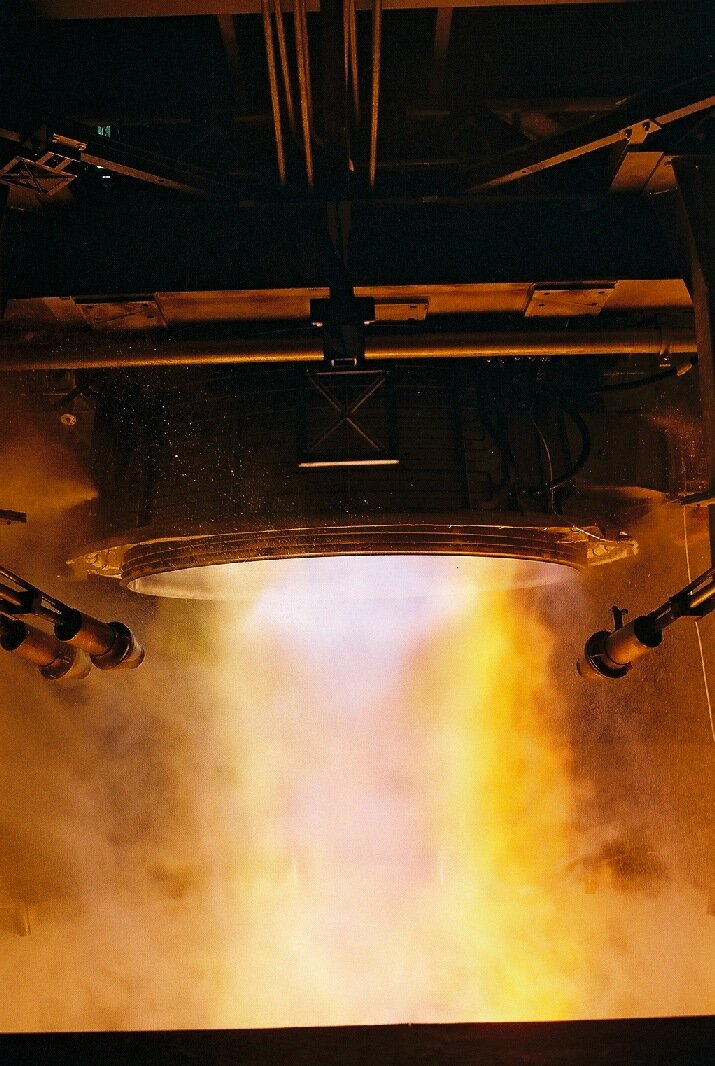
"The tests recreate the real flight situation, in terms of duration and simulate all the thermal and dynamic conditions," says Carole Hujeux, who has supervised all the test firings. "We detect any anomalies, we have simulated others, and finally we have fine-tuned the engine that will actually be used on the qualification flight to obtain the required performance."
But the ultimate truth will only come with a real flight into space. The launcher campaign is well underway at the European Spaceport in Kourou. The first qualification flight for the revised version of the Heavy Ariane 5 is not far off.
Engineers, technicians and managers throughout Europe look forward to the day when all their efforts to improve the Vulcain-2 engine will be rewarded. December 2002 will become just a bad souvenir. The constant improvements to the Ariane 5 vehicles will ensure that Europe continues to lead the field on the international launcher market.
EuroNews
EuroNews is a key medium for delivering international information with a European point of view. Broadcast in 79 countries, EuroNews reaches 144 million households in Europe, the Middle East, Africa, Central Asia and North and Latin America via cable, digital satellite and through terrestrial channels. This Space Magazine is produced and broadcast every two weeks, with a new programme starting every second Friday. Each magazine is four minutes long and broadcast 21 times in one week, including evening prime time on Fridays and Saturdays, in order to reach a maximum audience.
Broadcast times
| Monday | 12:45 | 18:15 | 00:15 | |
|---|---|---|---|---|
| Tuesday | 12:45 | 18:15 | 00:15 | |
| Wednesday | 12:45 | 18:15 | 00:15 | |
| Thursday | 12:45 | 18:15 | 00:15 | |
| Friday | 17:45 | 20:45 | 00:15 | |
| Saturday | 12:45 | 21:15 | 00:15 | |
| Sunday | 12:45 | 18:15 | 00:15 |

