• → European Space Agency

      • Space for Europe
      • Space News
      • Space in Images
      • Space in Videos
    • About Us

      • Welcome to ESA
      • DG's News and Views
      • For Member State Delegations
      • Business with ESA
      • ESA Exhibitions
      • ESA Publications
      • Careers at ESA
    • Our Activities

      • Space News
      • Observing the Earth
      • Human Spaceflight
      • Launchers
      • Navigation
      • Space Science
      • Space Engineering
      • Operations
      • Technology
      • Telecommunications & Integrated Applications
    • For Public

    • For Media

    • For Educators

    • For Kids

    • ESA

    • Home

    • Launch vehicles

    • Europe's Spaceport

    • New Technologies

    • Strategy for launchers
    • Launcher strategy
    • Future Launchers Preparatory Programme
    • International cooperation
    • Launchers and industry
    • Launcher history
    • A look at the past
    • Ariane 1, 2, 3
    • Ariane 4
    • Launches
    • Previous launches
    • Launch schedule
    • Multimedia
    • Image gallery
    • Video gallery
    • RSS feeds
    • Flyers
    • Vega - Europe's small launcher
    • Soyuz - Europe's medium launcher
    • IXV - Intermediate Experimental Vehicle
    • NGL - Europe's Next-Generation Launcher
    • Launchers on your desktop
    • Screensavers and wallpaper
    • Services
    • Glossary
    • Frequently asked questions
    • Comments

    ESA > Our Activities > Launchers

    Hot structures for reentry vehicles

    The reusable NGL system concept studies and the development of the IXV by FLPP have spurred technology activities on structures in harsh environments. These activities validate dedicated critical ceramic and metallic Thermal Protection Systems (TPSs) as well as Ceramic Matrix Composite (CMC) hot structures.

    The challenge was to design, build and test subsystems based on:

    • The lightest TPS available, preventing the load-carrying substructure from excessive heat exposure and harsh environment of space and during the reentry phase. It should be able to withstand the repeated missions of the Reusable Launch Vehicle. Additionally, the TPS must be durable, with a smooth surface to prevent boundary layer interference.
    • The lightest load-carrying hot structures available, with material retaining sufficient physical and chemical properties at the operating temperature and withstanding thermo-mechanical loading. These components must be reused for a certain number of flights with a minimum effort of maintenance.


    Reusable CMC elements have been tested in a realistic environment of dynamic flow, such as encountered in flight or simulated in a plasma arcjet facility.

    These technology activities for atmospheric reentry missions, in particular CMC TPSs, have provided positive and useful results for IXV.

    Last update: 30 October 2012

    Rate this

    Views

    Share

    • Currently 5 out of 5 Stars.
    • 1
    • 2
    • 3
    • 4
    • 5
    Rating: 5/5 (1 votes cast)

    Thank you for rating!

    You have already rated this page, you can only rate it once!

    Your rating has been changed, thanks for rating!

    54
    Tweet
    • Intermediate eXperimental Vehicle (IXV)
    • Related news
      • New milestone in IXV development
        • IXV prepares the European Low Earth Orbit return ambition
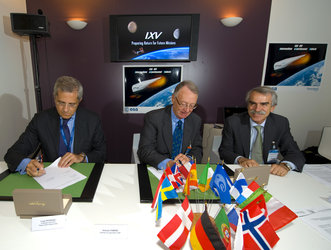
          • ESA and Thales Alenia Space establish agreement for development of Intermediate eXperimental Vehicle (IXV)

    Connect with us

    • RSS
    • Youtube
    • Twitter
    • Flickr
    • G+
    • Facebook
    • Livestream
    • Subscribe
    • App Store
    • LATEST ARTICLES
    • · Rare merger reveals secrets of gal…
    • · Watching for hazards: ESA opens as…
    • · ESA astronaut Timothy Peake set fo…
    • · Space drives e-mobility
    • · Proba-V opens its eyes
    • FAQ

    • Jobs at ESA

    • Site Map

    • Contacts

    • Terms and conditions