Ariane 5 boosters (EAP)
The Ariane 5 solid propellant boosters were the largest solid rocket boosters ever produced in Europe.
Weighing 37 tonnes each when empty, they were 31 m high and 3 m in diameter. Each booster, or EAP as they are referred to from the French Etage d'Acceleration à Poudre, contained about 238 tonnes of propellant. Ariane 5 boosters provided 1100 tonnes of thrust, roughly 92% of the total thrust at liftoff.
Each EAP consisted of a steel casing enclosing three segments filled with propellant and joined together. The top segment was loaded with 23.5 tonnes of propellant in Colleferro (Italy), while the middle and bottom segments were filled in the solid propellant production plant (UPG) at the Spaceport. The middle segment contained 107.5 tonnes of propellant and the bottom segment contained 107 tonnes of propellant. Although the casings were only 8 mm thick, they could resist pressures of up to 64 bar.
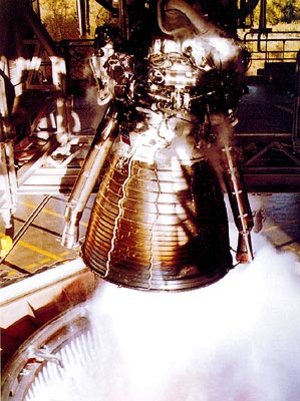
After arrival of the top segment from Italy, the boosters were assembled at the Spaceport and then anchored to the main cryogenic stage on the launch table. At the base of each booster was the 3.8 m long solid rocket engine nozzle. This could be swivelled up to 7.3° degrees around its axis by a nozzle-actuating unit to vary the direction of thrust. The outer diameter of the nozzle is 3.1 m.

Approximately 132 seconds after liftoff, at an altitude of 60 km, pyrotechnic devices freed the boosters and separation rockets distanced the spent boosters from the main stage. The boosters then continued their trajectory for about 100 km before falling into the Atlantic Ocean, approximately 450 km from the launch site. From time to time, when performance of the launcher allowed it, the boosters are equipped with a parachute recovery system. After sea recovery, boosters were examined to check that the stage performed as expected.
It took 350 milliseconds for the igniter in the upper segment of the booster to ignite the propellant. The radial rate of combustion, from the centre to the exterior of the booster segment, was approximately 7.5 mm/sec. Specific impulse was 262 sec., maximum pressure 64 bar and thrust 5400 kN. Gases from the combustion were expelled at an average flow rate of 2 tonnes/sec.
The propellant had three main constituents:
- ammonium perchlorate: the oxidiser
- aluminium powder: acted as the reducer
- polybutadiene: binder and catalyser
Responsible contractor: EADS/LV (France)
motor: Europropulsion (France-Italy)
nozzle actuators and structures: Sabca (Belgium)
sea-recovery systems: Dutch Space (The Netherlands)
The solid propellant production plant (UPG) at Europe’s Spaceport was operated by the French-Italian company REGULUS.