• → European Space Agency

      • Space for Europe
      • Space News
      • Space in Images
      • Space in Videos
    • About Us

      • Welcome to ESA
      • DG's News and Views
      • For Member State Delegations
      • Business with ESA
      • ESA Exhibitions
      • ESA Publications
      • Careers at ESA
    • Our Activities

      • Space News
      • Observing the Earth
      • Human Spaceflight
      • Launchers
      • Navigation
      • Space Science
      • Space Engineering
      • Operations
      • Technology
      • Telecommunications & Integrated Applications
    • For Public

    • For Media

    • For Educators

    • For Kids

    • ESA

    • Home

    • Launch Vehicles

    • Europe's Spaceport

    • Future launchers

    • Launcher technology
    • Launcher systems
    • Solid propulsion
    • Liquid propulsion
    • Materials, structure and stages
    • Reentry technologies
    • Launches
    • Next launch
    • Launch update
    • Multimedia
    • Image gallery
    • Video gallery
    • RSS feeds
    • Services

    ESA > Our Activities > Launchers > Launcher Technology

    Launcher systems

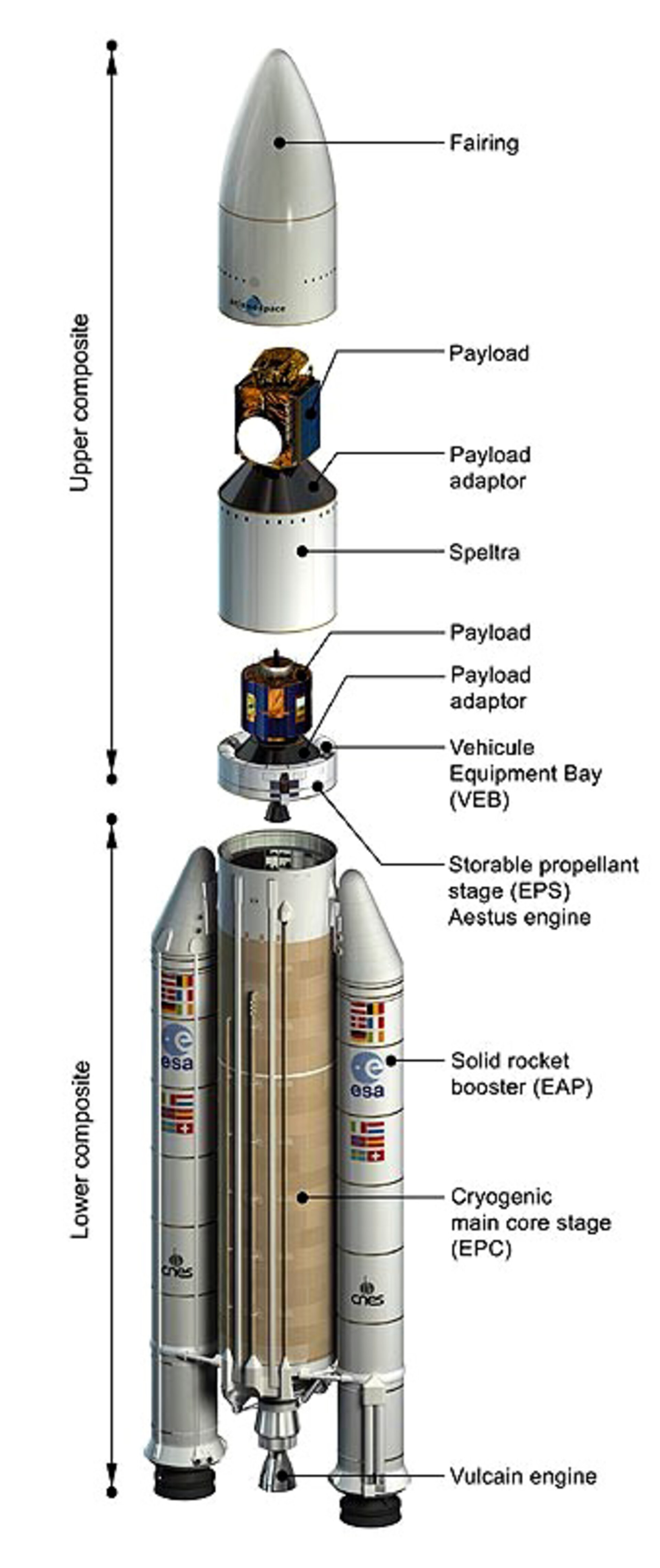
    An Ariane 5G

    A launch vehicle is a complex system conceived to deliver a payload to a given orbit by providing the right altitude and velocity for orbit injection. This has to be achieved at the mimumum launch cost possible and with the maximum reliability and overall quality of launch service.

    Launchers are usually composed of several stages to optimise the payload mass to be delivered to orbit.

    The main elements of a launcher are:

    • the rocket propulsion system (liquid or solid) required to provide the thrust to reach orbit
    • the structural elements needed to contain the propellant tanks and the payload and sustain all the loads (quasi-static, dynamic, thermal, acoustic and shock) encountered during its mission
    • the guidance, navigation and control systems required to follow an established trajectory
    • the various electrical sub-systems


    Europe’s guaranteed access to space will likely rely, for the long-term, upon the Ariane-5 and Vega launch systems and their possible evolutions. The exploitation of Soyuz from Europe's Spaceport will complete the family of launchers exploited by Arianespace, enhancing the flexibility and competitiveness of its launch services. Evolutions of the Ariane 5 and Vega may be needed in the next decade to improve their capability to cope with future institutional needs and to enhance their competitiveness.

    New and innovative research and technology will be required to ensure that a European Next Generation Launcher will be ready to be operational around 2020. This means examining possible future configurations of expendable launchers as well as the system concepts and technology needed for a reusable launcher vehicle.

    Rate this

    Views

    Share

    • Currently 0 out of 5 Stars.
    • 1
    • 2
    • 3
    • 4
    • 5
    Rating: 0/5 (0 votes cast)

    Thank you for rating!

    You have already rated this page, you can only rate it once!

    Your rating has been changed, thanks for rating!

    36
    facebook
    twitter
    reddit
    google plus
    digg
    tumbler
    digg
    blogger
    myspace

    Connect with us

    • RSS
    • Youtube
    • Twitter
    • Flickr
    • Google Buzz
    • Subscribe
    • App Store
    • LATEST ARTICLES
    • · CryoSat hits land
    • · Ariane 5 completes seven launches …
    • · Measuring skull pressure without t…
    • · Malargüe station inauguration
    • · The solar wind is swirly
    • FAQ

    • Jobs at ESA

    • Site Map

    • Contacts

    • Terms and conditions