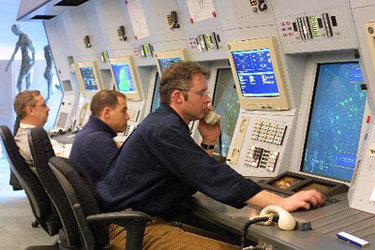
First EGNOS signal in space
ESA PR 34-2003. After several years of initial definition, detailed design, production and deployment activities, the EGNOS (European Geostationary Navigation Overlay Service) system started its first signal transmission tests in April.
This system is Europe’s first venture into satellite navigation and by early next year will deliver the first European Satellite Navigation service. It will augment the two military satellite navigation systems now operating, the US GPS and Russian GLONASS, making them suitable for many mass market applications such as car navigation, bus and truck fleet management, but also for specific applications such as assisting blind people when walking in an unknown area. In addition, after a certification process, EGNOS will be used for safety-critical applications such as flying aircraft or navigating ships through narrow channels.
When completed, EGNOS will consist of three geostationary satellites and a network of ground stations that will transmit signals containing information on the reliability and accuracy of the positioning signals sent out by GPS and GLONASS. It will enable users in Europe and beyond to determine their position within 2m compared with about 20m with GPS.
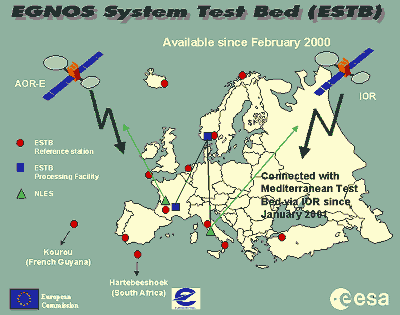
Since 2000 a prototype of the system (the EGNOS System Test Bed, ESTB) has been providing test signals, fully demonstrating its worth and validity.
By spring 2004 the full network needed for this augmentation system will have been deployed all around Europe and beyond. It will comprise monitoring stations, called RIMSs (Ranging and Integrity Monitoring Stations), and several Master Control Centres, the first of which is already installed in Langen, Germany.
Altogether, nearly 40 stations will be deployed.
This installation phase includes the testing of all equipment. This necessitates the availability of a signal in space and that is why the first signal is so important.
EGNOS is a joint project of the European Space Agency, the European Commission and Eurocontrol, the European Organisation for the Safety of Air Navigation. It is Europe’s contribution to the first stage of the global navigation satellite system (GNSS) and is a precursor to Galileo, the full global satellite navigation system under development in Europe.
Event in Langen, Germany

This “first signal in space” of the satellite system will be relayed from the first EGNOS master control centre in Europe, located in the DFS air traffic control centre in Langen, near Frankfurt (Germany).
The European Space Agency and DFS are pleased to invite you to this event, which takes place on 6 June at 10:30 hrs at the headquarters of DFS Deutsche Flugsicherung GmbH - Am DFS-Campus 10 - 63225 Langen (Germany).
Dieter Kaden, DFS Chairman and Chief Executive Officer, and Claudio Mastracci, ESA Director of Application Programmes, will be there to describe the various functionalities of the system.
We would appreciate it if you would reply by fax as soon as possible to DFS using the attached form or contact us by telephone on +49 6103 707-4111 or by e-mail to claudia.sielaff@dfs.de
For more information on EGNOS:
ESA Applications Directorate
Dominique Detain
Tel: + 33(0)1.5369.7726
dominique.detain@esa.int