• → European Space Agency

      • Space for Europe
      • Space News
      • Space in Images
      • Space in Videos
    • About Us

      • Welcome to ESA
      • DG's News and Views
      • For Member State Delegations
      • Business with ESA
      • ESA Exhibitions
      • ESA Publications
      • Careers at ESA
    • Our Activities

      • Space News
      • Observing the Earth
      • Human Spaceflight
      • Launchers
      • Navigation
      • Space Science
      • Space Engineering
      • Operations
      • Technology
      • Telecommunications & Integrated Applications
    • For Public

    • For Media

    • For Educators

    • For Kids

    • ESA

    • Navigation

    • EGNOS

    • Galileo

    • Evolution

    • About satellite navigation
    • Europe's satellite navigation services
    • Resources
    • Development Facilities
    • Navipedia
    • Multimedia
    • Galileo's In-Orbit Validation phase - 2012 video
    • Galileo - Europe leads the way 3D video
    • Image gallery
    • Video gallery
    • Documents
    • Galileo factsheet (PDF)
    • Galileo IOV factsheet (PDF)
    • Galileo FOC factsheet (PDF)
    • GNSS Evolution factsheet (PDF)
    • Galileo IOV brochure (PDF)
    • Galileo IOV brochures in French and German (PDF)
    • Archives
    • News archive
    • Navigation projects
    • Services
    • Subscribe

    ESA > Our Activities > Navigation

    GIOVE-B arrives at ESTEC for final tests

    10 September 2007

    GIOVE-B, the second experimental satellite in the Galileo Programme, has arrived at ESA's European Space Research and Technology Centre in Noordwijk, The Netherlands, for its final tests.

    An industrial consortium led by EADS Astrium GmbH was responsible for the construction of GIOVE-B. The satellite's main purpose is to secure the availability of the Galileo Signal-In-Space (SIS) after GIOVE-A reaches the end of its service life, which is expected to occur in March 2008.
     
    Compared with GIOVE-A, GIOVE-B will fly new on-board technologies such as:

    • a passive hydrogen maser, used as a precise time reference
    • a different type of navigation signal generator
    • solid-state radio transmitters
    • a different design of L-band antenna to broadcast the navigation signals
    • an alternative type of radiation monitor to continue characterising the environment in medium-Earth orbit

    The combined in-orbit experience gained with GIOVE-A and GIOVE-B will constitute an invaluable resource for the Galileo In-Orbit Validation (IOV) programme and for the completion of the operational Galileo satellites.
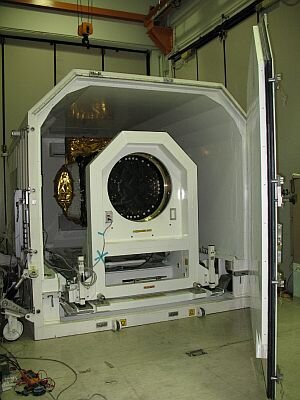
    GIOVE-B in transport container
    GIOVE-B in transport container

    The GIOVE-B spacecraft has recently completed its thermal vacuum test, which simulated the heating and cooling conditions it will encounter in space, at the Thales-Alenia Space facilities in Rome. It has been delivered to the European Space Research and Technology Centre (ESTEC) for final testing in the ESTEC Test Centre.
     
    The final test campaign will include:

    • vibration and acoustic tests
    • an electromagnetic compatibility test and passive intermodulation tests
    • electrical fit checks with the launcher adapter
    • a solar array deployment test
    • interface tests with the ground operations centre, under the responsibility of Telespazio
    • alignment checks
    • propulsion subsystem functional tests
    • final satellite-level performance tests

    At the end of the test campaign at ESTEC, currently expected in mid-November 2007, the satellite will be transported to the Baikonur Cosmodrome in Kazakhstan. There, the launch campaign will be commenced, leading to a launch by the end of the year aboard a Soyuz-Fregat launcher.
     
    In 2009, the first two satellites of the operational Galileo constellation will be launched, followed by the second two operational satellites in 2010. They will be used for in-orbit verification of the Galileo system design before being joined by the 26 additional spacecraft required for full operations by the end of 2013.
     
    Galileo is a joint initiative between ESA and the European Commission. When fully deployed in the early years of the next decade, it will be the first civilian positioning system to offer global coverage.

    Rate this

    Views

    Share

    • Currently 0 out of 5 Stars.
    • 1
    • 2
    • 3
    • 4
    • 5
    Rating: 0/5 (0 votes cast)

    Thank you for rating!

    You have already rated this page, you can only rate it once!

    Your rating has been changed, thanks for rating!

    22
    Tweet
    • Related news
      • GIOVE-A test campaign completed
        • First Colloquium on Scientific and Fundamental Aspects of the Galileo Programme
          • Galileo rubidium clocks – a year of in-orbit experience
            • GIOVE-A transmits first navigation message
              • GIOVE-A2 to secure the Galileo programme
                • GIOVE A transmits loud and clear
                • Related links
                • Galileo website (European Commission)
                • European GNSS Agency
                • EADS Astrium

    Connect with us

    • RSS
    • Youtube
    • Twitter
    • Flickr
    • G+
    • Facebook
    • Livestream
    • Subscribe
    • App Store
    • LATEST ARTICLES
    • · ESA astronaut Timothy Peake set fo…
    • · Space drives e-mobility
    • · Proba-V opens its eyes
    • · First new Galileo satellite arrive…
    • · Next destination: space
    • FAQ

    • Jobs at ESA

    • Site Map

    • Contacts

    • Terms and conditions