Global network to track Sun’s effect on Earth
Next year the Sun enters the most active phase of its 11-year cycle. ESA is establishing a worldwide chain of monitoring stations to give a ringside seat to see how this solar activity affects our upper atmosphere, and assess the consequences for satellite navigation and communications.
ESA’s Monitor project will track changes to Earth’s ‘ionosphere’, a shell of plasma towards the top of the atmosphere.
Its sensor station network is being set up in advance of the next solar maximum, predicted for mid-2013.
“The current Monitor network is still being developed but has already been detecting mild ionospheric storms,” said Roberto Prieto-Cerdeira, heading the project.
Monitor stations work by measuring variations in GPS signals with greater accuracy than existing systems.
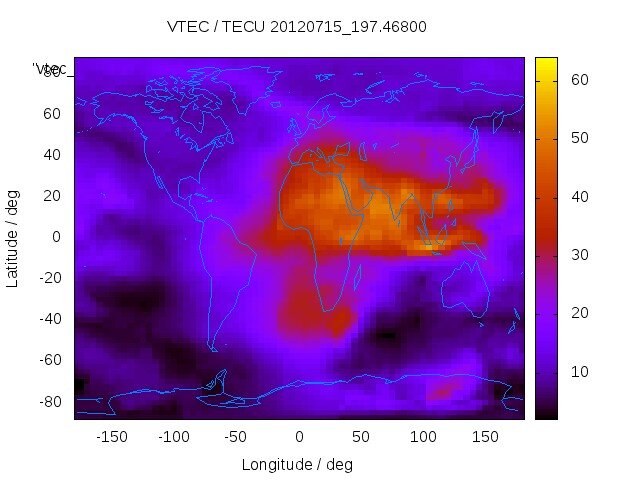
“We are placing sensor stations around the globe, but the vicinity of the equator is a particular focus of interest,” added Roberto. “It exhibits much more dynamic behaviour than the mid-latitudes.
“So we have established stations at Cape Verde off West Africa and Malindi, Kenya, on the other side of the continent.
“In addition, through a deal with French space agency CNES, we will have access to stations hosted by existing tracking sites at Libreville, Gabon and Ascension Island in the mid-Atlantic, the latter site being where the magnetic equator diverts from the geographic equator.
“Further sensor stations under consideration are Maspalomas in the Canary Islands and Kourou in French Guiana.
“Stations in Kevo and Sodankylä in the Arctic, provide high-latitude coverage.”
Ionospheric influences
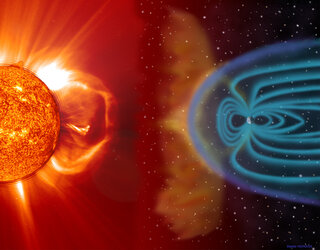
Earth’s atmosphere is made up of onion-like layers. The ionosphere is a layer of electrically charged particles strongly influenced by the Sun, discovered by 20th-century radio pioneers who bounced long-wave radio signals off it.
With the coming of the Space Age, radio signals started passing through the ionosphere to and from orbiting satellites.
Today, everyday life is more reliant than ever on space systems – although the current generation of satellite navigation technology has never experienced a ‘solar max’.
The ionosphere becomes most turbulent as the Sun’s warming thickens it, and then again in the evening as cooling leads to turbulence – including the production of ‘plasma bubbles’ – with the greatest dynamic change around Earth’s magnetic equator.
The effect on radio systems includes signal delay – an important detrimental factor for satnav, where ranging is based on timing accuracy of a billionth of a second – and signal-scattering ‘scintillations’ that render the signal unstable.

The Monitor sensor stations record scientific ionospheric information to help in the development of future versions of Galileo and the European Geostationary Navigation Overlay Service (EGNOS), although the latter, being an operational system for safety-critical civil aviation, additionally monitors the performance of GPS satellites to sharpen the accuracy and guarantee the integrity of GPS across European territory.
“This project’s results could well help improve EGNOS performance, such as helping develop techniques to maintain signal lock during heavy scintillations,” said Bertram Arbesser-Rastburg, head of ESA’s Electromagnetics and Space Environment division.
“In addition, detailed knowledge of equatorial ionospheric behaviour will be essential if the decision is one day taken to extend EGNOS coverage from Europe to Africa.”
Monitor

Funded through ESA’s GNSS Evolution programme to develop next-generation satnav systems, Monitor is the work of a large pan-European consortium including IEEA (France), DLR (Germany), Thales Alenia Space (France and Italy), Jena Optronik (Germany), gAGE/UPC (Spain), QinetiQ (UK), CLS (France), Finnish Meteorological Institute (Finland), GMV (Spain), Enst Bretagne (France) and ICTP (Italy).
Monitor also intends to establish collaboration and share data with other networks like the US-led Low-Latitude Ionospheric Sensor Network (LISN), which covers Central and South America and the Canadian High Arctic Ionospheric Network (CHAIN).
Additional Monitor stations comprise Lima in Peru, Tahiti in French Polynesia, Noordwijk in the Netherlands and Milan in Italy, along with other stations inherited with previous ESA projects: Cayenne in French Guiana, Koudougou in Burkina Faso, Hanoi in Vietnam and Kiruna in Sweden.
This activity is taking place as part of ESA's GNSS Evolution programme, which supports the development of next generation European satellite navigation systems.