

How the Galileo atomic clocks work
For a satellite navigation system to work correctly, it is necessary that the signals broadcast by the satellites are transmitted synchronously. In order to achieve this, the satellites carry very stable clocks.
The Galileo satellites carry two types of clocks: rubidium atomic frequency standards and passive hydrogen masers. The stability of the rubidium clock is so good that it would lose only three seconds in one million years, while the passive hydrogen maser is even more stable and it would lose only one second in three million years. However this kind of stability is really needed, since an error of only a few nanoseconds (billionths of a second) on the Galileo measurements would produce a positioning error of metres which would not be acceptable.
An atomic clock works like a conventional clock but the time-base of the clock, instead of being an oscillating mass as in a pendulum clock, is based on the properties of atoms when transitioning between different energy states.
An atom, when excited by an external energy source, goes to a higher energy state. Then, from this state, it goes to a lower energy state. In this transition, the atom releases energy at a very precise frequency which is characteristic of the type of atom. This is like a signature for the type of material used. All that is needed for making a good clock is a way of detecting this frequency and using it as an input to a counter. This is the principle behind an atomic clock.
The transitions between energy states can take place by releasing or absorbing energy at optical or microwave frequencies. An atomic second corresponds to 9 192 631 700 counts of the frequency of the energy detected in the transition of the Cesium 133 isotope when exposed to suitable excitation.
Rubidium clock
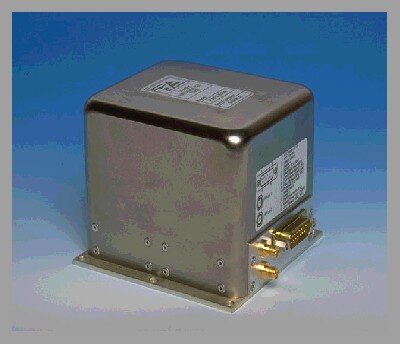
The Galileo rubidium clock is made of an atomic resonator and its associated control electronics. Inside the atomic resonator there is a rubidium vapour cell. The atoms are kept in a gaseous state at high temperature. In order to initiate the resonance, the atoms of the cell are excited to a higher state by the light of a rubidium discharge lamp located in one end of the atomic resonator. At the other end of the resonator there is a photodiode which detects the amount of light that passes through the cell.
Following the excitation, the atoms decay to a lower state. From this state, the atoms are excited back to an intermediate level by injecting microwave energy in the resonator at a given frequency. Transition to the intermediate level only occurs if the frequency corresponds exactly to the one associated with this transition. When the atoms are in the intermediate state, the absorption of light is at a maximum.
The output of the photodiode is connected to control circuitry which adjusts the microwave frequency. The correct frequency is maintained by tuning the microwave source to obtain maximum light absorption. The resonance is maintained by the energy from the rubidium lamp, since the atoms in the intermediate state are again excited to the higher state and then decay to the lower state, from which the whole process starts again.
Hydrogen maser clock

The Galileo passive hydrogen maser clock is also made of an atomic resonator and its associated control electronics. In this clock, a small storage bottle supplies molecular hydrogen to a gas discharge bulb. Here molecules of hydrogen are dissociated into atomic hydrogen. After dissociation, the atoms enter a resonance cavity by passing through a collimator and a magnetic state selector. This magnetic state selector is used to let only atoms of the desired energy level enter a resonant cavity. Here the atoms are confined in a quartz storage bulb. Once in this storage bulb the hydrogen atoms tend to return to their 'fundamental' energy state, emitting a microwave frequency as they do so.
This frequency is detected by an interrogation circuit which locks an external signal to the 'natural' transition of the hydrogen atoms. Locking occurs when the injected frequency is the same as the resonant frequency of the atoms; this corresponds to an amplification of the microwave signal.
The resonant frequency of the microwave cavity is approximately 1.420 GHz. The clock's electronics includes circuitry for the control of the frequency plus the thermal control system to maintain the resonant cavity at the correct temperature.
The atomic resonator is very sensitive to the external environment (for example, magnetic field). Great care is required to keep environmental disturbances small so that the full performance potential of these sophisticated clocks can be realized.

