• → European Space Agency

      • Space for Europe
      • Space News
      • Space in Images
      • Space in Videos
    • About Us

      • Welcome to ESA
      • DG's News and Views
      • For Member State Delegations
      • Business with ESA
      • ESA Exhibitions
      • ESA Publications
      • Careers at ESA
    • Our Activities

      • Space News
      • Observing the Earth
      • Human Spaceflight
      • Launchers
      • Navigation
      • Space Science
      • Space Engineering
      • Operations
      • Technology
      • Telecommunications & Integrated Applications
    • For Public

    • For Media

    • For Educators

    • For Kids

    • ESA

    • Navigation

    • EGNOS

    • Galileo

    • Evolution

    • About satellite navigation
    • Europe's satellite navigation services
    • Resources
    • Development Facilities
    • Navipedia
    • Multimedia
    • Galileo's In-Orbit Validation phase - 2012 video
    • Galileo - Europe leads the way 3D video
    • Image gallery
    • Video gallery
    • Documents
    • Galileo factsheet (PDF)
    • Galileo IOV factsheet (PDF)
    • Galileo FOC factsheet (PDF)
    • GNSS Evolution factsheet (PDF)
    • Galileo IOV brochure (PDF)
    • Galileo IOV brochures in French and German (PDF)
    • Archives
    • News archive
    • Navigation projects
    • Services
    • Subscribe

    ESA > Our Activities > Navigation

    Signal-in-Space through the Internet

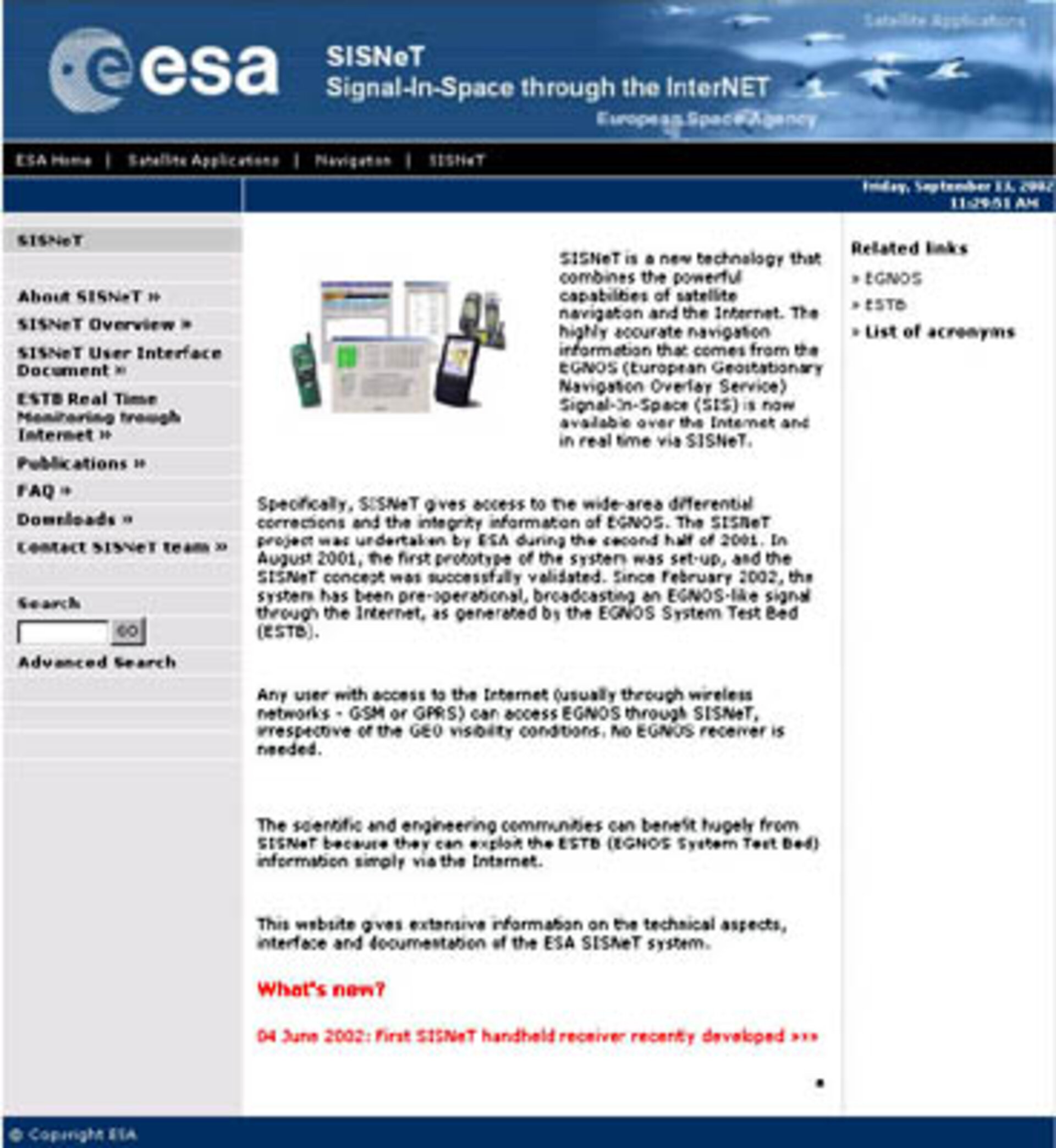
    SISNeT website
    SISNeT website
    19 September 2002

    SISNeT is a new technology developed by the European Space Agency (ESA) that makes satellite navigation accessible via the Internet. Anyone with an Internet connection can tap into this service.

    The SISNeT (Signal-in-Space through Internet) specialist website gives extensive information on the general and technical aspects, interface and documentation of the SISNeT system. It includes resources for:

    • scientists and engineers interested in the development of SISNeT applications
    • people interested in the general aspects of the SISNeT technology
    • people wanting to know about existing or planned SISNeT applications and their added value

    The highly accurate navigation information made available by SISNeT comes from the EGNOS (European Geostationary Navigation Overlay Service) Signal-In-Space (SIS). The information is available in real time across the Internet. Without SISNeT this information could only be accessed using an EGNOS receiver.

    Current applications of the SISNeT technology have included the development of a handheld receiver, based on an iPAQ Personal Digital Assistant (PDA). This has been demonstrated in a car as a navigation tool and outstrips the accuracy of current GPS systems. The system will be tested at the end of this year in buses around urban areas.

    Other SISNeT applications are currently being assessed at ESA. One promising application aims at providing guidance information to blind pedestrians. While the performance of GPS-only systems in urban environments may not provide adequate accuracy for all of these applications, the combination with SISNeT may be an excellent solution.

    Rate this

    Views

    Share

    • Currently 0 out of 5 Stars.
    • 1
    • 2
    • 3
    • 4
    • 5
    Rating: 0/5 (0 votes cast)

    Thank you for rating!

    You have already rated this page, you can only rate it once!

    Your rating has been changed, thanks for rating!

    106
    Tweet
    • Related news
    • Navigate via the web with the SISNeT receiver
    • Related links
    • SISNeT
    • About EGNOS
    • What is EGNOS?
    • How does EGNOS work?
    • Who's involved in EGNOS?
    • Who benefits from EGNOS
    • Interoperability
    • Satellite navigation today
    • Videos
    • Click to start video
      SISNeT receiver (real player)
    • Click to start video
      SISNeT receiver (real player)
    • Click to start video
      SISNeT receiver (windows media file)
    • Click to start video
      SISNeT receiver (windows media file)

    Connect with us

    • RSS
    • Youtube
    • Twitter
    • Flickr
    • G+
    • Facebook
    • Livestream
    • Subscribe
    • App Store
    • LATEST ARTICLES
    • · Proba-V opens its eyes
    • · First new Galileo satellite arrive…
    • · Next destination: space
    • · Leak repaired on International Spa…
    • · After Chelyabinsk: European expert…
    • FAQ

    • Jobs at ESA

    • Site Map

    • Contacts

    • Terms and conditions