• → European Space Agency

      • Space for Europe
      • Space News
      • Space in Images
      • Space in Videos
    • About Us

      • Welcome to ESA
      • DG's News and Views
      • For Member State Delegations
      • Business with ESA
      • ESA Exhibitions
      • ESA Publications
      • Careers at ESA
    • Our Activities

      • Space News
      • Observing the Earth
      • Human Spaceflight
      • Launchers
      • Navigation
      • Space Science
      • Space Engineering
      • Operations
      • Technology
      • Telecommunications & Integrated Applications
    • For Public

    • For Media

      • Media
      • ESA TV
      • Videos for professionals
      • Photos
    • For Educators

    • For Kids

    • ESA

    • Observing the Earth

    • Understanding Our Planet

    • Securing Our Environment

    • Benefiting Our Economy

    • About Observing the Earth

      • How does Earth Observation work?
      • How to get Earth observation data
      • Integrating Earth Observation in your job
      • Earth Observation users speak
    • EO programmes
    • The Living Planet
    • GMES
    • ESA's Earth Observing missions
    • Envisat overview
    • ERS overview
    • Earth Explorers overview
    • Sentinels overview
    • MSG overview
    • MetOp overview
    • Proba-1 overview
    • Third Party Missions overview
    • Opportunities with us

      • Education & training
      • International cooperation
      • Milestones & announcements
    • Multimedia

      • Image Gallery
      • Video Gallery
      • Online resources
      • RSS feeds
    • Services
    • Subscribe

    ESA > Our Activities > Observing the Earth

    ESA attending UN Climate Conference

    Climate Change Initiative
    29 November 2010

    Representatives from 194 countries have gathered at the 2010 UN Climate Change Conference in Cancun, Mexico, to continue working towards tackling climate change.

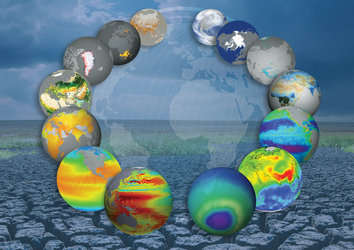
    ESA is attending 'COP16' to update negotiators on satellite observations of climate, and to explain how the ESA Climate Change Initiative will provide consistent data to help scientists better understand climate change.

    Our climate is a complex system made up of many different parts, all interacting together. No one part can be understood in isolation. Instead, measurements of all individual climate variables need to be combined.

    By using these new datasets to feed climate models, scientists can simulate the past, understand the present and improve their models to better predict the climate of the future.

    The Climate Change Initiative will combine data from satellites going back three decades with observations from new missions to produce consistent, long-term records for a wide range of essential climate variables such as sea level rise, ice extent and thickness, sea-surface temperature, and vegetation cover. Climate research and modelling communities worldwide will have free access to these data.

    The information is required by the Global Climate Observing System (GCOS) to support the UN Framework Convention on Climate Change (UNFCCC) and the scientific work of the Intergovernmental Panel on Climate Change.

    ESA will maintain an exhibit throughout COP16 (the 16th Conference of the Parties) and host a special side event on the Climate Change Initiative on 2 December, where top climate scientists will show examples of essential climate variables – such as sea level trends and forest fires) explaining how they are used to develop and validate climate models. The coordinated efforts of space agencies worldwide to provide climate data will also be outlined.

    The event will highlight the contribution of ESA’s Living Planet Programme, including two decades of observations from ERS and Enivsat, the recent Earth Explorer scientific missions and the Global Monitoring for Environment and Security (GMES) operational programme, which will maintain a constellation of satellites continuously monitoring 24 of the 44 essential climate variables for the next three decades.

    Discussions at COP16, 29 November – 10 December, are focusing on how countries should reduce their carbon emissions to ensure that global temperature rise does not exceed 2ºC.

    Another hot topic under the spotlight is the Reducing Emissions from Deforestation and Degradation (REDD+) scheme, which uses satellite observations of forests, that involves developed and developing countries working together for carbon offsetting.
    Rate this

    Views

    Share

    • Currently 0 out of 5 Stars.
    • 1
    • 2
    • 3
    • 4
    • 5
    Rating: 0/5 (0 votes cast)

    Thank you for rating!

    You have already rated this page, you can only rate it once!

    Your rating has been changed, thanks for rating!

    55
    Tweet
    • Space for our climate
    • COP16 Cancun 2010
    • In depth
    • GMES
    • Related links
    • UN Framework Convention on Climate Change (UNFCCC)
    • ESA Euronews: Global warming - the big picture

    Connect with us

    • RSS
    • Youtube
    • Twitter
    • Flickr
    • G+
    • Facebook
    • Livestream
    • Subscribe
    • App Store
    • LATEST ARTICLES
    • · Rare merger reveals secrets of gal…
    • · Watching for hazards: ESA opens as…
    • · ESA astronaut Timothy Peake set fo…
    • · Space drives e-mobility
    • · Proba-V opens its eyes
    • FAQ

    • Jobs at ESA

    • Site Map

    • Contacts

    • Terms and conditions