• → European Space Agency

      • Space for Europe
      • Space News
      • Space in Images
      • Space in Videos
    • About Us

      • Welcome to ESA
      • DG's News and Views
      • For Member State Delegations
      • Business with ESA
      • ESA Exhibitions
      • ESA Publications
      • Careers at ESA
    • Our Activities

      • Space News
      • Observing the Earth
      • Human Spaceflight
      • Launchers
      • Navigation
      • Space Science
      • Space Engineering
      • Operations
      • Technology
      • Telecommunications & Integrated Applications
    • For Public

    • For Media

    • For Educators

    • For Kids

    • ESA

    • Observing the Earth

    • Understanding Our Planet

    • Securing Our Environment

    • Benefiting Our Economy

    • About Observing the Earth
    • How does Earth Observation work?
    • How to get Earth observation data
    • Integrating Earth Observation in your job
    • Earth Observation users speak
    • EO programmes
    • The Living Planet
    • GMES
    • ESA's Earth Observing missions
    • Envisat overview
    • ERS overview
    • Earth Explorers overview
    • Sentinels overview
    • MSG overview
    • MetOp overview
    • Proba-1 overview
    • Third Party Missions overview
    • Opportunities with us

      • Education & training
      • International cooperation
      • Milestones & announcements
    • Multimedia

      • Image Gallery
      • Video Gallery
      • Online resources
      • RSS feeds
    • Services
    • Subscribe

    ESA > Our Activities > Observing the Earth

    Earth from Space: Bumpy borders

    9 December 2011

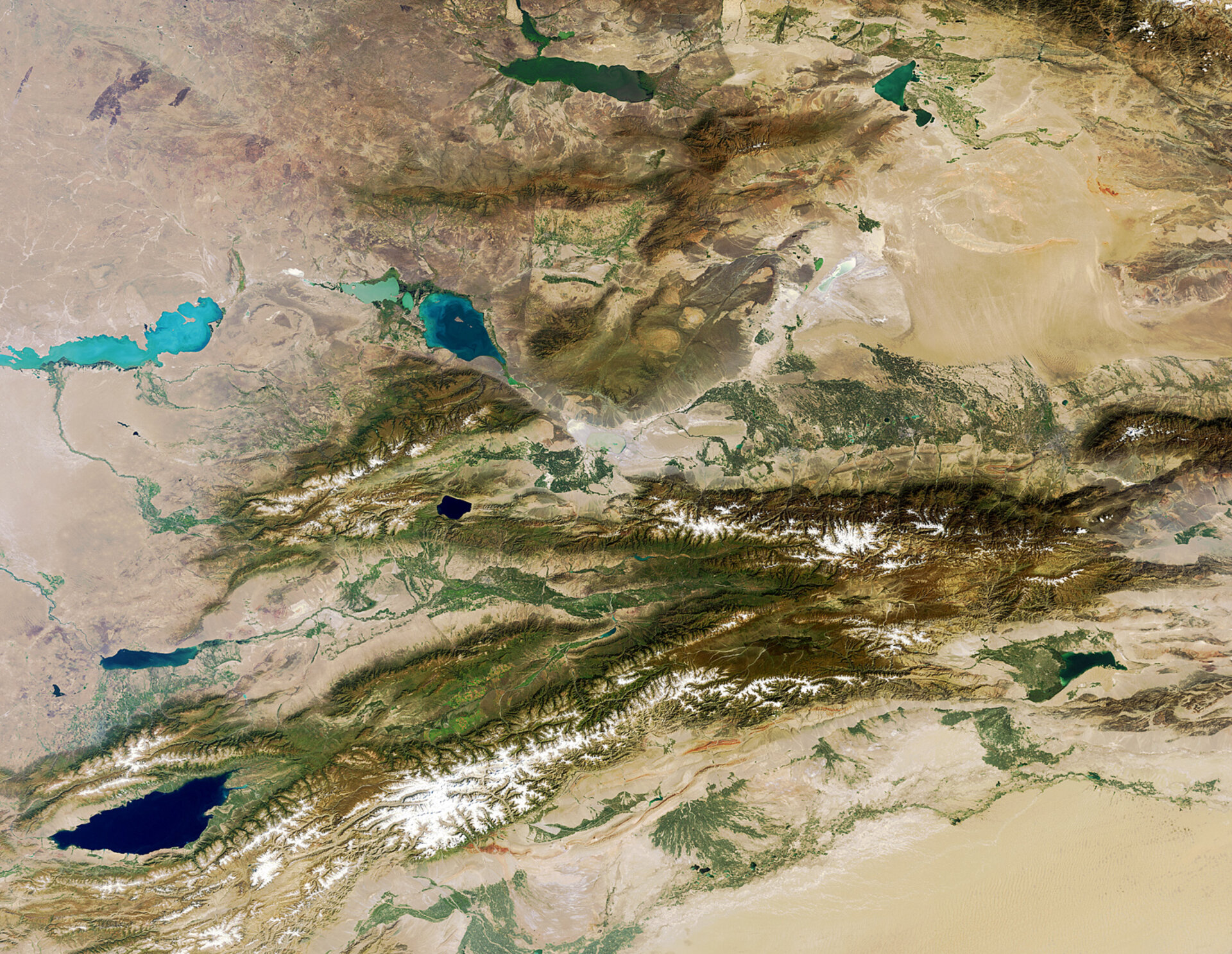
    The Tian Shan mountains, stretching across the border region of Kazakhstan, Kyrgyzstan and western China, are pictured in this Envisat image.

    As one of the longest mountain ranges in Central Asia, the Tian Shan mountain range is about 2800 km long. They are home to evergreen spruce trees at altitudes of over 2000 m, while the lower slopes have natural forests of wild walnuts and apples.

    The large, dark lake that splits the mountain range in eastern Kyrgyzstan (lower-left corner) is the second largest saline lake after the Caspian Sea.

    Named Issyk Kul – meaning ‘hot lake’ in the Kyrgyz language because it never freezes over – it covers an area of over 6000 sq km and reaches over 600 m deep.

    This was a stopover point on the Silk Road from the Far East to Europe, and some historians say it was the point of origin for the Black Death during the 14th century.

    In the upper-right corner are the Dzungarian Basin and its Gurbantunggut Desert in light brown.

    This image was acquired on 7 September 2011 by Envisat’s Medium Resolution Imaging Spectrometer.

    The Image of the Week is featured on ESA Web-TV, broadcast online every Friday at 10:00 CET.

    Rate this

    Views

    Share

    • Currently 0 out of 5 Stars.
    • 1
    • 2
    • 3
    • 4
    • 5
    Rating: 0/5 (0 votes cast)

    Thank you for rating!

    You have already rated this page, you can only rate it once!

    Your rating has been changed, thanks for rating!

    27
    facebook
    twitter
    reddit
    google plus
    digg
    tumbler
    digg
    blogger
    myspace
    • Image of the week archive
    • Satellite Images
      Satellite Images
      Earth images gallery
    • Related missions
      • Envisat overview
      • Image of the week on ESA Web-TV

    Connect with us

    • RSS
    • Youtube
    • Twitter
    • Flickr
    • Google Buzz
    • Subscribe
    • App Store
    • LATEST ARTICLES
    • · CryoSat hits land
    • · Ariane 5 completes seven launches …
    • · Measuring skull pressure without t…
    • · Malargüe station inauguration
    • · The solar wind is swirly
    • FAQ

    • Jobs at ESA

    • Site Map

    • Contacts

    • Terms and conditions