• → European Space Agency

      • Space for Europe
      • Space News
      • Space in Images
      • Space in Videos
    • About Us

      • Welcome to ESA
      • DG's News and Views
      • For Member State Delegations
      • Business with ESA
      • ESA Exhibitions
      • ESA Publications
      • Careers at ESA
    • Our Activities

      • Space News
      • Observing the Earth
      • Human Spaceflight
      • Launchers
      • Navigation
      • Space Science
      • Space Engineering
      • Operations
      • Technology
      • Telecommunications & Integrated Applications
    • For Public

    • For Media

    • For Educators

    • For Kids

    • ESA

    • Observing the Earth

    • Understanding Our Planet

    • Securing Our Environment

    • Benefiting Our Economy

    • About Observing the Earth
    • How does Earth Observation work?
    • How to get Earth observation data
    • Integrating Earth Observation in your job
    • Earth Observation users speak
    • EO programmes
    • The Living Planet
    • GMES
    • ESA's Earth Observing missions
    • Envisat overview
    • ERS overview
    • Earth Explorers overview
    • Sentinels overview
    • MSG overview
    • MetOp overview
    • Proba-1 overview
    • Third Party Missions overview
    • Opportunities with us

      • Education & training
      • International cooperation
      • Milestones & announcements
    • Multimedia

      • Image Gallery
      • Video Gallery
      • Online resources
      • RSS feeds
    • Services
    • Subscribe

    ESA > Our Activities > Observing the Earth

    Earth from Space: Contrail graffiti

    27 March 2009

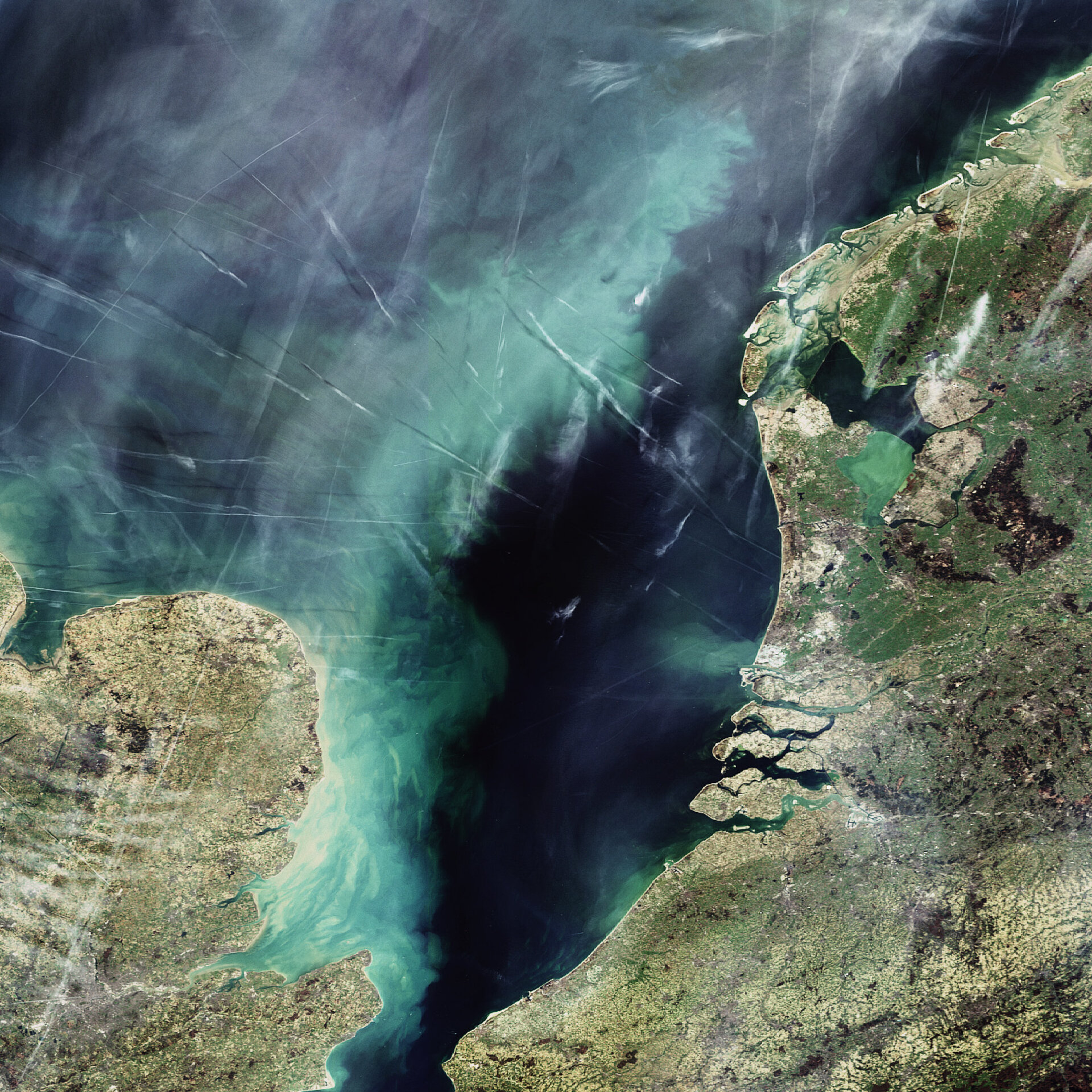
    This Envisat image over the North Sea captures numerous aircraft condensation trails, or 'contrails', as well as parts of the Netherlands (upper right), Belgium (lower right) and England (lower left).

    Exhaust emissions from jet aircraft contain large amounts of water vapour which, under certain atmospheric states, will condense to form ice crystals.

    These act as condensation nuclei around which even more water vapour in the surrounding air condenses. The end result is the formation of an elongated cloud-like condensation trail in the sky.

    Contrails can last anywhere from a few minutes to hours. They can also grow to form persistent artificial cirrus clouds that can last for days or weeks. Contrails and cirrus clouds could potentially have an impact on Earth’s climate by trapping the Earth's heat in our atmosphere in a similar way to greenhouse gases.

    The various colours of green visible in the sea are due to sediments transported in the water.

    This image was acquired by Envisat's Medium Resolution Imaging Spectrometer (MERIS) instrument on 21 March 2009, working in Full Resolution mode to provide a spatial resolution of 300 m.

    Rate this

    Views

    Share

    • Currently 0 out of 5 Stars.
    • 1
    • 2
    • 3
    • 4
    • 5
    Rating: 0/5 (0 votes cast)

    Thank you for rating!

    You have already rated this page, you can only rate it once!

    Your rating has been changed, thanks for rating!

    11
    facebook
    twitter
    reddit
    google plus
    digg
    tumbler
    digg
    blogger
    myspace
    • Image of the week archive
    • Satellite Images
      Satellite Images
      Earth images gallery
    • Related missions
      • Envisat overview

    Connect with us

    • RSS
    • Youtube
    • Twitter
    • Flickr
    • Google Buzz
    • Subscribe
    • App Store
    • LATEST ARTICLES
    • · CryoSat hits land
    • · Ariane 5 completes seven launches …
    • · Measuring skull pressure without t…
    • · Malargüe station inauguration
    • · The solar wind is swirly
    • FAQ

    • Jobs at ESA

    • Site Map

    • Contacts

    • Terms and conditions