• → European Space Agency

      • Space for Europe
      • Space News
      • Space in Images
      • Space in Videos
    • About Us

      • Welcome to ESA
      • DG's News and Views
      • For Member State Delegations
      • Business with ESA
      • ESA Exhibitions
      • ESA Publications
      • Careers at ESA
    • Our Activities

      • Space News
      • Observing the Earth
      • Human Spaceflight
      • Launchers
      • Navigation
      • Space Science
      • Space Engineering
      • Operations
      • Technology
      • Telecommunications & Integrated Applications
    • For Public

    • For Media

    • For Educators

    • For Kids

    • ESA

    • Observing the Earth

    • Understanding Our Planet

    • Securing Our Environment

    • Benefiting Our Economy

    • About Observing the Earth

      • How does Earth Observation work?
      • How to get Earth observation data
      • Integrating Earth Observation in your job
      • Earth Observation users speak
    • EO programmes
    • The Living Planet
    • GMES
    • ESA's Earth Observing missions
    • Envisat overview
    • ERS overview
    • Earth Explorers overview
    • Sentinels overview
    • MSG overview
    • MetOp overview
    • Proba-1 overview
    • Third Party Missions overview
    • Opportunities with us

      • Education & training
      • International cooperation
      • Milestones & announcements
    • Multimedia

      • Image Gallery
      • Video Gallery
      • Online resources
      • RSS feeds
    • Services
    • Subscribe

    ESA > Our Activities > Observing the Earth

    Earth from Space: Mountains of hunger

    16 November 2012

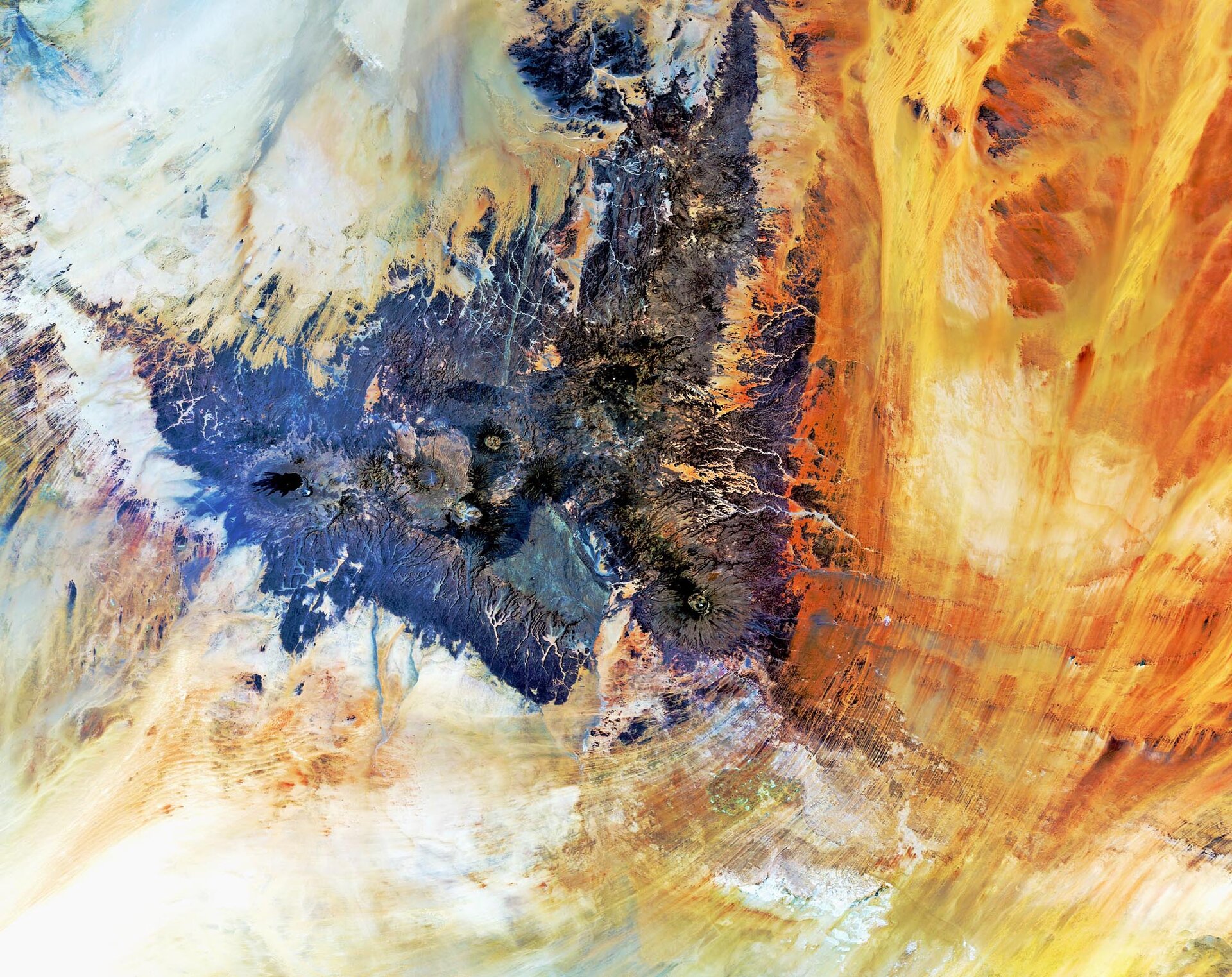
    The Tibesti Mountains, located mostly in Chad with the northern slopes extending into Libya, are captured in this Envisat image.

    This range of inactive – with some potentially active – volcanoes in the central Sahara desert covers about 100 000 sq km. Home to the Toubou people today, the region is known for its ancient cave paintings, mostly dating from the fifth to the third millennium BC.

    The isolated area with little vegetation is known as the 'mountains of hunger' because they can feed few people. Some plant life does exist, supporting populations of gazelle, Barbary sheep and cheetah.

    The mountains’ highest peak is Emi Koussi – pictured here as a circular structure in the lower-right portion of the dark area. Standing over 3400 m high, it is the tallest mountain in Chad and in the Sahara.

    The westernmost volcano is Toussidé. Our satellite view shows the dark peak with lava flows extending to the left. The white depression to the southeast gets its colour from the accumulation of carbonate salts, creating a soda lake.

    There are a number of hot springs and geysers throughout the mountain range. Local people use the hot and warm springs for medical purposes.

    Surrounding the Tibesti Mountains, the sands of the Sahara appear like orange, yellow and white brushstrokes.

    This image was acquired on 4 March by Envisat’s MERIS instrument.

    The Image of the Week is featured on ESA Web-TV, broadcast online every Friday at 10:00 CET.

    Rate this

    Views

    Share

    • Currently 0 out of 5 Stars.
    • 1
    • 2
    • 3
    • 4
    • 5
    Rating: 0/5 (0 votes cast)

    Thank you for rating!

    You have already rated this page, you can only rate it once!

    Your rating has been changed, thanks for rating!

    562
    Tweet
    • Image of the week archive
    • Satellite Images
      Satellite Images
      Earth images gallery
    • Related missions
      • Envisat overview
      • Image of the week on ESA Web-TV

    Connect with us

    • RSS
    • Youtube
    • Twitter
    • Flickr
    • G+
    • Facebook
    • Livestream
    • Subscribe
    • App Store
    • LATEST ARTICLES
    • · ESA astronaut Timothy Peake set fo…
    • · Space drives e-mobility
    • · Proba-V opens its eyes
    • · First new Galileo satellite arrive…
    • · Next destination: space
    • FAQ

    • Jobs at ESA

    • Site Map

    • Contacts

    • Terms and conditions