• → European Space Agency

      • Space for Europe
      • Space News
      • Space in Images
      • Space in Videos
    • About Us

      • Welcome to ESA
      • DG's News and Views
      • For Member State Delegations
      • Business with ESA
      • ESA Exhibitions
      • ESA Publications
      • Careers at ESA
    • Our Activities

      • Space News
      • Observing the Earth
      • Human Spaceflight
      • Launchers
      • Navigation
      • Space Science
      • Space Engineering
      • Operations
      • Technology
      • Telecommunications & Integrated Applications
    • For Public

    • For Media

    • For Educators

    • For Kids

    • ESA

    • Observing the Earth

    • Understanding Our Planet

    • Securing Our Environment

    • Benefiting Our Economy

    • About Observing the Earth
    • How does Earth Observation work?
    • How to get Earth observation data
    • Integrating Earth Observation in your job
    • Earth Observation users speak
    • EO programmes
    • The Living Planet
    • GMES
    • ESA's Earth Observing missions
    • Envisat overview
    • ERS overview
    • Earth Explorers overview
    • Sentinels overview
    • MSG overview
    • MetOp overview
    • Proba-1 overview
    • Third Party Missions overview
    • Opportunities with us

      • Education & training
      • International cooperation
      • Milestones & announcements
    • Multimedia

      • Image Gallery
      • Video Gallery
      • Online resources
      • RSS feeds
    • Services
    • Subscribe

    ESA > Our Activities > Observing the Earth

    Earth from Space: Multitude of mountains

    27 November 2009

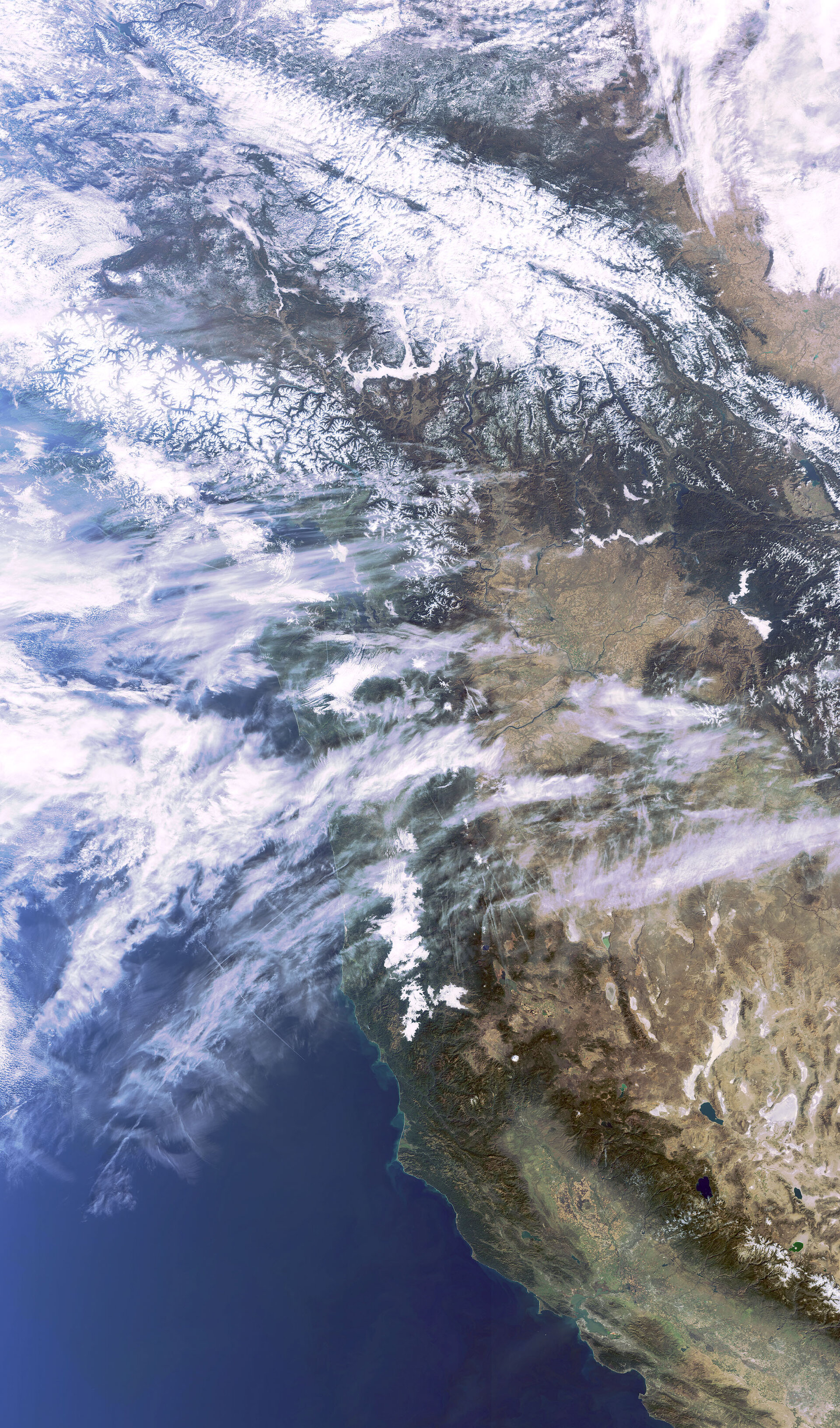
    This Envisat image features western North America, one of the most extensive mountainous regions on Earth.

    The Coast Mountains (snow-capped, visible top left) cover the Alaska Panhandle (not visible) in the U.S. and most of coastal British Columbia (top left) in Canada. Many glaciers have carved valleys, resulting in the formation of numerous fjords with precipitous cliffs that can rise 2100 m from the water along the Pacific coast.

    The Rocky Mountains (snow-capped, top centre), which include at least 100 separate ranges, stretch some 4800 km from northern Alberta and British Columbia southward to New Mexico, U.S.

    The Vancouver Island Range, a chain of mountains that appear as a series of islands, including Vancouver Island (snow-capped and partially cloud-covered, located in the southwestern corner of British Columbia), is visible running parallel to the coast of British Columbia.

    Covering more than 1200 km of the west coast, several U.S states are visible in the image, including Washington (beneath Vancouver Island) and California (from the middle of the image to bottom right hand corner).

    Numerous aircraft condensation trails, or 'contrails', over northern California and southern Oregon (above California) indicate heavy air traffic over the area.

    The Sierra Nevada mountain range is seen (brown, bottom right) in California and Nevada (east of California). Lake Tahoe (dark blue body of water located in the Sierra Nevada range) is located along the border between California and Nevada. Pyramid Lake (above Lake Tahoe), one of the largest lakes in the U.S., is located in Nevada.

    San Francisco Bay is visible near the bottom right in green. Sacramento Valley and the northern tip of the San Joaquin Valley are visible in green and tan to the east of the Sierra Nevada range.

    The Coast Range (snow-capped, visible northwest of Sierra Nevada) is a series of mountains along the Pacific coast, running from southern California through Oregon and into Washington. British Columbia’s Coast Mountains are not a continuation of these ranges but of the Cascade Range.

    This image was acquired by Envisat's Medium Resolution Imaging Spectrometer (MERIS) instrument on 3 November 2009, working in Full Resolution mode to provide a spatial resolution of 300 m.

    Rate this

    Views

    Share

    • Currently 0 out of 5 Stars.
    • 1
    • 2
    • 3
    • 4
    • 5
    Rating: 0/5 (0 votes cast)

    Thank you for rating!

    You have already rated this page, you can only rate it once!

    Your rating has been changed, thanks for rating!

    11
    facebook
    twitter
    reddit
    google plus
    digg
    tumbler
    digg
    blogger
    myspace
    • Image of the week archive
    • Satellite Images
      Satellite Images
      Earth images gallery
    • Related missions
      • Envisat overview
      • ESA on Youtube
      • Protecting our environment

    Connect with us

    • RSS
    • Youtube
    • Twitter
    • Flickr
    • Google Buzz
    • Subscribe
    • App Store
    • LATEST ARTICLES
    • · CryoSat hits land
    • · Ariane 5 completes seven launches …
    • · Measuring skull pressure without t…
    • · Malargüe station inauguration
    • · The solar wind is swirly
    • FAQ

    • Jobs at ESA

    • Site Map

    • Contacts

    • Terms and conditions