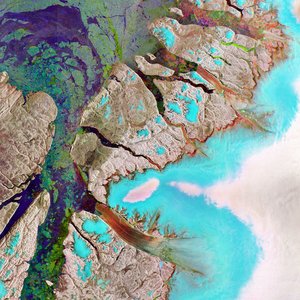
Greenland glacier gives birth to giant iceberg
Envisat has been observing a rare event in the Arctic since early August - a giant iceberg breaking off the Petermann glacier in North-West Greenland.
The Petermann glacier is one of the largest glaciers connecting the Greenland inland ice sheet with the Arctic Ocean. Upon reaching the sea, a number of these large outlet glaciers extend into the water with a floating 'ice tongue'.
The ice tongue of the Petermann glacier was the largest in Greenland, with an extension of about 70 km until early August. This tide-water glacier regularly advances towards the ocean at about 1 km per year. During the previous months, satellite images revealed that several cracks had appeared on the glacier surface, suggesting to scientists that a break-up event was imminent.

In the Envisat radar image taken on 3 August, the ice tongue was still intact but, on 4 August, a large part of the floating ice tongue was separated from the glacier, giving birth to what is currently the largest iceberg in the northern hemisphere. Such a process of detachment, called 'calving', occurs regularly on the Petermann glacier, with smaller calving events in summer 2008 and 2009. However large calving events are rare, with the last such significant event being documented in 1991 by ESA’s ERS-1 satellite.
The animation above was created by combining three Envisat Advanced Synthetic Aperture Radar (ASAR) acquisitions (31 July, 4 August and 7 August 2010) taken over the same area. The breaking of the glacier tongue and the movement of the iceberg can be clearly seen in this sequence.

The detached iceberg is now about 30 km by 14 km in size with an area of about 245 sq km. It is floating away from Petermann glacier and will enter into the Nares Strait, which separates Greenland from the Ellesmere Island in Canada.
The Nares Strait connects the Lincoln Sea and Arctic Ocean with the Baffin Bay. The strait is usually navigable by icebreakers during August/September, when sea ice extent is at its minimum after the summer melt period. Envisat ASAR images will be used in the coming days to monitor the movement of the giant iceberg in support of icebreaker navigation.
The radar imaging system used by Envisat and other satellites is particularly suited to observe polar areas, as it can acquire images through cloud or fog, and night and day.