• → European Space Agency

      • Space for Europe
      • Space News
      • Space in Images
      • Space in Videos
    • About Us

      • Welcome to ESA
      • DG's News and Views
      • For Member State Delegations
      • Business with ESA
      • ESA Exhibitions
      • ESA Publications
      • Careers at ESA
    • Our Activities

      • Space News
      • Observing the Earth
      • Human Spaceflight
      • Launchers
      • Navigation
      • Space Science
      • Space Engineering
      • Operations
      • Technology
      • Telecommunications & Integrated Applications
    • For Public

    • For Media

      • Media
      • ESA TV
      • Videos for professionals
      • Photos
    • For Educators

    • For Kids

    • ESA

    • Observing the Earth

    • Understanding Our Planet

    • Securing Our Environment

    • Benefiting Our Economy

    • About Observing the Earth

      • How does Earth Observation work?
      • How to get Earth observation data
      • Integrating Earth Observation in your job
      • Earth Observation users speak
    • EO programmes
    • The Living Planet
    • GMES
    • ESA's Earth Observing missions
    • Envisat overview
    • ERS overview
    • Earth Explorers overview
    • Sentinels overview
    • MSG overview
    • MetOp overview
    • Proba-1 overview
    • Third Party Missions overview
    • Opportunities with us

      • Education & training
      • International cooperation
      • Milestones & announcements
    • Multimedia

      • Image Gallery
      • Video Gallery
      • Online resources
      • RSS feeds
    • Services
    • Subscribe

    ESA > Our Activities > Observing the Earth

    Forests

    Originally the Earth had some 6.2 billion ha of forests, yet today less than a third of the Earth’s land surface is covered with trees. Deforestation has become particularly acute in the last few decades and according to some estimates, almost half of the world's tropical forests have been lost since the 1960s.

    Forests are invaluable. They act as the world’s lungs, absorbing the greenhouse gas carbon dioxide and converting it into oxygen; their roots help to prevent soil erosion and water runoff; and their trunks and branches act as windbreaks. Forests are also a source of food, wood for building, fuel for cooking and heating, and home to more of the world’s plant and animal species than any other habitat.

    Although the amount of forests is constantly decreasing due to fires, storms and encroachment onto forest land, of equal concern to foresters is the degradation of many of the world’s forests, leading to their inability to provide the goods and services demanded of them.
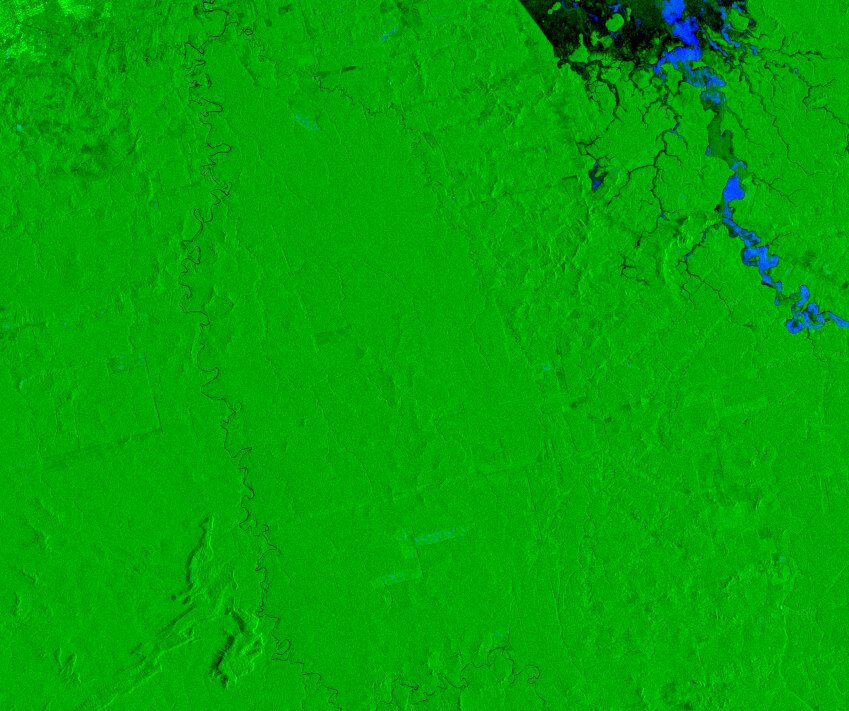
    Satellite image showing deforestation in North West Brasil
    Satellite image showing deforestation in North West Brasil

    Now that Envisat is in orbit, invaluable data will be available to help protect this important resource. For the first time, by combining multi-source data from ASAR, AATSR and MERIS, it will be possible to derive bio-geo information worldwide that can distinguish between forest cover, clear-cut logging and agricultural land, as well as monitor land-use changes. This will help to assess forest damage, and to quantify wood supply and production. Plus, in areas which are at risk and/or difficult to access, Envisat data can be used to provide reports every three days on how forest cover is changing.

    One of the greatest threats to our environment are forest fires - sometimes of natural origin but more often than not started deliberately. Each year thousands of trees all over the world literally go up in smoke. In Australia, at the beginning of 2002, fires burnt 1932 km of forests and shrub land across the state of New South Wales, shrouding Sydney in a pall of smoke. Every summer Europe braces itself for a spate of forest fires, particularly in Mediterranean areas.

    AATSR, on board Envisat, is able to detect the hot spots caused by forest fires and monitor the effects of the smoke particles floating in the highest layers of the atmosphere. Other instrument on board - MIPAS and SCHIAMACHY – can track the trace gases and aerosols which are the telltale signs of the large-scale burning of biomass. Help from space is now at hand to help the world's firefighters.

    Last update: 7 March 2002

    Rate this

    Views

    Share

    • Currently 0 out of 5 Stars.
    • 1
    • 2
    • 3
    • 4
    • 5
    Rating: 0/5 (0 votes cast)

    Thank you for rating!

    You have already rated this page, you can only rate it once!

    Your rating has been changed, thanks for rating!

    1
    Tweet
    • Envisat expected results
    • Envisat Expected Results Home Page
      • Oceans
        • Atmosphere
        • Land
          • Agriculture
            • Forests
              • Earthquakes
                • Floods
                  • Volcanoes
                  • Related links
                  • About Envisat
                  • Envisat Project Site
                  • EO Principal Investigator News
                  • Earthnet
                  • Envisat Launch
                  • Envisat multimedia links
                  • 3-D VRM Envisat model
                  • Earth Observation Gallery
                  • Envisat videos
                  • Envisat instruments

    Connect with us

    • RSS
    • Youtube
    • Twitter
    • Flickr
    • G+
    • Facebook
    • Livestream
    • Subscribe
    • App Store
    • LATEST ARTICLES
    • · Rare merger reveals secrets of gal…
    • · Watching for hazards: ESA opens as…
    • · ESA astronaut Timothy Peake set fo…
    • · Space drives e-mobility
    • · Proba-V opens its eyes
    • FAQ

    • Jobs at ESA

    • Site Map

    • Contacts

    • Terms and conditions