• → European Space Agency

      • Space for Europe
      • Space News
      • Space in Images
      • Space in Videos
    • About Us

      • Welcome to ESA
      • DG's News and Views
      • For Member State Delegations
      • Business with ESA
      • ESA Exhibitions
      • ESA Publications
      • Careers at ESA
    • Our Activities

      • Space News
      • Observing the Earth
      • Human Spaceflight
      • Launchers
      • Navigation
      • Space Science
      • Space Engineering
      • Operations
      • Technology
      • Telecommunications & Integrated Applications
    • For Public

    • For Media

    • For Educators

    • For Kids

    • ESA

    • Observing the Earth

    • Understanding Our Planet

    • Securing Our Environment

    • Benefiting Our Economy

    • About Observing the Earth
    • How does Earth Observation work?
    • How to get Earth observation data
    • Integrating Earth Observation in your job
    • Earth Observation users speak
    • EO programmes
    • The Living Planet
    • GMES
    • ESA's Earth Observing missions
    • Envisat overview
    • ERS overview
    • Earth Explorers overview
    • Sentinels overview
    • MSG overview
    • MetOp overview
    • Proba-1 overview
    • Third Party Missions overview
    • Opportunities with us

      • Education & training
      • International cooperation
      • Milestones & announcements
    • Multimedia

      • Image Gallery
      • Video Gallery
      • Online resources
      • RSS feeds
    • Services
    • Subscribe

    ESA > Our Activities > Observing the Earth

    Gabon

    7 October 2005

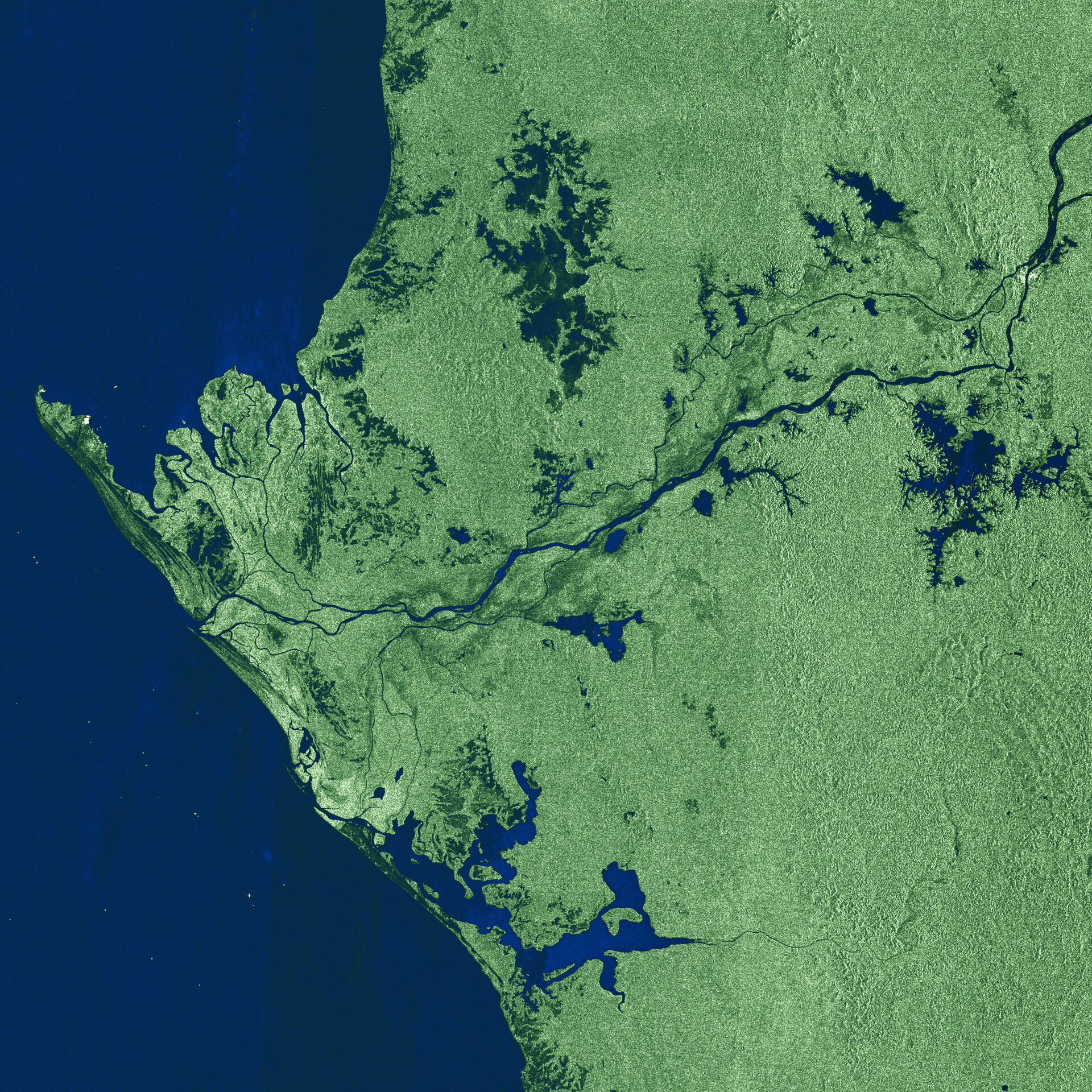
    This unobscured satellite view of Gabon shows how Envisat's radar sensor can acquire images over perennially cloudy regions effectively off-limits to its optical counterparts.

    Gabon is situated in Equatorial Africa, sharing borders with, Cameroon, the Republic of the Congo and Equatorial Guinea with its coast facing the Gulf of Guinea. The image illustrates how the country's geography is dominated by the watershed of the Ogooué (Ogowe) River, which drains almost the entire country, largely made up of undisturbed rainforest.

    The 900-km-long Ogooué rises in the northwest of the Bateke Plateau, running into the Gulf of Guinea where it forms a large delta south of Port Gentil, which is a major seaport and the second city of Gabon, located close to Cape Lopez, the most westerly point in the nation.

    Port Gentil is the centre of Gabon's petroleum and timber industries, although it is not connected by road to the rest of the nation. There are only 614 kilometres of tarred roads in Gabon. Instead the Ogooué River is the main means of transportation across the country, and also the main economic artery. In addition Gabon has almost 200 airstrips countrywide.

    Gabon's population is only 1.355 million, with one of the lowest population densities in the African continent, at 4.6 persons per square kilometre. Their per capita income however is four times higher than the sub-Saharan African average. This relatively low population has helped make possible a large number of national parks and protected areas across the country's forests, savannah and mountains.

    The region's hot and humid climate means that optical satellites can seldom acquire a cloud-free image of Gabon. By comparison, radar sensors measure surface texture instead of reflected light, so they can work through clouds and local darkness. They are also sensitive to bodies of water.

    This week ESRIN, ESA's European Centre for Earth Observation in Frascati, Italy has been hosting a Workshop of the TIGER Initiative. An outcome of the World Summit on Sustainable Development in Johannesburg in 2002, TIGER is about applying Earth Observation to improve the management and availability of water resources in developing countries, with a particular focus on Africa. ESA is currently supporting 50 TIGER projects across the African continent covering all stages of the water cycle.

    This false-colour image was acquired on 26 September 2005 by Envisat's Advanced Synthetic Aperture Radar (ASAR) operating in Wide Swath Mode, to provide pixel sampling of 185 metres.

    Rate this

    Views

    Share

    • Currently 0 out of 5 Stars.
    • 1
    • 2
    • 3
    • 4
    • 5
    Rating: 0/5 (0 votes cast)

    Thank you for rating!

    You have already rated this page, you can only rate it once!

    Your rating has been changed, thanks for rating!

    6
    facebook
    twitter
    reddit
    google plus
    digg
    tumbler
    digg
    blogger
    myspace
    • Image of the week archive
    • Satellite Images
      Satellite Images
      Earth images gallery
    • Related missions
      • Envisat overview
      • TIGER

    Connect with us

    • RSS
    • Youtube
    • Twitter
    • Flickr
    • Google Buzz
    • Subscribe
    • App Store
    • LATEST ARTICLES
    • · CryoSat hits land
    • · Ariane 5 completes seven launches …
    • · Measuring skull pressure without t…
    • · Malargüe station inauguration
    • · The solar wind is swirly
    • FAQ

    • Jobs at ESA

    • Site Map

    • Contacts

    • Terms and conditions