Novel technology
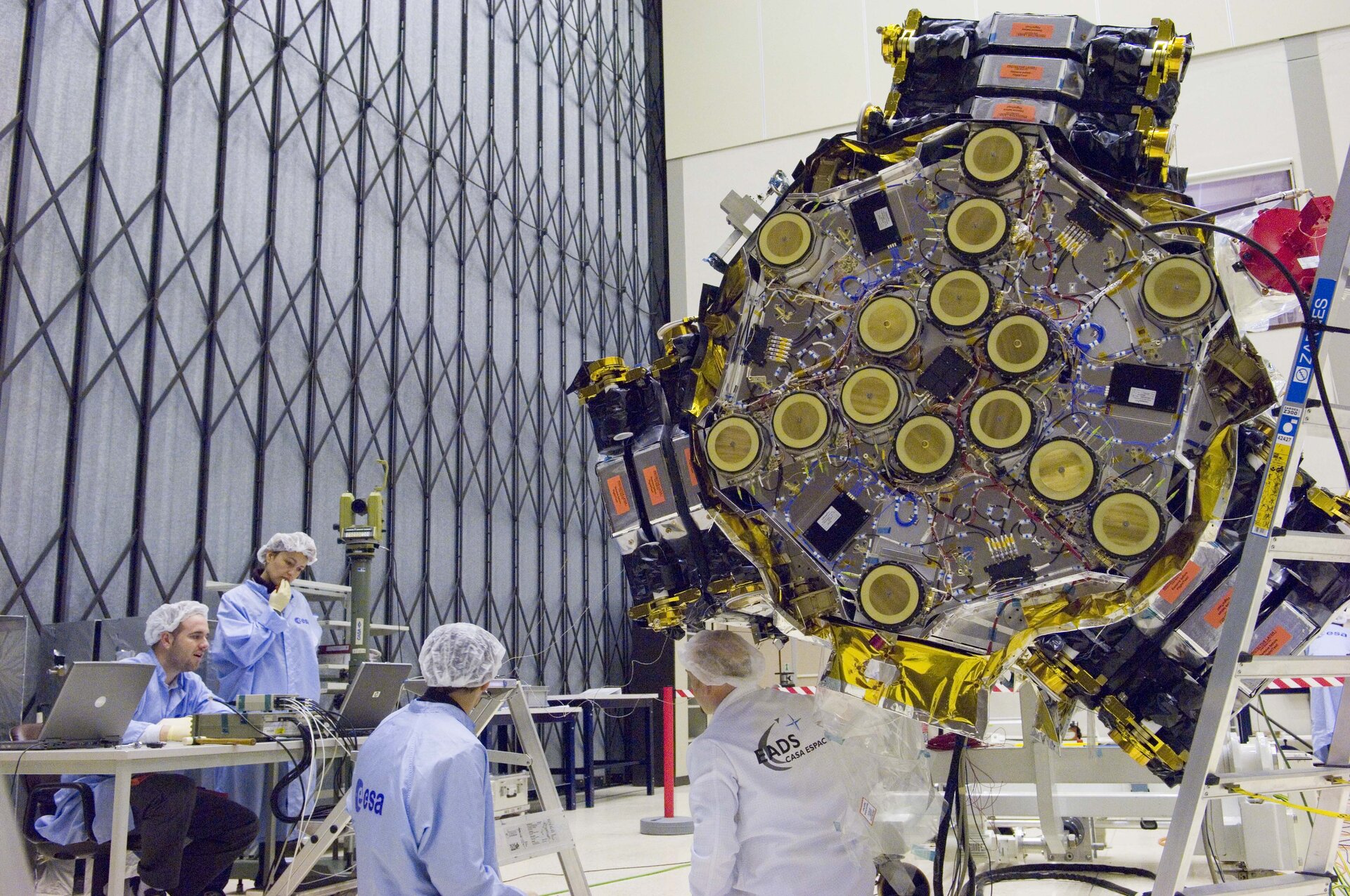
SMOS is designed to provide measurements of both soil moisture and ocean salinity with just one instrument: the 2D Microwave Imaging Radiometer with Aperture Synthesis, MIRAS.
This novel instrument uses a new measuring technique in space by operating at frequencies around 1.4 GHz (L-band) to capture images of emitted microwave radiation from Earth.
MIRAS is not the first L-band radiometer to be flown in space, but its truly novel approach sets it apart.
MIRAS’s job is to detect moisture in soil and salinity in water. The theory behind being able to do this is based on the contrast between the electromagnetic properties of liquid water and dry soil, and pure water and saline water.

Increases in the proportion of water in the soil-water mixture and salt in the saline mixture are detected by microwave sensors based on the amount of energy emitted. Detecting this microwave brightness temperature on the surface requires a long wavelength.
This presented a challenge because a long wavelength requires a big antenna, and big antennas are not easily operated in space.
Radio astronomers faced a similar problem in needing a large antenna to detect small signals from point sources in space at a long wavelength.
Since signals are detected as waves, signals from different telescopes can be added to synthesise the pinpointing of a much larger telescope.
To achieve this, radio astronomers combined 27 radio telescopes, each 25 m in diameter, and deployed them on a Y-shaped track that can be extended up to 35 km – the Very Large Array in New Mexico, US.
SMOS borrowed this technique of ‘aperture synthesis’ or ‘interferometry’– to mimic a much bigger antenna by placing 69 small antennas along three arms that together form a Y-shape.
The three deployable arms were folded up for launch, but once SMOS was in orbit each of the arms unfolded to form an unusual three-pointed star shape. Hence, with a diameter of eight metres, MIRAS is often dubbed a ‘star in the sky’.


Access the video
The 69 antenna elements, called LICEFs, are antenna-receiver integrated units, each measure radiation emitted from Earth’s surface at L-band. One LICEF antenna weighs 190 g, is 165 mm in diameter and 19 mm high.
MIRAS was built by a consortium of over 20 European companies led by EADS-CASA Espacio in Spain (now part of the Airbus Group).
Back to SMOS homepage |