• → European Space Agency

      • Space for Europe
      • Space News
      • Space in Images
      • Space in Videos
    • About Us

      • Welcome to ESA
      • DG's News and Views
      • For Member State Delegations
      • Business with ESA
      • ESA Exhibitions
      • ESA Publications
      • Careers at ESA
    • Our Activities

      • Space News
      • Observing the Earth
      • Human Spaceflight
      • Launchers
      • Navigation
      • Space Science
      • Space Engineering
      • Operations
      • Technology
      • Telecommunications & Integrated Applications
    • For Public

    • For Media

    • For Educators

    • For Kids

    • ESA

    • SMOS

    • Earth Explorers

    • Observing the Earth

    • Living Planet

    • SMOS at a glance
    • An Earth Explorer
    • Mapping soil moisture and ocean salinity
    • Improving our understanding of the water cycle
    • Introducing a novel use of technology
    • Facts and figures
    • About the satellite

      • Platform
      • Instrument
    • About the launch

      • Launch site
      • Launcher
    • SMOS in orbit

      • After liftoff
      • Data
    • Meet the team

      • Achim Hahne, Project Manager
      • Susanne Mecklenburg, Mission Manager
      • Matthias Drusch, Mission Scientist
      • Jordi Font, Co-Lead Investigator
      • Yann Kerr, Co-Lead Investigator
      • Manuel Martin-Neira, Instrument Principal Engineer
      • Guillermo Buenadicha, Payload Operations Engineer
      • Andrés Borges, EADS CASA Espacio Payload Project Manager
      • Roger Jegou, Launch Campaign Manager
      • Norrie Wright, Payload Data Ground Segment Manager
    • Multimedia
    • Image gallery
    • Videos
    • Online resources

    ESA > Our Activities > Observing the Earth > SMOS

    Mapping soil moisture

    Mapping soil moisture and ocean salinity

    The amount of water in the soil and salinity in the oceans may not seem connected, but, in fact, they are both key variables linked to Earth’s water cycle, affecting weather and climate. Variations of moisture in soil and salinity in the surface waters of the ocean are a consequence of the continuous exchange of water between the oceans, the atmosphere and the land.
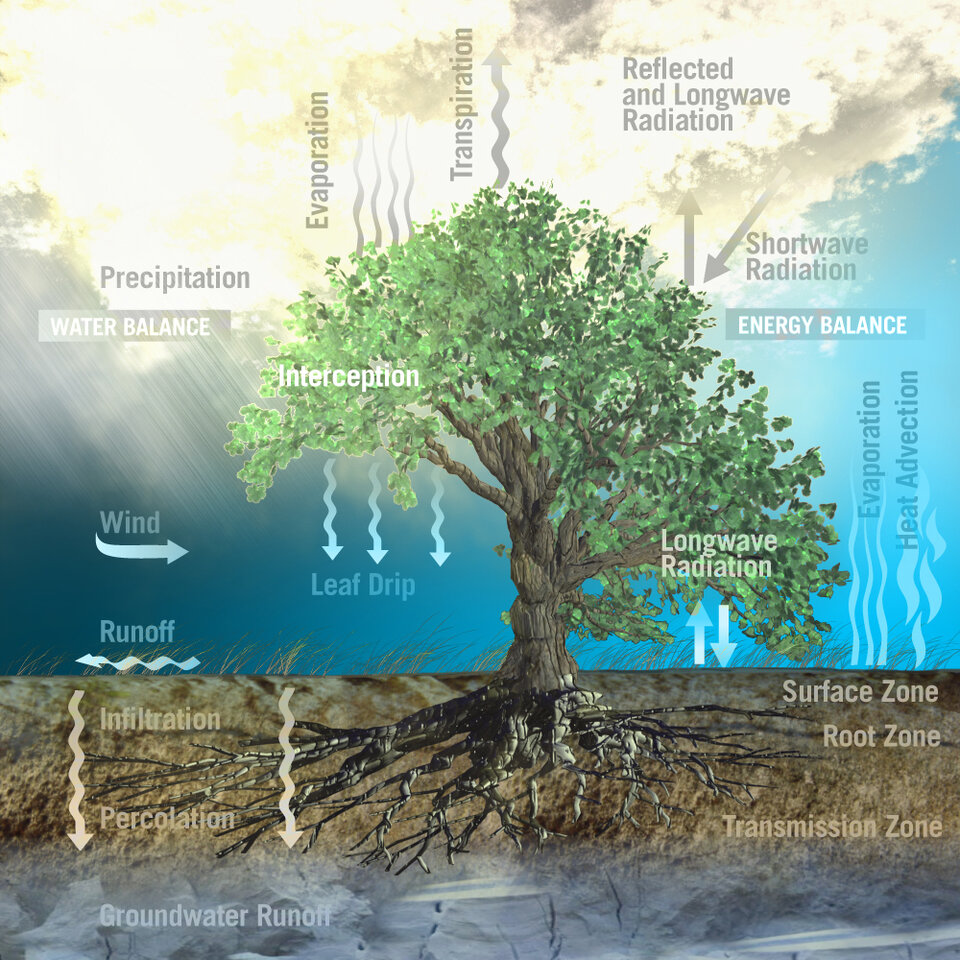
    There are currently relatively few global datasets on either soil moisture or ocean salinity. However, this information is urgently needed to improve our knowledge of the global water cycle and help understand more about how a changing climate may be affecting patterns of evaporation over the land and ocean.

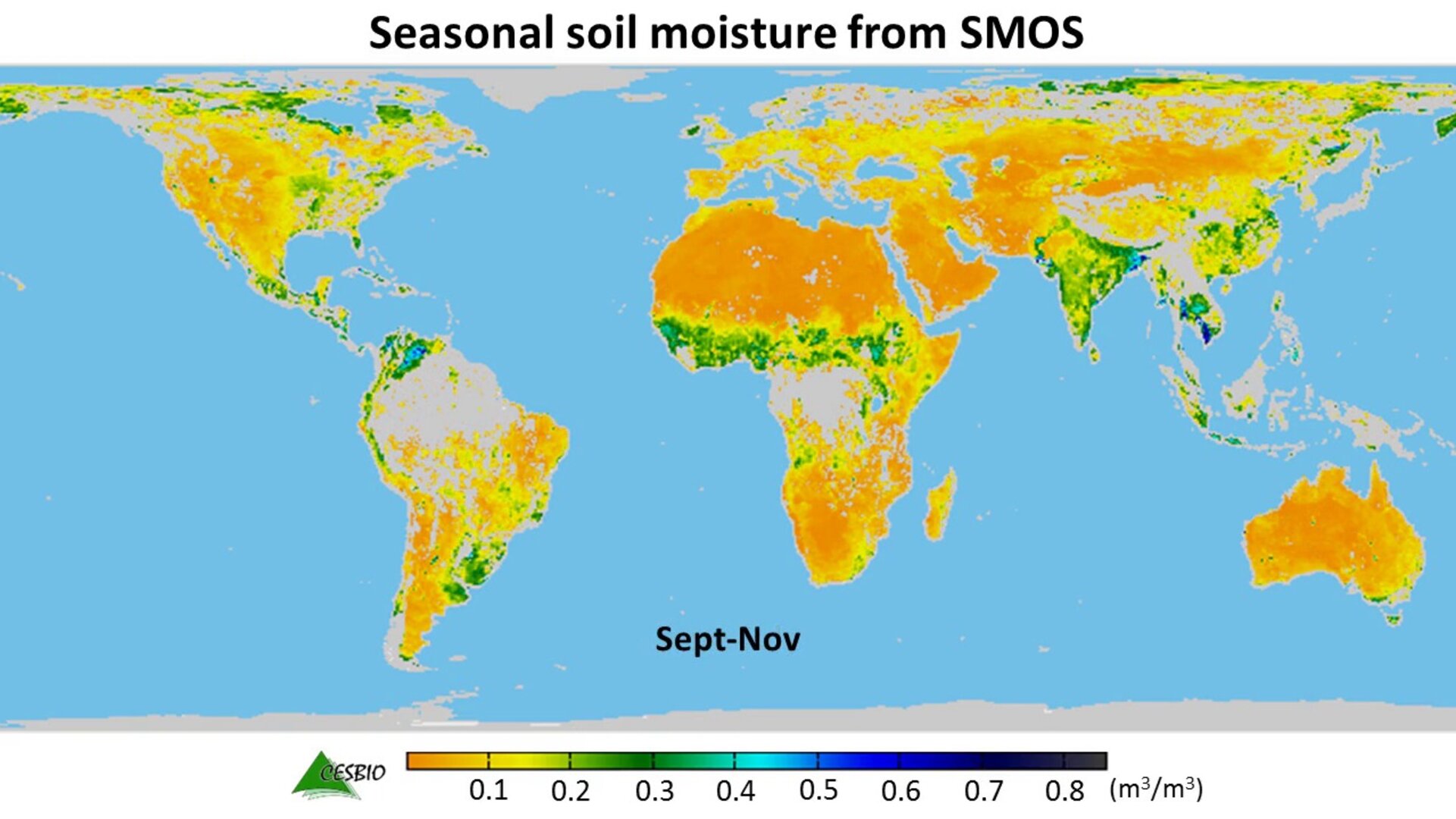
    SMOS will fill this gap by providing a global image of surface-soil moisture every three days. This information, along with numerical modelling techniques, will result in a better estimation of the water content in soil down to a depth of 1-2 m, which is referred to as the ‘root zone’.

    Estimation of soil moisture in the root zone is important for improving short- and medium-term meteorological forecasting, hydrological modelling, monitoring photosynthesis and plant growth, and estimating the terrestrial carbon cycle. Timely estimates of soil moisture are also important for contributing to the forecasting of hazardous events such as floods, droughts and heat waves.

    Mapping ocean salinity

    Data from SMOS will also provide regular maps of salinity in the surface waters of the oceans. These maps are needed to further our knowledge of the processes driving the global ocean circulation patterns that are driven by changes in the sea-surface temperature and salinity.

    Ocean circulation plays an important role moderating the climate by, for example, transporting heat from the equator to the poles. Consequently, data on sea-surface salinity will improve our understanding of the conditions that influence global ocean circulation and thus climate.

    SMOS will provide:

    • Global maps of soil moisture every three days within an accuracy of 4% at a spatial resolution of 50 km – comparable to detecting one teaspoon of water mixed into a handful of soil.

    • Global maps of sea-surface salinity down to 0.1 practical salinity units for a 30-day average over an area of 200×200 km – comparable to detecting 0.1 g of salt in a litre of water.

    Rate this

    Views

    Share

    • Currently 0 out of 5 Stars.
    • 1
    • 2
    • 3
    • 4
    • 5
    Rating: 0/5 (0 votes cast)

    Thank you for rating!

    You have already rated this page, you can only rate it once!

    Your rating has been changed, thanks for rating!

    106
    facebook
    twitter
    reddit
    google plus
    digg
    tumbler
    digg
    blogger
    myspace
    • Special features
    • SMOS: Helping Europe respond to climate change

    Connect with us

    • RSS
    • Youtube
    • Twitter
    • Flickr
    • Google Buzz
    • Subscribe
    • App Store
    • LATEST ARTICLES
    • · CryoSat hits land
    • · Ariane 5 completes seven launches …
    • · Measuring skull pressure without t…
    • · Malargüe station inauguration
    • · The solar wind is swirly
    • FAQ

    • Jobs at ESA

    • Site Map

    • Contacts

    • Terms and conditions